The practical answer
- Short answer
- A Fortune 1000 aerospace transformation sat "Green" for two quarters while shipping nothing. The fix wasn't more PMs. It was killing the weekly SteerCo.
- Best fit
- Industry: Enterprise Tech. Function: Governance
- Operating path
- Project Recovery → Turnaround & Restructuring → Transaction Execution Services
- Key metric
- 92% Reduction in decision latency achieved by switching from weekly SteerCos to daily Executive Standups.
The status was "Green." Production hadn't moved in six months.
The dashboard said Green. The 40-page deck said Green. The risk register—150 line items deep, color-coded, last meaningfully read sometime in the prior fiscal year—said Green. And the CFO of this Fortune 1000 aerospace manufacturer sat across the table knowing that not one line of their $10M transformation platform had shipped to production since spring.
I call this the Green-Melon problem: green rind, red flesh. By the time you cut into it, you've already lost two quarters. When I walked into this program, the engineering team wasn't the issue. They knew exactly how to build the platform. The steering committee met for 90 minutes every week, produced beautiful artifacts, and had not cleared a single milestone in two quarters. The thing killing the program wasn't talent or budget. It was the clock that started ticking the moment anyone hit a blocker.
Decision latency is the metric nobody on the SteerCo was tracking
Here is a number that should rearrange how you think about governance. The Standish Group finds that roughly 1,000 decisions get made for every $1M of project spend. Do the arithmetic on a $10M program: you are signing up for about 10,000 decisions. If each one has to crawl through a weekly committee, the math simply does not close inside any sane timeline—the project is late before the first sprint ends.
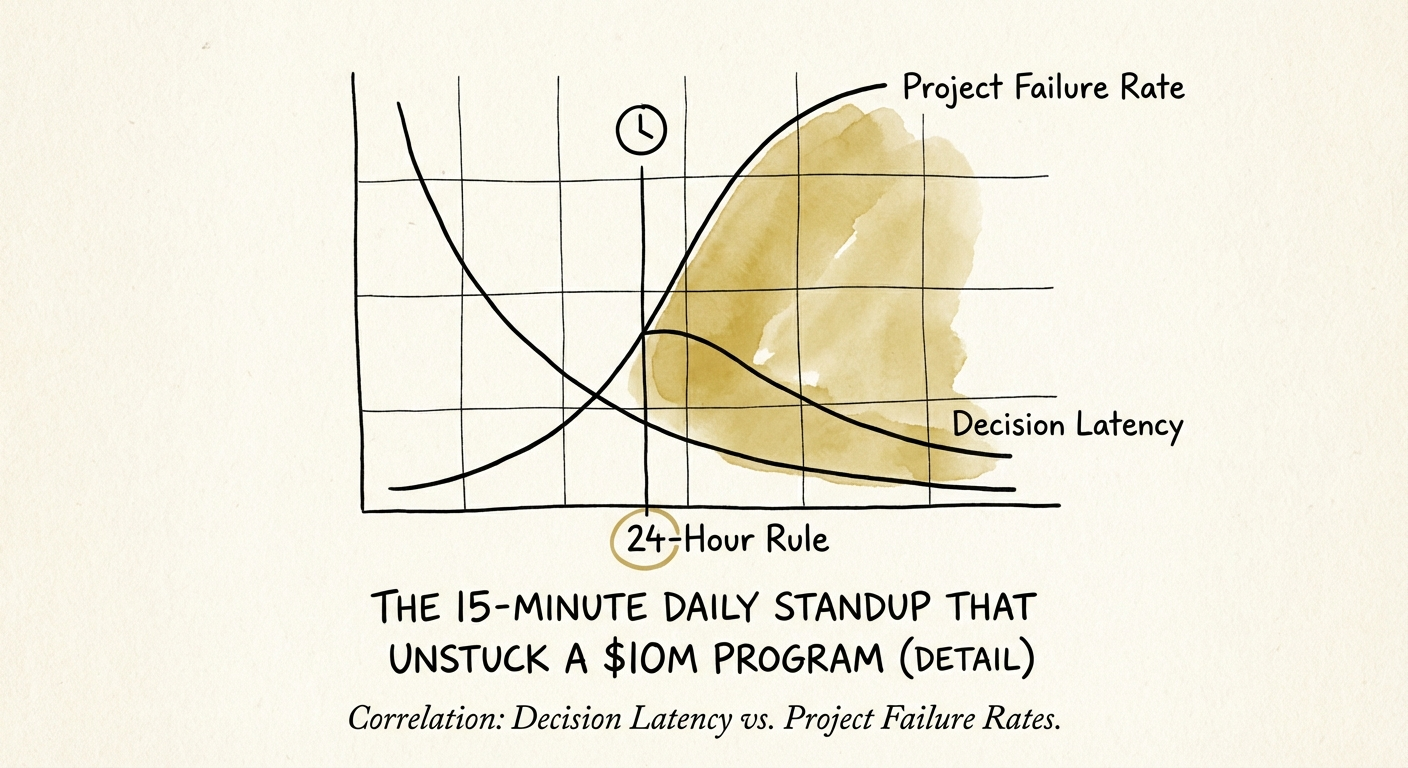
So we measured the one thing the risk register never did: decision latency—the elapsed time between a blocker getting raised and a decision actually executed. The answer was 14 days. Two full weeks per decision, on a program that needed thousands of them. That is not a project that is behind. That is a project that is mathematically dead and waiting for someone to read the autopsy. And it tracks with the broader pattern McKinsey documents: roughly 70% of digital transformations fail. Most of them don't fail on engineering. They suffocate in governance.
A $10M program isn't one big decision. It's a thousand small ones. Win on speed-to-decide and the rest takes care of itself.
We didn't hire more PMs. We dissolved the steering committee.
The instinct in a stalled program is to add coordination—another project manager, another tracking tool, another weekly sync. We did the opposite. We stood down the weekly SteerCo entirely and replaced it with a single 15-minute event every morning that I'll call the Executive Daily Standup. It is not the developer standup down the hall. It is a decision-forcing event, and it has exactly four seats.
The room, the rules, no exceptions
- 8:45 to 9:00 AM. Hard stop, hard start. No grace period, no "let's wait two minutes for everyone."
- Four people, no proxies: the CIO who can actually decide, the lead architect who tells the technical truth, the program lead who owns the blockers, and the business sponsor who owns the money. If you send a delegate, your decision waits a day.
- No slides, no seats. Walk in with a PowerPoint and you walk back out. Status lives in the dashboard. This room is for unblocking, not reporting.
Three questions, and not the ones agile taught you
A developer standup asks what you did yesterday. That is activity theater. The executive version asks only about what is stopping forward motion: What is blocked right now? (Stopped—not "at risk," not "amber." Stopped.) Who personally owns the decision to unblock it? (A named human, never a committee.) What is the decision deadline? (Under 24 hours. Always.)
The 24-hour rule did something I didn't expect
The rule is brutal and simple: when a blocker surfaces, the named owner either decides on the spot or commits to a decision by tomorrow's standup. "Let me check with my team" is banned—you are the leader, you represent the team. "I need to research this" is fine only if the answer lands in 24 hours.
Here is what the daily cadence exposed. When we forced daily resolution, 60% of the supposedly technical blockers turned out to be legal or compliance sign-offs sitting in someone's queue waiting for a signature. The architecture was never the problem. The signature was. We asked the General Counsel to seat a delegate in the standup for one week—and that week cleared a four-month backlog of vendor approvals in three days. That is the same cross-functional deadlock hiding under a fake engineering label.
Gartner reports that 65% of decisions are more complex than two years ago, and I believe it—but complexity is frequently fear in a suit. Forcing a daily deadline doesn't make hard decisions easy. It just strips out the room people use to avoid them. Decision latency on this program dropped 92% in two weeks, from 14 days to under 24 hours. The team went from shipping nothing to deploying the MVP alpha in 45 days.
You can run this Monday. You don't need anyone's permission.
Changing how your program meets is squarely inside your authority as a CIO or VP of Engineering. If your transformation is stuck in committee, here is the five-day reset I'd run.
Day 1 — Put a number on the latency
Pull your last five "resolved" blockers. Measure the hours from the ticket or email that raised each one to the moment the decision was actually executed. If your average clears 48 hours, your governance is the bottleneck—not your engineers. Then publish the number to your stakeholders, plainly: "We are deciding on 14-day cycles in a market that moves in 24 hours."
Day 2 — Cancel the SteerCo
Kill the weekly 90-minute status meeting and send the 15-minute standup invite in its place. Frame the trade honestly: "I'm handing back 75 minutes of your week. In return I need 15 minutes of total focus every morning."
Day 3 — Run the "no status" standup
Someone will reflexively start a status update. Cut it off. As one of our governance resets puts it: "Status lives in the dashboard. This room is only for decisions. What is stopping you from shipping today?"
Day 4 — Hold the silence on the 24-hour rule
The first real blocker surfaces. Name the decision owner and ask, "Can I have a decision by 8:45 tomorrow?" The room will tense. Do not rescue them. Hold the silence until you get a yes. That silence is where the speed comes from.
Day 5 — Count what you cleared
Tally the decisions made in week one. On the aerospace program, the team made more decisions in those five days than in the previous two months combined. Show that number to the people who thought the project was Green.
Recovery is governance, not heroics
Stalled programs rarely need a weekend death march, a "10x" hire, or a new tool. They need governance simple enough to move at the speed of the work. A $10M program is just a long chain of small decisions—if you decide faster than the program is bleeding, you win. Stop reporting on the weather and start flying the plane.