
The practical answer
- Short answer
- A 60-day diagnostic and execution plan to triple sales win rates. Learn how to fix the 'Founder Distortion Field,' implement radical disqualification, and scale GTM execution.
- Best fit
- Industry: B2B Technology. Function: Sales
- Operating path
- GTM Execution → Commercial Performance → Performance Improvement
- Key metric
- 130% Increase in win rates for deals over $50k when engaging 3+ stakeholders (Multi-threading).
The Diagnostic: Why Your Win Rate Crashed When You Stepped Back
The story is always the same. As a founder, you closed 60% of the deals you touched. You knew the product, you owned the vision, and you could make engineering commitments on the fly. Then you hit $10M ARR, hired a VP of Sales, and stepped back. Suddenly, the board deck shows a 25% win rate.
You didn't hire bad salespeople. You hired salespeople who are trying to execute a Founder Operating System without Founder authority. The 2025 benchmarks for Mid-Market B2B SaaS show an average win rate of 24% for deals between $10k-$50k. If your team is hovering there, they are aggressively average. But you didn't build a Series B company to be average.
The root cause of the 25% win rate isn't usually a closing problem; it's a denominator problem. Your reps are filling the pipeline with hope. They are suffering from "Happy Ears," mistaking a pleasant conversation for a qualified opportunity. When you look at the data, the difference between a 25% win rate and a 65% win rate is rarely about better negotiation—it's about radical disqualification.
The "Stale Pipeline" Tax
A 25% win rate means your team spends 75% of their time working on deals that will never close. This is the "Stale Pipeline"—deals that drift in the forecast for 90+ days (vs. the 84-day median sales cycle). These deals distort your forecast, burn your CAC, and mask the reality of your GTM efficiency. To fix it, we don't teach your team how to sell better; we teach them how to disqualify faster.
Pipeline coverage is a vanity metric. Win rate is a sanity metric. I would rather have a 2x pipeline closing at 60% than a 5x pipeline closing at 20%. The former is a business; the latter is a casino.
The 60-Day Turnaround Playbook
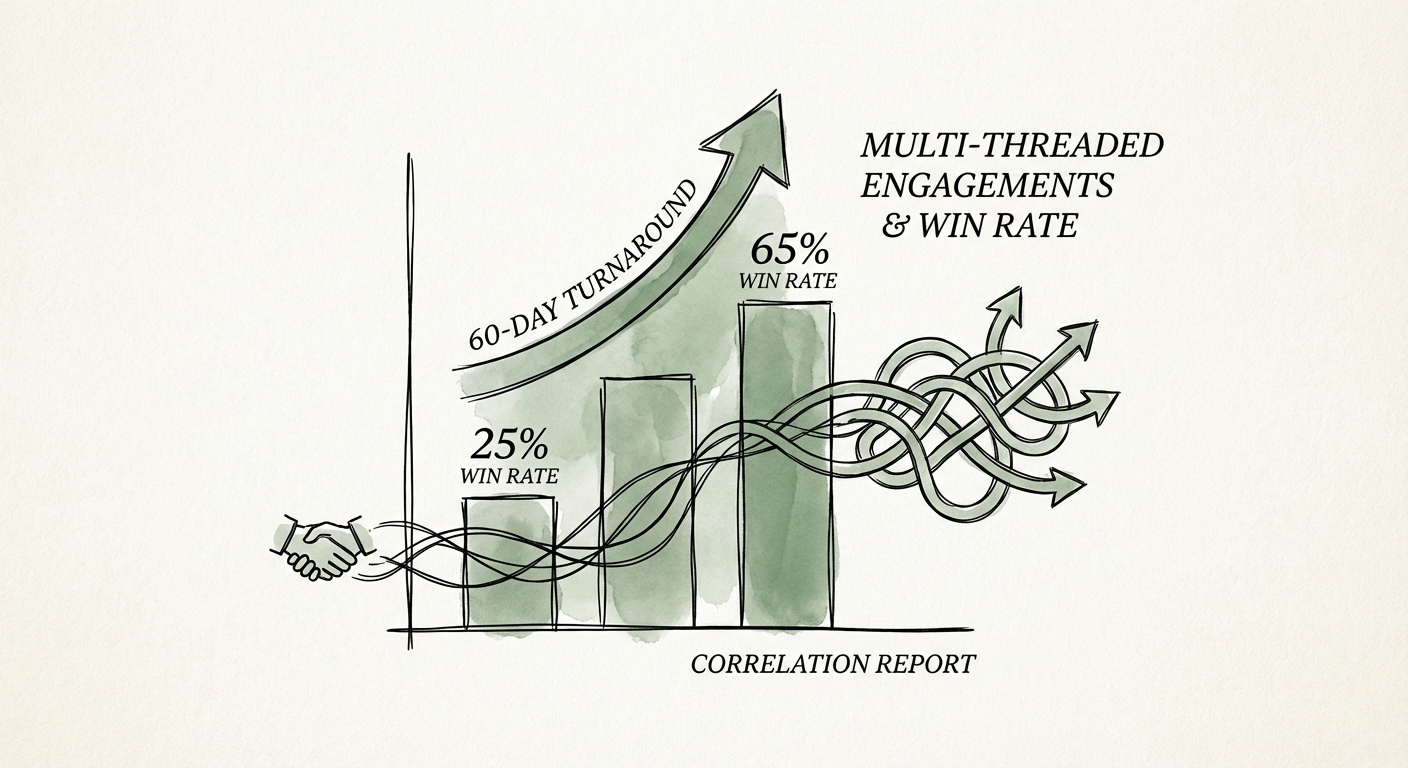
We don't do "sales training" seminars that are forgotten by Monday. We execute a 60-day operational sprint designed to break bad habits and install rigorous governance. Here is the exact protocol we use to move win rates from 25% to 65%.
Days 1-15: The Great Purge
We start by auditing the current pipeline. The rule is simple: If a deal has not advanced a stage in 14 days, or if there is no scheduled next step on the calendar, it is Closed-Lost. We strip the pipeline down to the studs. Usually, this reduces "pipeline coverage" from a comforting 4x to a terrifying 1.5x. Good. Now we see the truth.
Days 16-30: The "No Demo" Gate
The biggest killer of win rates is the premature demo. Reps use the demo as a crutch to avoid discovery. We implement a hard gate: No demo until three specific pain points are documented and verified. According to 2025 data, deals where discovery criteria (like MEDDIC) are fully documented show a 40% higher close rate. If the rep cannot articulate the pain, they are not allowed to show the product.
Days 31-60: The Multi-Thread Mandate
In the final phase, we attack single-threaded deals. A single champion cannot buy enterprise software. Gong's 2025 data reveals that multi-threading (engaging 3+ stakeholders) boosts win rates by 130% in deals over $50k. We mandate that no deal can enter the "Proposal" stage without engagement from at least three stakeholders: the Economic Buyer, the Technical Validator, and the User Champion. If your rep is talking to one person, they aren't selling; they're visiting.
The Outcome: Predictable Revenue, Not Heroics
By Day 60, the panic subsides. Your pipeline is smaller, but it flows. The deals that remain are real. When a rep forecasts a deal, it closes.
Moving to a 65% win rate transforms your unit economics. Your CAC payback period drops because you aren't spending marketing dollars on tourists. Your sales cycle compresses because you aren't chasing ghosts. Most importantly, you regain the ability to forecast with precision—a skill that Series B and C investors value higher than almost anything else.
The Founder's New Role
Your job is no longer to be the "Super Closer" who swoops in to save the quarter. Your job is to be the Chief Disqualification Officer. In your pipeline reviews, stop asking "How do we win this?" and start asking "Why should we disqualify this?" When you flip the script, you force your team to defend the quality of the deal, not just the activity. That is how you scale.