
The practical answer
- Short answer
- New 2025 data shows 88% of transformations miss their targets. Learn the 8 early warning signs of failure and the governance fixes to save your initiative.
- Best fit
- Industry: B2B Tech / Enterprise. Function: IT Leadership
- Operating path
- Project Recovery → Turnaround & Restructuring → Transaction Execution Services
- Key metric
- 88% Failure rate of business transformations achieving original goals (Bain 2024)
The "Green Light" Trap
Your project dashboard is green. The steering committee slides look polished. The System Integrator (SI) reports that the ERP migration is "on track." Yet, you have a gnawing feeling that something is wrong. Your engineering leads are quiet in meetings, the marketing team just bought their own CRM because they couldn't wait for yours, and your budget contingency is already 40% deployed in month three.
You are right to be worried.
Despite decades of "lessons learned," the failure rate for digital transformations is actually increasing. Recent analysis from Bain & Company (2024) reveals that 88% of business transformations fail to achieve their original ambitions. Even more alarming, Gartner's 2025 CIO Agenda reports that only 48% of digital initiatives meet or exceed their business outcome targets.
The problem isn't the technology. We have better tools, faster cloud infrastructure, and smarter AI than ever before. The problem is that most Enterprise CIOs are fighting a war on two fronts: political deadlock inside the boardroom and technical debt inside the codebase. You are being asked to rebuild a jet engine while flying the plane, often by a board that thinks "Agile" just means "faster and cheaper."
If you wait until the project formally misses a deadline to intervene, it's too late. The capital is burned. The reputation damage is done. You need to spot the rot while the dashboard is still green. Here are the eight non-obvious warning signs that your transformation is heading for a cliff.
Digital transformations rarely die from bad code; they die from bad decisions made slowly. A quarterly steering committee is not governance; it's theater.
The 8 Signs of a Failing Transformation
1. The "Big Bang" Roadmap
If your plan relies on a single, massive cutover date 18 months from now, you have already failed. In the modern enterprise, 18 months is an eternity. By the time you launch, the market requirements will have shifted, and your "new" system will already be legacy. Successful transformations deliver incremental value every 30 to 90 days. If you haven't shipped code to production in six months, you aren't building a platform; you're building a $3M sunk cost.
2. The "Interest-Only" Budget
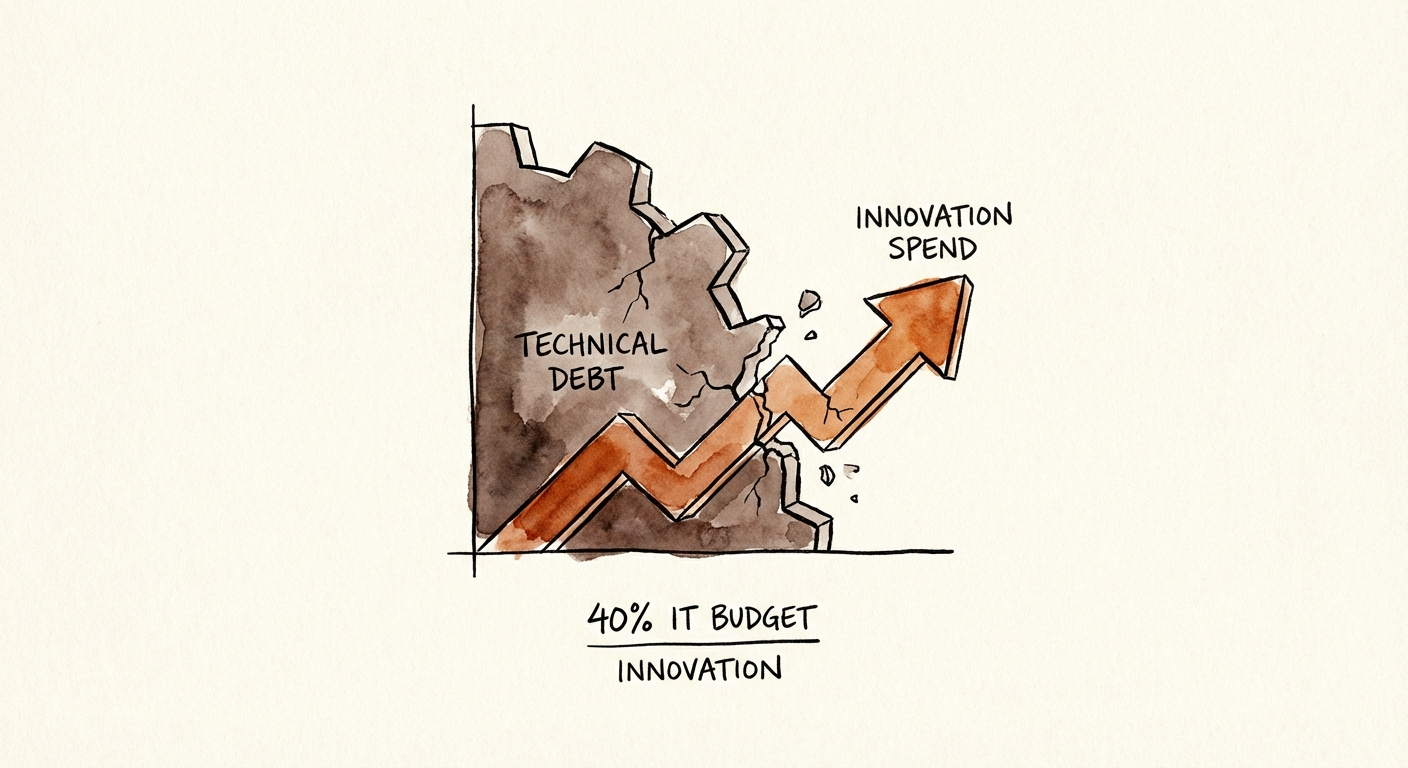
Take a hard look at your IT spend. McKinsey research from 2025 indicates that technical debt now consumes 40% of enterprise IT budgets. If nearly half your budget is spent just keeping the lights on (maintenance, patching, refactoring), you do not have the runway to transform. You are merely treading water while paying high interest on 10-year-old architectural decisions.
3. The SI Owns the Roadmap
External partners are for capacity, not strategy. If your System Integrator is defining what you build rather than just how to build it, you have outsourced your brain. The moment the SI project manager knows more about your dependency map than your internal VP of Engineering, you have lost control. We call this "Vendor Capture," and it usually ends with a change order that doubles the budget.
4. Shadow IT Has Stopped Asking for Permission
When Marketing buys HubSpot on a credit card or Sales hires a freelance developer to build a middleware patch, they aren't just being rogue—they are voting with their wallets. They are signaling that IT is too slow to support revenue. Shadow IT is a leading indicator that your governance model is broken. Instead of fighting it, you need to understand why your governance is blocking value creation.
5. The "Lift and Shift" Cloud Strategy
Moving a monolithic, on-premise mess to AWS doesn't make it a "cloud-native platform." It makes it an expensive, hosted mess. "Lift and shift" migrations often result in cloud bills 2-3x higher than on-prem estimates because you aren't utilizing auto-scaling or serverless architectures. You're just renting someone else's expensive data center.
6. Metric Misalignment (The Vanity Trap)
Your dashboard tracks "uptime" and "milestones completed." But the CEO cares about "customer acquisition cost" and "revenue per user." If your transformation KPIs are purely technical (e.g., "migrated 500 mailboxes"), you cannot prove business value. You need to bridge the gap: How does this migration improve EBITDA? If you can't answer that, your funding is at risk.
7. The Governance Void
A quarterly steering committee is not governance; it's theater. Real governance happens in the weekly trenches—resolving cross-functional blockers between Legal, Security, and Product. If your "Governance Board" only meets to review PowerPoint slides, they aren't solving problems. They are just witnessing the crash in slow motion.
8. Change Management by Email
Sending a "Welcome to the New ERP" email on Monday morning is not change management. Prosci data consistently shows that projects with excellent change management are 6x more likely to meet objectives. If you haven't budgeted for training, user acceptance testing, and workflow redesign, your users will reject the new system. The technology will work, but the transformation will fail.
The 30-Day Recovery Plan
If you recognized three or more of the signs above, you need to trigger a "Project Reset." Continuing on the current path without a reset is high-risk. Here is the operator's playbook for stabilizing a wobbling transformation:
1. Pause and Audit (The "Red Team" Approach)
Stop new development for two weeks. Bring in an independent "Red Team" (not your current SI) to audit the code, the architecture, and the schedule. You need the unvarnished truth. Is the foundation stable? Is the timeline unsupported by the evidence? Use this data to reset expectations with the Board. It is better to take a 30-day delay now than a $10M write-off later.
2. Implement "Radical Incrementalism"
Retire the 18-month roadmap. Break the project into 6-week "value sprints." Each sprint must deliver something tangible to a user—a report, a feature, an automation. This builds momentum and restores trust with the business stakeholders. If a feature can't be built in 6 weeks, it's too big. Scope it down.
3. Re-establish the "Unit of Value"
Stop reporting on "activities" and start reporting on "outcomes." Change your weekly status report to track business blockers. Instead of "API integration 50% complete," report "Compliance review pending for Customer Data Module." Force the non-technical stakeholders (Legal, Compliance, Sales) to own their part of the delay. Use our triage framework to force these decisions into the open.
4. Fix the "Hidden" Budget
Acknowledge the technical debt. Carve out 20% of your sprint capacity permanently for refactoring and debt paydown. This isn't "maintenance"; it's speed insurance. You cannot run a marathon in boots filled with concrete.
Conclusion: Governance is Your Safety Valve
Digital transformations rarely die from bad code; they die from bad decisions made slowly. As the leader, your job isn't to write the code—it's to build the machine that builds the code. That means rigorous governance, honest metrics, and the courage to filter weak ideas before they become bad products.
The difference between a failed project and a turnaround story is often a single difficult conversation. Have it today.