
The practical answer
- Short answer
- New data reveals unstructured Agile projects are 268% more likely to fail. Here is the risk-based framework for choosing the right methodology for enterprise implementations.
- Best fit
- Industry: Enterprise IT. Function: Engineering Leadership
- Operating path
- Project Recovery → Turnaround & Restructuring → Transaction Execution Services
- Key metric
- 268% Higher failure rate for Agile projects lacking clear requirements (Engprax 2024)
The "Agile Transformation" Trap
For the last decade, the enterprise technology sector has been dominated by a single, religious dogma: Waterfall is dead; Agile is the future. If you are a CIO at a Fortune 1000 company, you have likely spent millions on Agile coaches, Scrum certifications, and "digital transformation" initiatives designed to make your 5,000-person engineering organization move like a startup.
Yet, the results are often catastrophic. You have likely seen the pattern: A $50M ERP migration is broken down into two-week sprints. The teams are "velocity-obsessed," burning down story points, yet eighteen months later, the project is still in a "stabilization phase," the board is furious about the lack of a delivery date, and Finance cannot reconcile the CapEx forecast. You didn't get speed; you got chaos.
You are not an anomaly. Recent 2024 data has shattered the "Agile is always better" narrative. A study of 600 software engineers found that projects adopting Agile practices were 268% more likely to fail than those that did not, specifically when requirements were not clearly defined upfront. Furthermore, BCG reports that 70% of large-scale tech programs fail to meet their original targets.
The problem isn't that Agile doesn't work. The problem is that Agile is a production methodology, not a governance model. When you apply a methodology designed for discovery (SaaS product development) to a project with fixed regulatory constraints and massive switching costs (SAP migration), you are not "innovating." You are gambling with the company's balance sheet.
Agile is a production methodology, not a governance model. When you apply a methodology designed for discovery to a project with fixed regulatory constraints, you aren't innovating. You're gambling.
The Risk-Based Selection Matrix
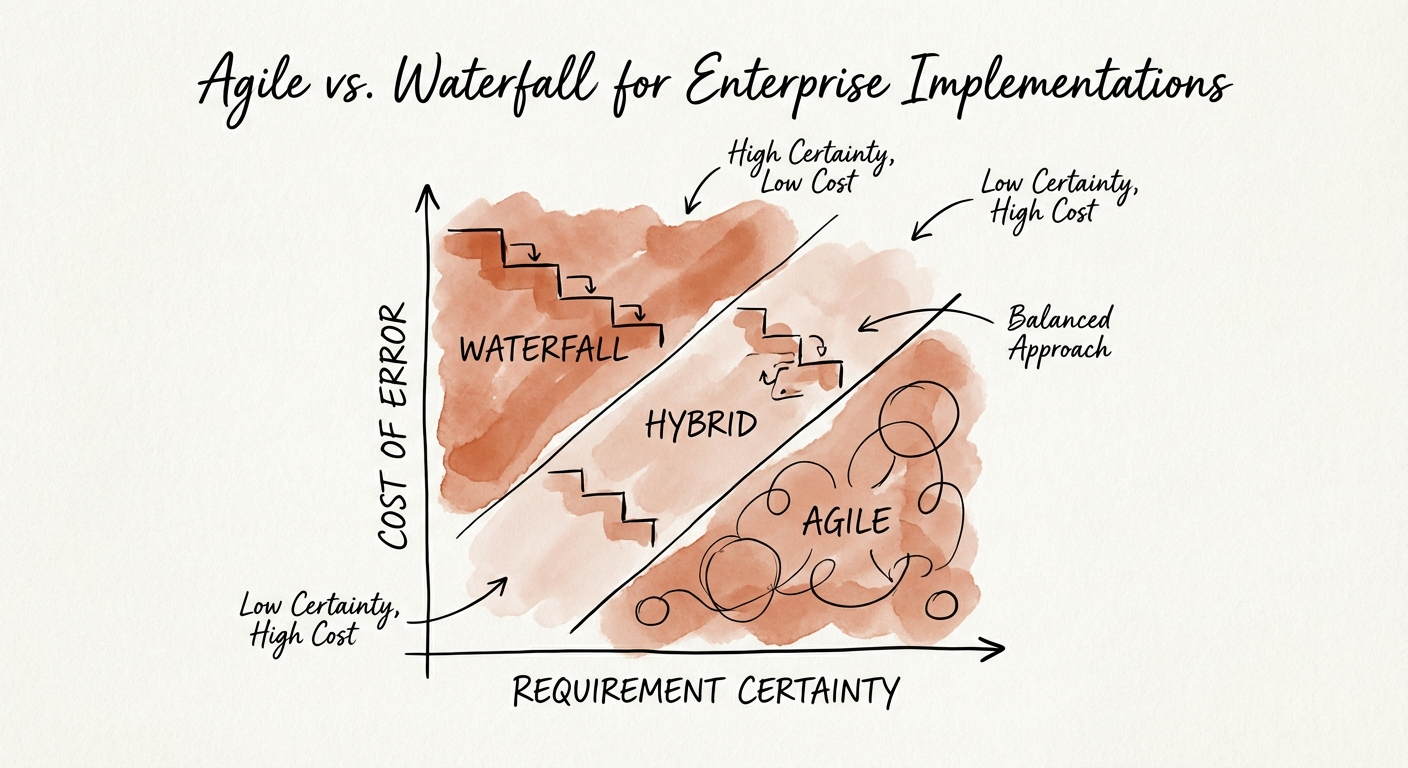
The job of the modern enterprise CIO is not to pick a "favorite" methodology; it is to map the methodology to the risk profile of the workload. While Silicon Valley runs on pure Agile, the Enterprise runs on Hybrid. According to the PMI Pulse of the Profession 2024 report, the use of Hybrid methodologies (blending Waterfall planning with Agile execution) has surged by 57% in just three years.
To determine the right approach, you must audit your initiative against three non-negotiable variables: Requirement Certainty, Cost of Error, and Stakeholder Integration.
1. The Waterfall Zone (Predictive)
Use Waterfall when the Cost of Error is high and Requirement Certainty is absolute. If you are replacing a General Ledger system or upgrading FDA-compliant medical device software, "move fast and break things" is not a strategy; it is negligence. In these scenarios, you need the rigidity of stage gates.
- Best for: ERP migrations, Data Center moves, Regulatory compliance projects.
- Metric to Watch: Requirements Volatility. If requirements change <10% during the project, Waterfall is safer and cheaper.
2. The Agile Zone (Adaptive)
Use Agile when Requirement Certainty is low and the goal is Market Discovery. If you are building a new customer-facing mobile app, you cannot know what the user wants until they see it. Waterfall here is high risk because you will spend $10M building the wrong thing perfectly.
- Best for: UX/UI heavy apps, Innovation labs, SaaS product extensions.
- Metric to Watch: User Feedback Cycles. If you aren't shipping to users every 2 weeks, you aren't doing Agile.
3. The Hybrid Zone (Water-Scrum-Fall)
This is where 80% of enterprise IT actually lives. You use Waterfall for the Macro Governance (Budgeting, Timeline, Architecture, Compliance) and Agile for the Micro Execution (Development Sprints).
- The Setup: Finance gets a fixed budget and a go-live date (Waterfall). The engineering teams work in 2-week sprints to execute the work (Agile). The Project Management Office (PMO) acts as the translator layer.
- Why it wins: It satisfies the Board's need for predictability while giving developers the flexibility to solve technical challenges without micromanagement.
The Governance Sandwich: How to Operationalize Hybrid
If your digital transformation is stuck in committee, it is likely because you are fighting a methodology war instead of solving a governance problem. To unblock a stalled initiative, you must implement what we call the "Governance Sandwich."
Top Layer: The Executive Gate (Waterfall)
Establish a Steering Committee that meets monthly. Their language is Milestones, Budget Burn, and Risk. They do not care about "Story Points" or "Burndown Charts." They care about whether the project is Red, Yellow, or Green against the Q4 launch date. This layer provides the "air cover" needed for the team to focus.
Middle Layer: The Translation API (The PMO)
This is where most firms fail. You need strong Technical Program Managers (TPMs) who can translate "we refactored the auth service" (Agile update) into "Security Milestone 3 Complete" (Waterfall update). Without this translation, the Board loses trust in the timeline.
Bottom Layer: The Delivery Engine (Agile)
Let your engineering teams run Scrum or Kanban. Let them do daily standups. Do not force them to fill out Gantt charts. Their output is code, not status reports. Your job is to ensure their definition of "Done" includes the documentation required by the Top Layer.
As you restructure your portfolio, remember: Project recovery is rarely about writing better code. It is about aligning the cadence of delivery with the cadence of governance. If you force a Waterfall financial model onto a pure Agile team without a translation layer, you will have a variance analysis meeting every month until you are fired.
Stop letting consultants dictate your risk profile. If the requirements are known and the cost of failure is catastrophic, build a plan. If the market is unknown, build a prototype. And if you are in the messy middle—like every other enterprise CIO—admit that Hybrid is not a compromise. It is the sophisticated choice.