Here is the hard truth for Mid-Market COOs: you are likely under-investing in AI while simultaneously wasting money on it. Recent data from IoT Analytics reveals that the average U.S. manufacturer invests just 0.1% of revenue into AI. Yet, despite this caution, a staggering 74% of companies struggle to move beyond the pilot phase and achieve scalable value.
We call this "Pilot Purgatory." It is the operational equivalent of buying a Ferrari engine and putting it in a go-kart. You have the technology, but you lack the chassis—the data infrastructure and workforce readiness—to handle the torque.
For "Transition Tom"—the COO tasked with modernizing legacy systems without breaking the bank—this is the nightmare scenario. You run five different proofs-of-concept (PoCs). The vision systems detect defects in the lab. The predictive maintenance model works on one conveyor belt. But nothing connects. Nothing impacts the P&L. And EBITDA remains flat while your R&D spend creeps up.
The market has split into two distinct groups: the AI Leaders and the Observers. According to Boston Consulting Group (BCG), the Leaders are not just running more pilots; they are generating 1.5x higher revenue growth and 1.6x greater shareholder returns than their peers. They aren't just "trying AI"; they are embedding it into core processes.
Forget the hype about generative AI writing emails. In manufacturing, value comes from dirt, noise, and heat. If your AI initiatives aren't hitting the following benchmarks, you are falling behind.
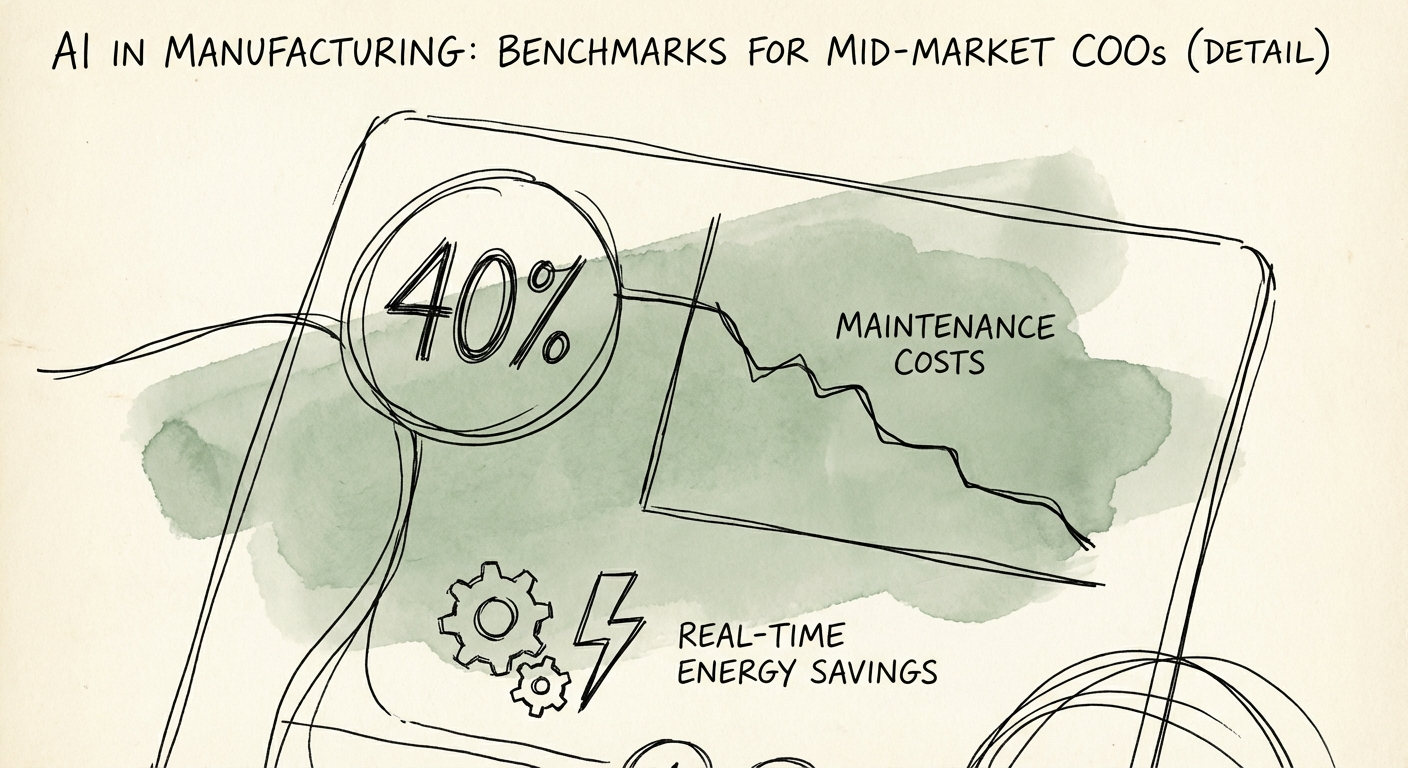
The most immediate ROI for mid-market firms is in predictive maintenance. Leading firms are seeing a 25–40% reduction in maintenance costs by moving from schedule-based to condition-based interventions. If you are still changing parts "just in case," you are burning cash.
With industrial energy costs rising, AI-driven energy management systems are no longer optional. Benchmarks show a 12% average reduction in energy consumption for facilities that let AI optimize HVAC and machine load balancing in real-time.
A critical mistake is relegating AI to support functions (IT, HR). BCG data indicates that 62% of AI's value lies in core business functions—operations, logistics, and R&D. If your AI strategy is focused on a chatbot for your intranet rather than your production line, you are missing the point.
How do you move from the 74% who fail to the 26% who scale? You invert your investment thesis.
Successful AI transformation is not a technology problem; it is a people problem. The winning formula for resource allocation is:
Most mid-market firms spend 90% on the technology and 10% on the people. This is why pilots fail. Your operators don't trust the model, so they ignore it.
Don't sign another vendor contract until you have a data governance strategy. The "Transition Tom" move is to pause all new PoCs. consolidate your data into a single source of truth (Unified Namespace or similar), and pick one high-value use case—likely predictive maintenance on your bottleneck asset—and drive it to full production scale across all shifts. Validate the P&L impact there before moving to the next asset.
The era of experimentation is over. The era of execution has begun.