If you ask three of your sales reps to define "Commit," you will likely get three different answers. In the absence of data, human nature fills the void with optimism. For scaling B2B tech firms, this optimism is expensive. It kills credibility with the board, creates cash flow volatility, and ultimately depresses valuation.
The market data is damning. According to Gartner, 55% of sales leaders lack high confidence in their own forecast accuracy. They know the numbers in the CRM are a blend of fact and fiction, yet they lack the infrastructure to separate the two. This isn't just an operational nuisance; it is a strategic liability. Research from Xactly reveals that only 20% of sales organizations achieve forecasts within 5% of their projections, while 43% miss their goal by more than 10%. In a capital-constrained environment, a 10% variance is the difference between hiring a new engineering squad and a reduction in force.
In the early stages of a startup, forecasting relies on "Hero Selling"—founders and early reps willing deals across the line through sheer force of personality. As you scale past $10M ARR, this breaks. You cannot model a financial future on the intuition of individual contributors. You need a machine. When forecasting is subjective, you are not managing revenue; you are managing hope. And hope is not a strategy.
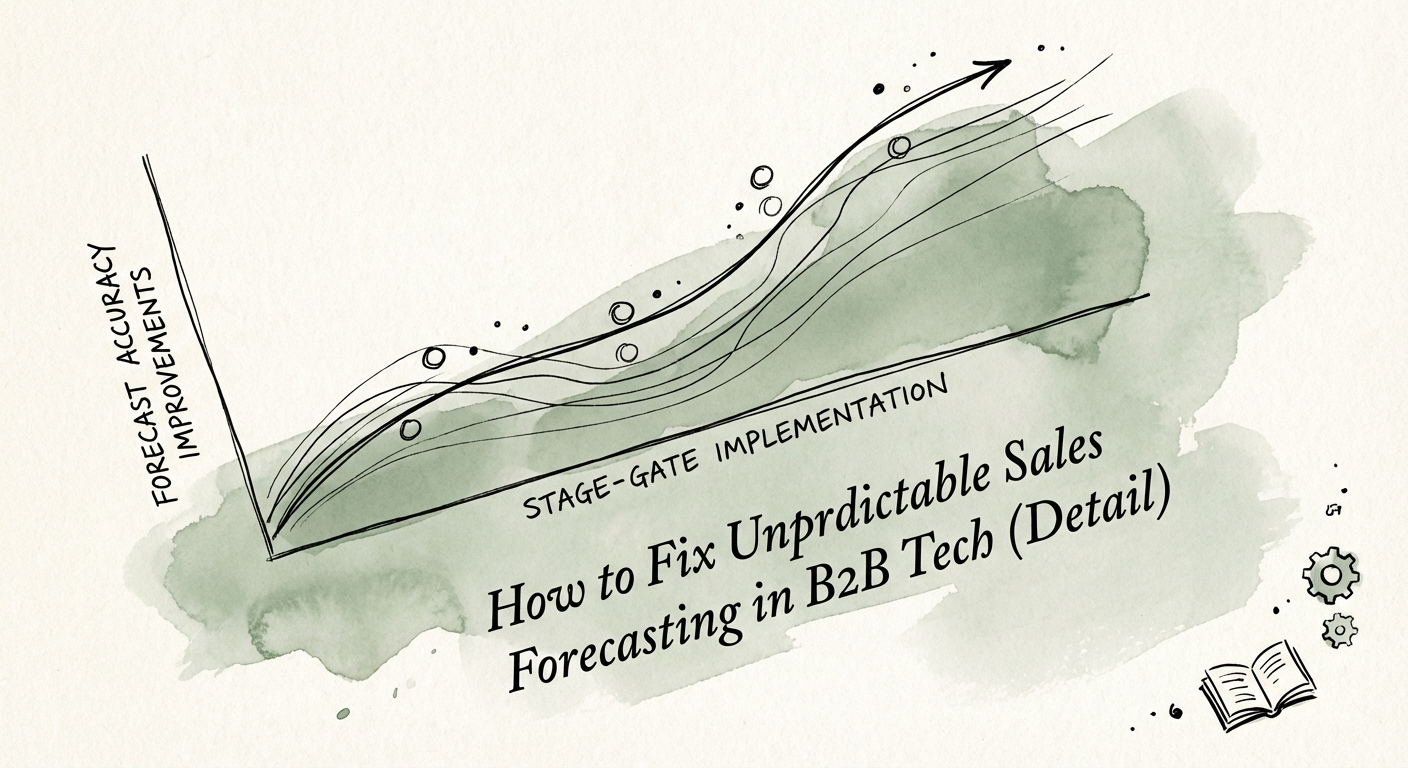
To move from guessing to precision, you must strip subjectivity out of the CRM. The mechanism for this is the Stage Gate. Most CRMs are set up with stages defined by rep activity (e.g., "Demo Given"). This is backward. Accurate forecasting requires stages defined by buyer verification (e.g., "Technical Validation Confirmed by CTO").
We implement a strict policy: a deal cannot move forward in the CRM until specific, binary exit criteria are met and documented. This shifts the conversation from "How do you feel about this deal?" to "Show me the evidence."
When you replace optimism with evidence, the P&L responds immediately. Data from Korn Ferry shows that organizations adopting a dynamic, formal forecasting process see a 17% increase in win rates on forecasted deals. Furthermore, Gartner research highlights that a mere 1% improvement in forecast accuracy can lead to a 2.7% to 7% improvement in cash flow. This is not about administrative hygiene; it is about releasing capital trapped in inefficiencies.
Achieving 92% forecast accuracy is not a pipe dream; it is a standard operational requirement for top-tier SaaS firms. Here is the immediate action plan for the C-Suite to stop the bleeding:
Audit your CRM today. If a stage description relies on what the rep did, rewrite it. Define what the customer verified. Example: Change "Proposal Sent" to "Commercial Terms Validated by CFO." If the CFO hasn't validated it, the deal stays in the previous stage.
InsightSquared data suggests that less than 50% of opportunities actually close within their original forecast date. Implement a weekly rigorous inspection. If a close date pushes three times, the deal is dead or dormant. Kill it. A smaller, accurate pipeline is infinitely more valuable than a bloated, fictional one.
Stop asking reps "What's closing?" Start asking "What risks remain?" Shift your weekly forecast call to a risk-mitigation session. Use data, not stories. If the data doesn't support the "Commit," remove it from the forecast. You are better off reporting a lower number you can hit than a higher number you will miss.
Precision leads to valuation. Investors pay a premium for predictability. Fix your forecast, and you don't just fix your revenue operations—you secure your company's future.