The practical answer
- Short answer
- Avoid the $350M mistake. A diagnostic compliance checklist for PE Operating Partners to assess portfolio readiness before the exit window opens.
- Best fit
- Industry: Private Equity. Function: Operations
- Operating path
- Compliance & Security → Turnaround & Restructuring → Turnaround & Restructuring Services
- Key metric
- 6-12 Months required for SOC 2 Type II observation period
The $350M Line Item You Didn't Model
In the high-velocity world of private equity, compliance is often relegated to the back office—a checkbox for the General Counsel or a quarterly report that gets filed and forgotten. PE operating partners focus on EBITDA expansion, sales velocity, and product roadmap. But in 2025, this prioritization error is triggering massive value erosion at the exit.
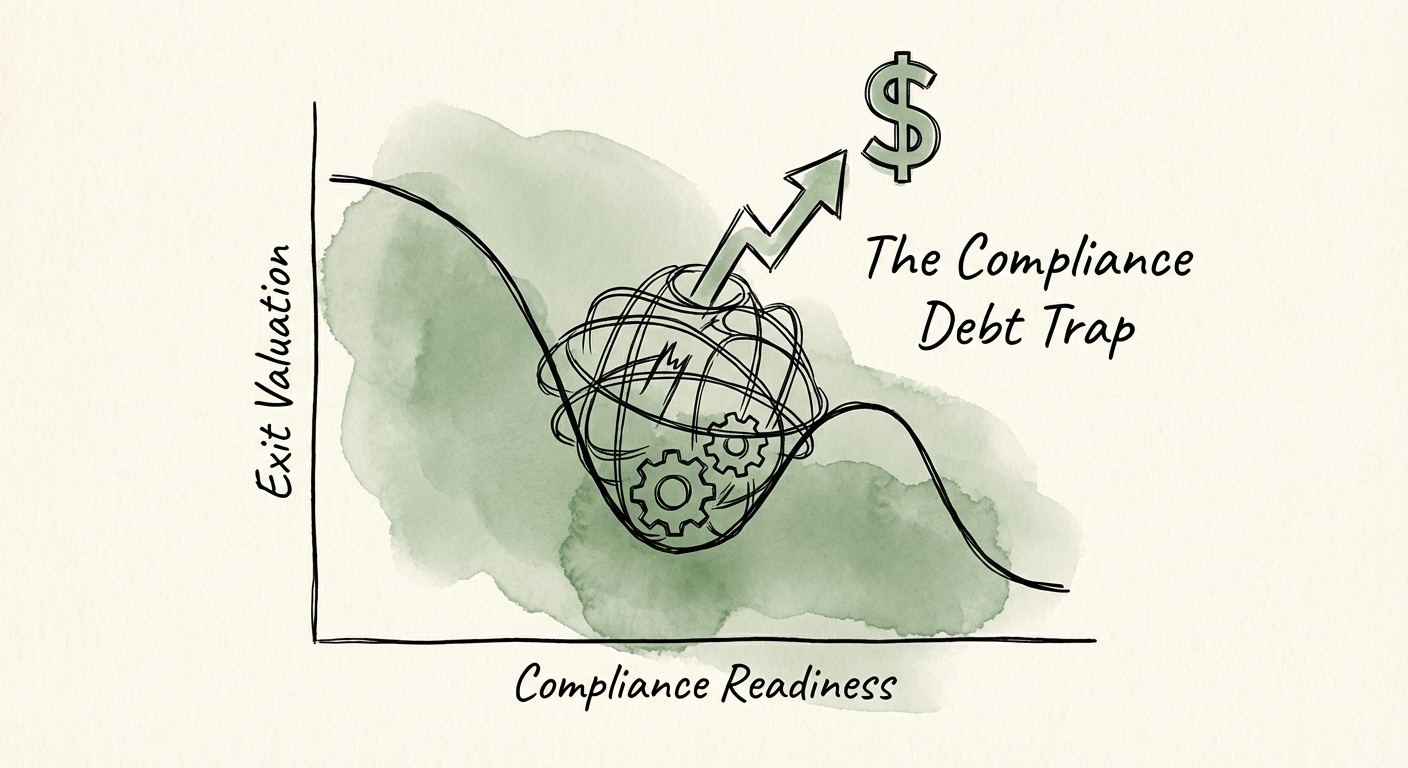
We call it Compliance Debt. Like technical debt, it accumulates silently. Unlike technical debt, it doesn't just slow you down; it can blow up your deal. The classic cautionary tale is Verizon’s acquisition of Yahoo, where undisclosed data breaches led to a $350 million purchase price reduction. That is direct enterprise value destruction.
Today, buyers are more sophisticated. They don't just ask if you are compliant; they deploy forensic teams to prove you aren't. In 2024 alone, GDPR fines totaled €1.2 billion, with major penalties hitting firms for "invisible" tracking pixels and data mishandling. If your portfolio company is sitting on a non-compliant data lake, you aren't holding an asset; you're holding a liability.
The era of "we'll fix it post-close" is over. Reps and warranties insurance costs are spiking for firms with weak governance, and extensive escrows are becoming the norm for companies that lack a clean SOC 2 report or demonstrable GDPR adherence. Compliance is no longer a legal shield; it is a valuation lever.
If you have had a security incident, you want to make sure that the buyer is aware of it while you still have negotiating power... If it comes out during due diligence, then it looks like you are trying to hide something.
The Diagnostic Checklist: Assessing Your Exposure
Stop treating compliance as a binary "pass/fail." For a PE Operating Partner, readiness is a spectrum of risk. Use this diagnostic checklist to grade your portfolio companies 12-18 months before a planned exit.
1. The "Table Stakes" (Operational Trust)
If you are in B2B SaaS or Tech Services, you cannot exit to a strategic buyer without these. Missing them is a red flag that signals operational immaturity.
- SOC 2 Type II: Do you have a report covering a minimum 6-month observation period? Warning: A Type I (point-in-time) report is insufficient for most enterprise acquirers.
- Vendor Risk Management: Do you have signed DPAs (Data Processing Agreements) with all sub-processors?
- Penetration Testing: Has a third-party remediation test been completed in the last 12 months? (Not just the scan, but the fix).
For a deeper dive on timelines, read our SOC 2 Compliance Roadmap for PE Portfolios.
2. The "Deal Killers" (Data & Privacy)
These are the issues that cause buyers to walk away entirely due to uncapped liability.
- GDPR/CCPA/CPRA: Can you demonstrate a "Right to be Forgotten" workflow that actually deletes data across all backups?
- Data Mapping: Do you know exactly where PII (Personally Identifiable Information) lives? If you can't map it, you can't protect it.
- AI Governance: If you're using GenAI features, is customer data isolated? The SEC and EU are aggressively targeting "AI-washing" and misuse of data.
3. The "Price Chippers" (Technical & IP)
These won't change the deal, but they will be used to chip away at your multiple.
- Open Source Hygiene: Are you using GPL-licensed code in your proprietary product? Black Duck scans will find this instantly.
- Technical Debt as Compliance Risk: Are you running on End-of-Life (EOL) infrastructure that violates security patching standards? See our framework on Technical Debt Assessment to quantify this cost.
Benchmark Data: The average cost to achieve SOC 2 Type II readiness for a mid-market firm is now $30,000 to $150,000, but the time cost is 6-12 months. You cannot cram this into a 60-day exclusivity window.
The Remediation Playbook: 100 Days to Clean
You’ve run the checklist and found gaps. Now what? You don't have time for a multi-year transformation. You need a triage plan that protects the exit.
Phase 1: Triage & Containment (Days 1-30)
Identify the "bleeding neck" issues. If you lack a SOC 2, start the observation period immediately. You need at least 3 months of data before you can even talk to an auditor about a Type II report. If you have Open Source violations, quarantine the code and assign senior engineering resources to rewrite or replace those libraries. This is arguably more important than shipping a new feature this quarter.
Phase 2: The "Compliance-as-Code" Pivot (Days 31-60)
Move away from spreadsheet compliance. Implement a GRC (Governance, Risk, and Compliance) automation platform (like Vanta or Drata) connected to your cloud infrastructure. This gives you real-time evidence collection, which is catnip for due diligence teams. It proves that your compliance isn't just a paper tiger.
Phase 3: The Narrative (Days 61-90)
Prepare the "Disclosure Schedule" proactively. If you had a breach three years ago, document the remediation, the post-mortem, and the subsequent security upgrades. Security incidents kill deals when they are discovered by the buyer, not when they are disclosed by the seller. Control the narrative.
Conclusion: Asset vs. Liability
In 2025, a portfolio company with clean, documented, and automated compliance trades at a premium. It signals a "turnkey" asset that a strategic acquirer can integrate without fear of regulatory contagion. A company with "Compliance Debt" is a distressed asset, regardless of its growth rate. Do the work now, or pay the price at the closing table.