
The practical answer
- Short answer
- 88% of enterprise transformations fail. Learn the $500M process documentation playbook that Fortune 500 CIOs use to rescue stalled initiatives.
- Best fit
- Industry: Enterprise Tech. Function: Operations
- Operating path
- Process Documentation → Operational Excellence → Transaction Execution Services
- Key metric
- 12% Revenue lost annually by organizations due to failed digital transformations (Integrate.io).
The Strategy Trap: Why $500M Initiatives Die in Committee
You have the strategy. You have the budget. You have the mandate from the Board. Yet, six months into your digital transformation, the project is stalled, the steering committee is deadlocked, and your burn rate is accelerating. You are not alone.
According to 2024 analysis by Bain & Company, 88% of business transformations fail to achieve their original ambitions. This isn't a failure of vision; it is a failure of mechanical execution. In the Fortune 500, the difference between a successful turnaround and a nine-figure write-down rarely comes down to “better strategy.” It comes down to the unglamorous, rigorous work of process standardization.
The root cause of this failure is almost always Process Debt—the accumulation of tribal knowledge, undocumented workarounds, and “hero heroics” that keep the lights on but prevent scalability. When you attempt to layer a $500M digital transformation on top of a foundation of tribal knowledge, you don't get modernization; you get chaos. As IDC reports, the cost of these knowledge deficits and skills gaps is projected to hit $5.5 trillion globally by 2026. For a single enterprise, this manifests as the “silent killer” of EBITDA: expensive talent wasting 40% of their week hunting for information that should be codified.
You don't have a strategy problem; you have a documentation problem. You are trying to scale 'genius' instead of scaling systems, and that is why your $500M project is stuck in committee.
The Methodology: Standardize Before You Automate
The most common mistake enterprise CIOs make is attempting to automate chaos. They buy ServiceNow, Salesforce, or SAP S/4HANA hoping the tool will enforce the process. It never does. To unlock value, you must invert the sequence: Standardize, then Automate.
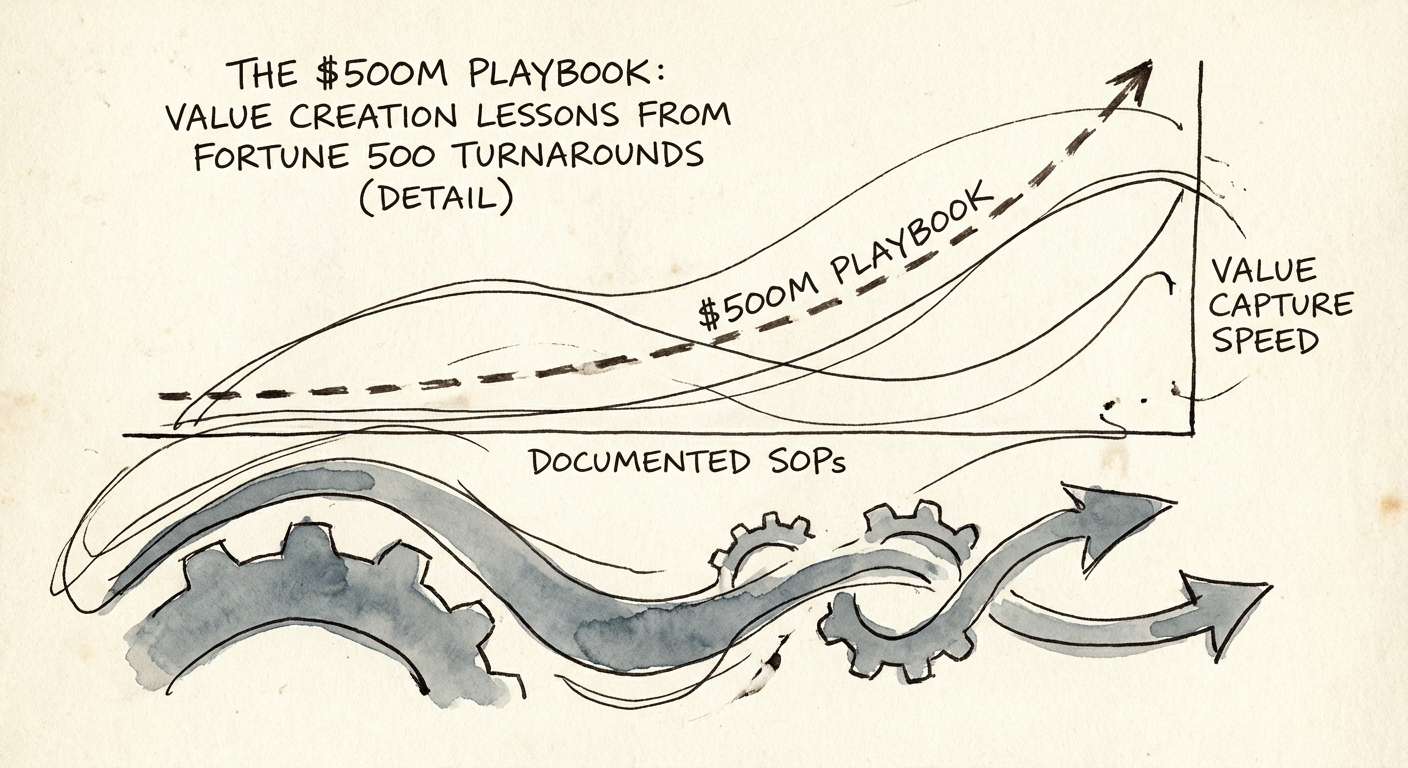
Successful Fortune 500 turnarounds follow a strict “Process First” doctrine. This isn't about writing dusty manuals; it is about creating a turnkey operating model that removes key-person dependency. Data from McKinsey & Company reveals that companies with top-quartile performance capture 74% of their transformation's value within the first 12 months. They achieve this speed not by moving fast and breaking things, but by moving deliberately with documented, repeatable standards.
The Cost of “Strategic Vaporware”
When processes remain undocumented (or exist only in PowerPoint decks), your organization pays a “complexity tax” on every transaction. Integration costs balloon because no one knows the edge cases. Compliance becomes a nightmare because the audit trail is in someone's head. Why 70% of Digital Transformations Fail is often because leadership confuses a strategic roadmap with an operational instruction set. The former tells you where to go; the latter tells your teams exactly how to get there without crashing.
The Action Plan: 90 Days to Codify Value
To rescue a stalled initiative, you must stop treating process documentation as an administrative burden and start treating it as a value creation lever. Here is the 90-day recovery protocol used in high-stakes operational turnarounds:
- Day 1-30: The Tribal Knowledge Audit. Identify the “load-bearing” individuals in your organization. These are the 5% of staff who hold 80% of the operational logic in their heads. Interview them not to learn what they do, but to map the specific decision trees they use to solve problems.
- Day 31-60: Codify the ‘Happy Path.’ Document the standard execution path for your critical workflows (e.g., Order-to-Cash, Incident Response, Code Deployment). Do not aim for 100% coverage; aim for the 80% of volume that creates the bottleneck. This allows you to unblock stalled projects by giving junior staff a reliable playbook.
- Day 61-90: Govern the Exception. Once the standard process is documented, automation becomes possible. Use your expensive talent only for the exceptions—the complex edge cases that actually require their expertise.
Conclusion
In a Fortune 500 context, “genius” is not scalable. Systems are. If you want to secure your legacy and your budget, stop relying on heroes and start building a playbook that anyone can run.