
The practical answer
- Short answer
- Your delivery worked at 5 customers because you were the product. Here's the exact point it breaks, the 537% margin gap that proves it, and what to fix first.
- Best fit
- Industry: B2B Services. Function: Operations
- Operating path
- Process Documentation → Operational Excellence → Transaction Execution Services
- Key metric
- 537% Higher profit margins for firms with 'Optimized' (Level 5) processes vs. 'Ad-hoc' (Level 1) firms.
At customer five, you were the product
Picture the early days of a B2B services firm. Five clients, all of whom signed because of one person: the founder. You ran every kickoff, reviewed every deliverable, and walked into every escalation personally. NPS sat near 90 because the service wasn't a service — it was you, applied directly to the problem. That isn't a delivery model. It's a one-person manufacturing line that happens to wear a blazer.
Then you cross fifty customers, and something quietly inverts. You hired sharp people, but they keep landing in your inbox: "How did we handle this for the last client?" "What's our standard config?" "Can you review this before it goes out?" You patch the gaps the only way you know — by working Saturdays. The reputation that got you here is now the exact thing capping you.
The tell isn't a sales slump. It's an efficiency collapse you can measure. Service Performance Insight's 2024 Professional Services Maturity Benchmark puts average billable utilization at 68.9% — meaning your most expensive people spend nearly a third of every week not generating a dollar. In a firm built on founder access, that idle third isn't slack. It's your team standing in a queue, waiting for the one person who knows the answer to free up. That person is you, and you do not scale.
Hire the person who builds the checklist that prevents the 2 a.m. fire. Stop bonusing the one who shows up to put it out.
The 537% gap between a lifestyle business and an asset
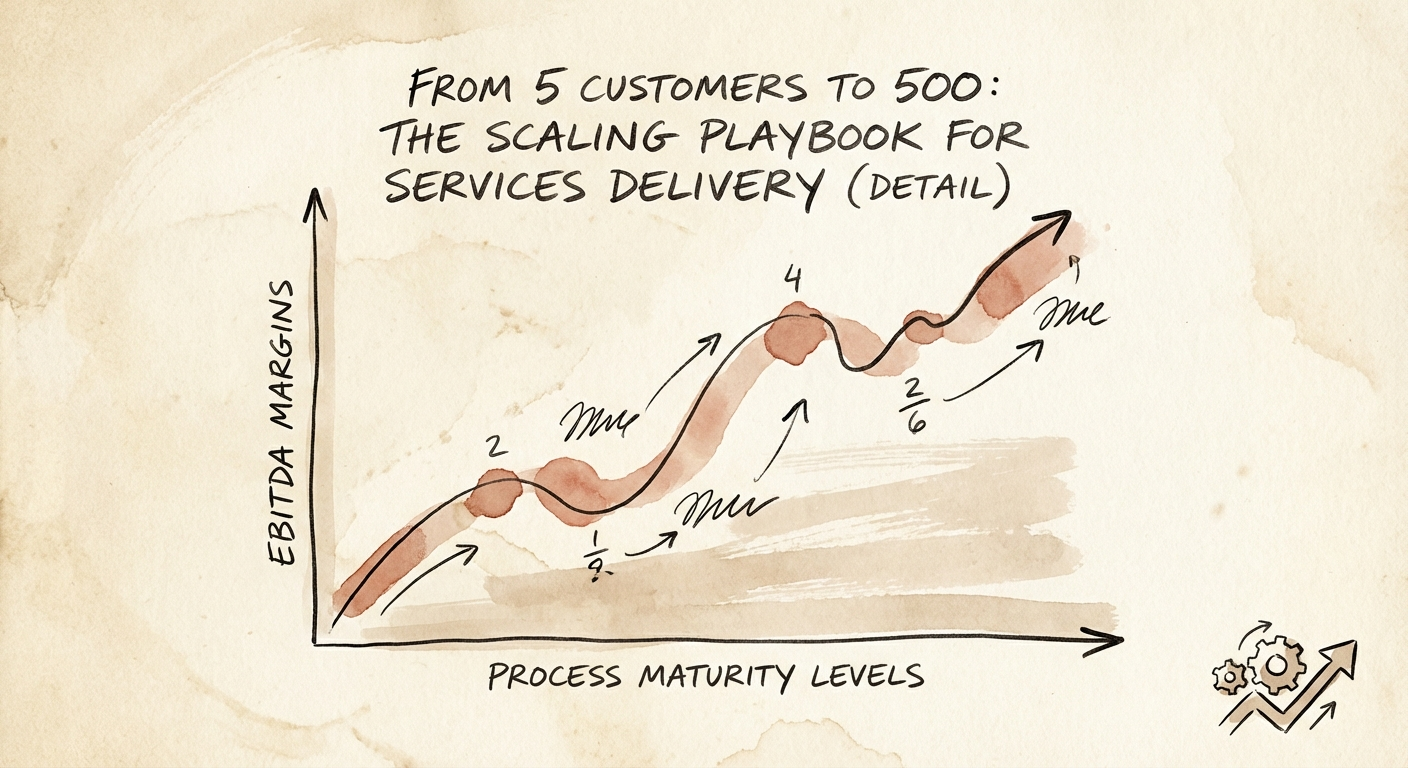
Here's the number that should reframe how you think about every undocumented process in your firm. SPI's benchmark found that "Level 5" firms — the ones with standardized, documented, optimized delivery — post 537% higher profit margins than "Level 1" firms running everything ad-hoc. That is not a tuning gain. That is the difference between a business that pays you well and a business someone will pay you to own.
Why the chasm? Because undocumented knowledge is a tax you pay in cash every week without seeing the invoice. Panopto's research found the average knowledge worker burns 5.3 hours a week chasing information or rebuilding something a colleague already figured out. Run that across a 50-person delivery team and you're funding 265 wasted hours every week — roughly six and a half full-time salaries spent on people waiting in a virtual line.
The fix isn't "write more docs." It's choosing what level of question you want your team asking:
- Heroic: "Go ask the delivery lead, they know." — caps at the lead's bandwidth.
- Managed: "It's in the SOP folder." — scales with headcount.
- Optimized: "The system already routed it." — scales without headcount.
Most founders read that and assume the answer is to stop hiring brilliant people and start hiring rule-followers. Wrong move. The point of documenting the repeatable 80% of delivery is to free your best people from the dumb work so they spend their judgment on the 20% that actually needs it. You're not de-skilling the work. You're aiming the skill. The wider services-benchmark data points the same direction: firms that grow margin while adding headcount are the ones that stopped treating every project as a blank canvas.
What to fix before you sign customer 51
Don't build a 300-page manual. Nobody reads it, and you'll be obsolete by chapter four. Productizing delivery is a triage exercise, and it has a clear sequence.
1. Run the 80/20 audit, then document only three things. Find the 20% of delivery activity that eats 80% of your team's hours. For most B2B services firms it's the same trio: client onboarding and data intake, the recurring status report, and the "standard" implementation config. Write rigid SOPs for those three first. The rule of thumb: if a task happens more than three times, it gets documented; once it's documented, it can be delegated; once delegated, it can scale.
2. Kill the hero bonus. Most firms reward the person who stayed up until 2 a.m. saving a client account. That's backwards — you're paying people to let fires start. Redirect the recognition to whoever built the checklist that made the fire impossible. Celebrate the save and you'll keep getting fires; celebrate the system and you'll stop needing saves.
3. Drive your key-person dependency below one. Ask the brutal question: if a single person vanished tomorrow, would the company seize up? If the answer is one person, and that person is you, your firm is functionally unsellable — there's nothing to buy but your calendar. Every SOP you write moves an asset out of your head and onto the balance sheet. That transfer is what earns multiple expansion at exit.
Going from five customers to 500 means mourning the artisan years — and that's a real loss for a founder who built something by hand. But the alternative is a business that can never operate a day without you. Pick the version that survives your vacation.