The practical answer
- Short answer
- Series B/C founders interview 12 hours a week and still mis-hire senior engineers at $240k a pop. Here's the scorecard-and-veto system that gets you out of the loop.
- Best fit
- Industry: B2B SaaS. Function: Operations & HR
- Operating path
- Team & Hiring → Operational Excellence → Transaction Execution Services
- Key metric
- 92% Retention rate at 12 months for firms using structured scorecards
You're sitting in 12 hours of interviews a week. That's the symptom, not the job.
Open your calendar from last week. Count the candidate loops you personally sat in. If a Series B or C founder is spending more than four hours a week in interviews, something has quietly broken: you've made yourself the human quality gate for every hire because you no longer trust the process to catch a bad one.
You earned that distrust. You hired a VP of Sales who could narrate a pipeline but never built one. You hired a "senior" engineer who shipped fast and left a billing service nobody else can touch. So now you insert yourself into every final round, asking the same vague questions, reading the same inflated resumes, deciding on a feeling you can't quite explain. The feeling is the problem.
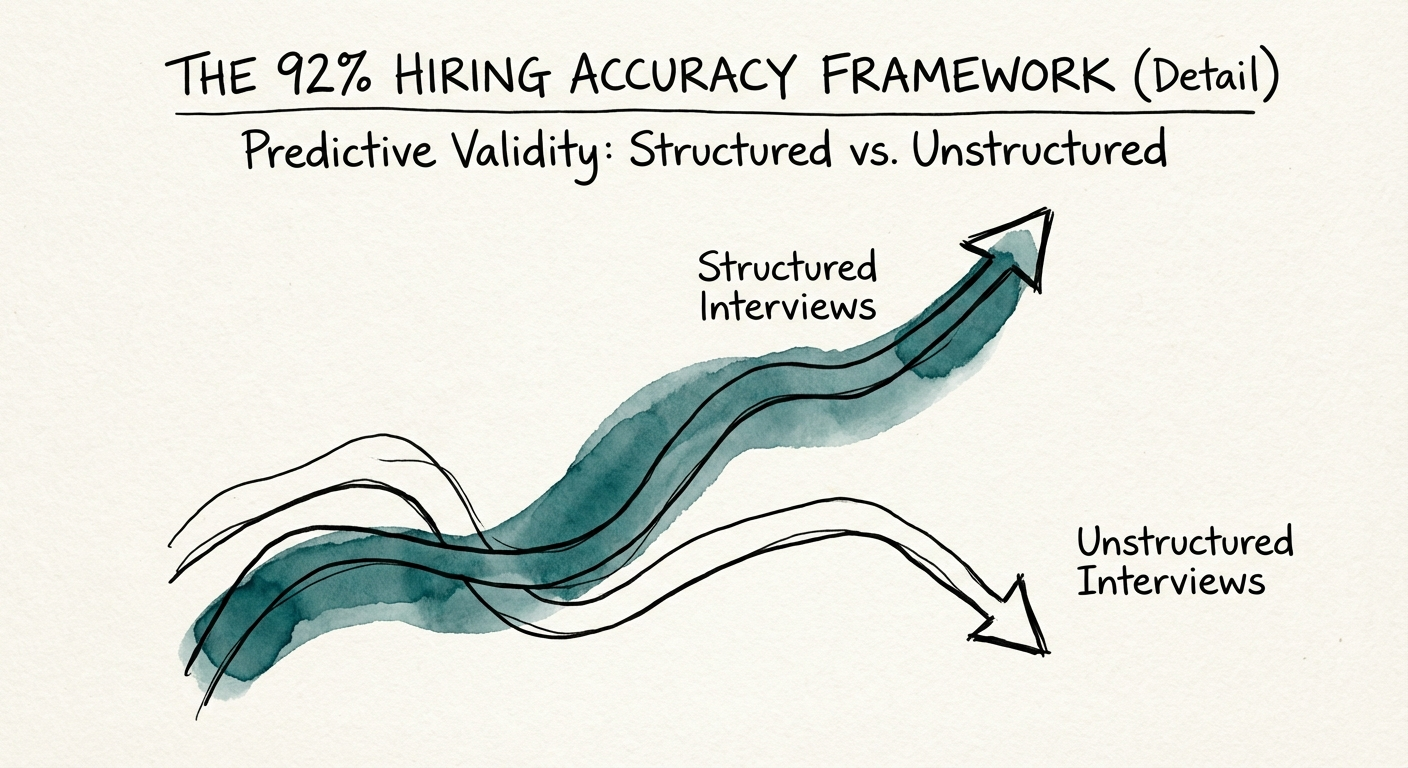
Unstructured interviews — the "let's just chat and see if there's chemistry" round you're running — sit at a predictive validity of roughly 0.38. That is barely above noise. Yet the price of a wrong call keeps climbing: SHRM's data on recruitment cost puts a senior mis-hire as high as 200% of annual salary once you stack recruiter fees, severance, the burned base, and the work that never got done. On a $120k engineer in a B2B SaaS org, that's roughly $240,000 of runway you can't get back.
And the cash is the cheap part. A bad senior engineering hire doesn't just cost money — they cost the roadmap. They hold the seat for six months while everyone tiptoes around their decisions, then you spend three more months backfilling. That's a feature quarter you'll never recover, on a payroll that's measured in months of runway, not years.
We don't have a talent shortage. We have a clarity shortage. Most founders can't write down the three things this hire must accomplish in 12 months, so they hire someone who interviews well and pray. Praying has a predictive validity of about a coin flip.
Replace the gut with three artifacts: a scorecard, a script, and a work sample
The move is to stop treating hiring as a vibe and start treating it like any other system you'd instrument. At a Series B/C SaaS company the goal is concrete: lift hiring accuracy — defined as people still in the seat and rated strong performers at the 12-month mark — from the rough 50/50 most teams live with toward the low-90s. Three artifacts do most of that work.
1. Burn the job description. Write a scorecard.
"Must have 5+ years of Java" predicts nothing. It tells you what a person has touched, not what they'll accomplish on your team. Replace the requirements list with a scorecard of three to five outcomes for the first 12 months, each one falsifiable: "Cut p95 API latency below 200ms by end of Q2." "Migrate billing off the legacy service to Stripe with zero invoicing errors by Q3." Now you're not auditioning for a skill set, you're auditioning for a mission — and you can tell within an hour whether a candidate has done this exact kind of thing before. This is the same discipline you apply when right-sizing an engineering team: every seat carries a number it's accountable for.
2. Ask every candidate the identical questions, in the identical order.
You cannot compare candidates if each interview is a different conversation. A structured loop — same questions, same sequence, same scoring rubric — lets you rank people against each other instead of against whatever mood you walked in with. The research backs the gap precisely: Schmidt and Hunter's work on selection methods shows that structured interviewing paired with a cognitive measure pushes predictive validity to around 0.65 — nearly double the chat-and-chemistry round you're running now. While you're at it, stop scoring "culture fit," which usually decodes to "someone I'd grab a beer with." Score values alignment instead: if you actually run on ownership, ask for a specific time they took the blame for a failure that wasn't entirely theirs, and listen for whether they reach for "we" or "they."
3. Make them do the actual job for an hour.
Resume inflation is the worst it's ever been, and a senior title from a name-brand company tells you who they sat near, not what they can do. So buy the test drive. For an engineering hire, pay them for a scoped, real code review or a small PR against a sandboxed slice of your stack and watch how they reason out loud. For a marketer, hand them last quarter's campaign and ask what they'd kill. A work sample is the only part of the loop that's immune to charisma. You wouldn't wire $240k to a vendor on a slide deck alone — don't do it for a hire either.
The part founders skip: give someone outside the team a veto
Here's where most scorecard rollouts die. The hiring manager is six weeks behind on a roadmap, the seat is bleeding velocity, and by the final round they want a warm body more than they want the right one. So they round up. The fix is a Bar Raiser — borrowed from Amazon, sized down for the mid-market: a trained interviewer from a different function who scores the loop and holds an actual veto. Their incentive is the only clean one in the room, because they don't have to live with the open req. They're not there to fill the seat; they're there to protect the bar.
You can stand the whole thing up in a month:
- Week 1 — Rewrite three scorecards. Take your next three open roles and replace each job description with three-to-five outcomes a stranger could grade as hit or miss 12 months from now.
- Week 2 — Script the questions. Build a question bank tied to those outcomes. For an engineer: "Walk me through a time you shipped a critical feature with half the resourcing you asked for — what did you cut, and what broke?"
- Week 3 — Name two Bar Raisers. Pick two leaders from outside the hiring function, train them on the rubric, and hand them the veto. Not advisory. Veto.
- Week 4 — Run a data debrief. After the loop, no "I liked her," no show of hands. Put every interviewer's scores against the scorecard. Anything short of a strong yes on the outcomes is a no — and a no is cheaper than a $240k maybe.
The point of all this isn't a better interview. It's getting you out of the loop entirely. You can't delegate hiring until the machine earns the trust your gut has been faking, and the machine only earns it once it's catching the mis-hires you used to catch by sitting in. Build it, and the calendar that was 12 hours of interviews becomes your next quarter of product. For the rest of that extraction, see our guide on removing the founder from critical paths.