
The practical answer
- Short answer
- 75% of enterprise IT projects fail due to governance gaps. Here is the operator's guide to running a steering committee that actually makes decisions, not just status updates.
- Best fit
- Industry: Enterprise IT. Function: Operations
- Operating path
- Project Recovery → Turnaround & Restructuring → Transaction Execution Services
- Key metric
- 75% of US IT projects are considered failures by their initiators (Gartner)
The Most Expensive Meeting on Your Calendar
If you are a CIO or VP of Engineering at a Fortune 1000 company, you likely spend 15% of your month in steering committee meetings. You sit in a windowless room (or a Zoom waiting room) while a Project Manager reads 40 slides of "Green" status updates for a project that you know, deep down, is red. Everyone nods, drinks their lukewarm coffee, and agrees to "monitor the situation."
This is the "Stale Committee." It is alive enough to consume budget, but dead where it counts: decision-making. And it is costing you millions.
The data is merciless. According to Gartner, 75% of US IT projects are considered failures by those who initiated them—missing deadlines, blowing budgets, or failing to deliver functionality. Even more alarming, Bain & Company reports that 88% of business transformations fail to achieve their original ambitions. The culprit is rarely the code or the vendor; it is governance latency.
The Cost of Indecision
In most enterprises, a blocked project burns between $50,000 and $200,000 per week in idle labor, vendor retainers, and opportunity cost. When your steering committee takes three weeks to approve a change request or resolve a resource conflict, you haven't just lost three weeks of schedule. You have effectively set fire to half a million dollars.
We recently audited a stalled ERP migration for a $2B logistics firm. The project was six months behind. The steering committee had met six times. In those six meetings, they had made exactly zero binding decisions. They had, however, consumed 120 executive hours reviewing "status." This isn't governance; it's theater. And for an executive like you, staring down a massive digital transformation that is currently stuck in committee, theater is a luxury you cannot afford.
If you leave a steering committee meeting without a decision logged, the meeting was a failure. You have just burned $20,000 of executive time to admire a problem.
The "Decision-First" Methodology
Effective governance is not about "steering"; it is about unblocking. The only reason a steering committee exists is to make decisions that the project team does not have the authority to make themselves. If you leave a meeting without a decision logged, the meeting was a failure.
Benchmark: The 60-Minute Rule
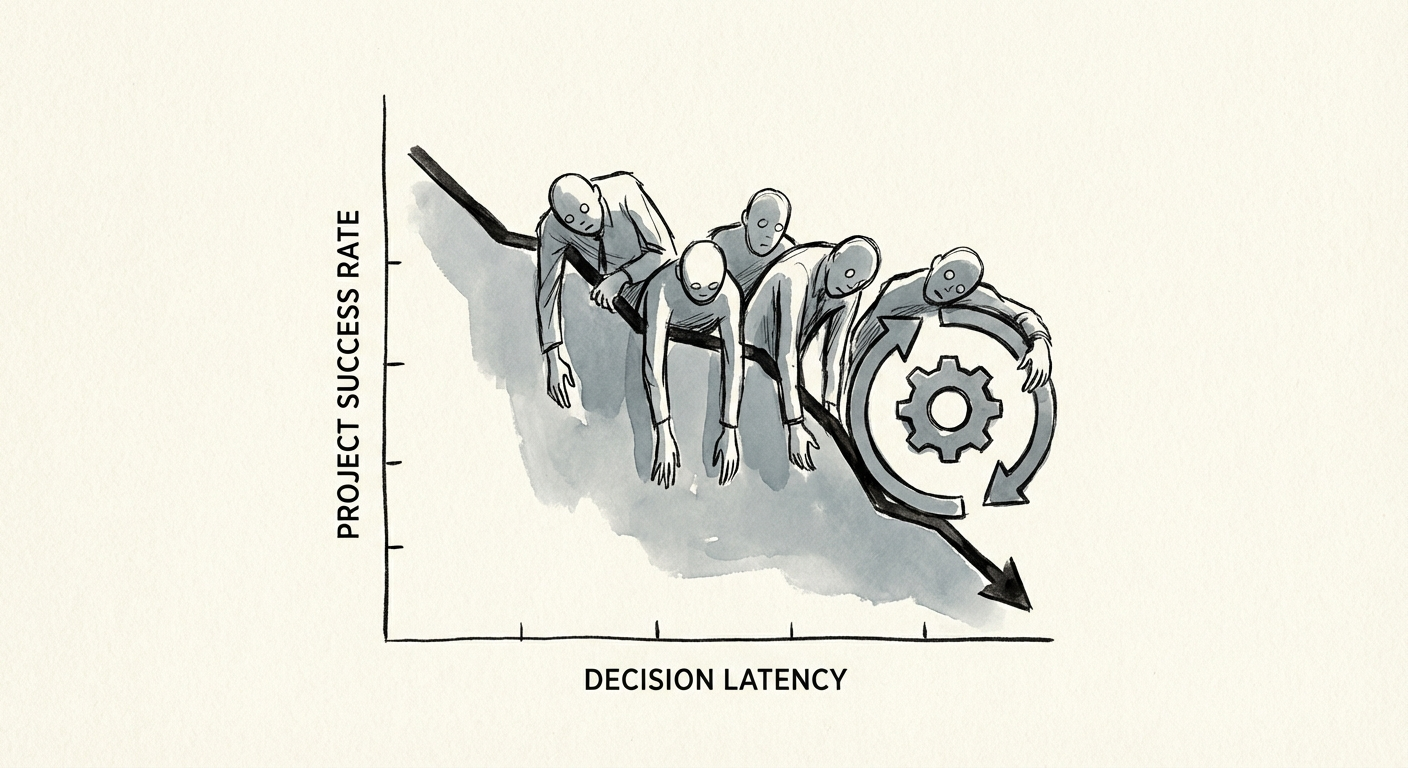
Speed is the primary predictor of success. Data indicates that organizations where leadership makes decisions in under one hour have a 40% higher project success rate compared to those that take five hours or more. In the private equity world, we measure "Decision Latency"—the time between a blocker being identified and a decision being executed. Top-quartile firms measure this in hours; bottom-quartile firms measure it in weeks.
To achieve this speed, you must restructure the committee itself. Research suggests the optimal size for a decision-making body is 5 to 9 members. Any more, and you trigger the "bystander effect," where everyone assumes someone else is solving the problem.
The Only Agenda That Matters
Stop letting your PMO run the meeting with a 50-slide deck. Implement the "Decision-First" agenda:
- 0-5 Mins: Review of last meeting's decisions (Status: Done/Not Done).
- 5-15 Mins: The "Ask." What specific decision is required today to keep the project moving? (e.g., "Approve $50k variance for API middleware" or "Prioritize feature A over feature B").
- 15-45 Mins: Debate and Decision. No deferrals allowed.
- 45-60 Mins: Risk Review (forward-looking only).
This approach forces the project team to do their homework before the meeting. They cannot just report status; they must frame a decision. As discussed in The 30-Day Governance Fix, this shift from information-sharing to decision-making is often the single variable that recovers a stalled initiative.
The Red/Yellow/Green Lie
Ban "Watermelon Reporting" (Green on the outside, Red on the inside). A status of "Green" often means "we haven't found the problem yet." Instead, demand Earned Value metrics or Milestone Verification. Did the code deploy? Did the user acceptance test pass? If not, the status is not Green. Real governance requires brutal honesty about practical project risks, not sanitized executive summaries.
Action Plan: The 48-Hour Governance Reset
If you are currently overseeing a stalled initiative, you don't need a new Gantt chart. You need to reset the rules of engagement. Here is your play for the next 48 hours.
1. Purge the Room
Look at your invite list. If someone is there "for visibility," remove them. They can read the minutes. Keep only the people who have the authority to commit budget, resources, or political capital. If you cannot fire a vendor or reallocate an engineer without checking with someone else, you shouldn't be on the committee either.
2. The "Disagree and Commit" Protocol
Consensus is the enemy of velocity. In your next meeting, establish the "Disagree and Commit" rule. You will debate a decision for a maximum of 20 minutes. At minute 21, the Sponsor (you) makes the call. Everyone else—regardless of their opinion—must publicly commit to supporting that decision. Passive-aggressive obstructionism is what kills digital transformations stuck in committee.
3. Implement the "Flash Report"
Replace the monthly deck with a weekly "Flash Report." One page. Three sections: Decisions Made, Decisions Needed, and Critical Blockers. If the "Decisions Needed" section is empty, cancel the meeting. Respect your team's time enough to only meet when you are ready to work.
Conclusion: Governance is an Active Verb
In 2025, S&P Global reported that AI project abandonment rates jumped to 42%. Why? Because companies launched pilots without the governance structures to scale them. They treated AI like a science experiment, not a capital project.
Effective steering committees don't just watch projects happen; they make them happen. They function as a snowplow, clearing the road ahead so the delivery team can drive at full speed. If your committee isn't a snowplow, it's a roadblock. Clear the way, or get out of the road.