
The practical answer
- Short answer
- 53% of enterprise projects are delayed by IT-Security misalignment. Here is the operator's guide to breaking the deadlock, automating governance, and unblocking your $3M initiative in 30 days.
- Best fit
- Industry: Enterprise Tech. Function: Operations
- Operating path
- Project Recovery → Turnaround & Restructuring → Transaction Execution Services
- Key metric
- 53% Projects delayed by architecture/security disconnects (BetaNews 2025)
The $3M Project Stuck in "Compliance Purgatory"
You have a $3M digital transformation initiative that was supposed to go live in Q4. It is now Q1, and the status report has been yellow-turning-red for six weeks. The code is written. The infrastructure is provisioned. But the release is blocked because the CISO’s team found a vulnerability in a third-party library, or the compliance team won't sign off on the data residency controls until they have "more documentation."
This isn't a technical problem. It's a governance deadlock. And you are not alone.
According to 2025 research from BetaNews, 53% of organizations report project delays specifically due to architectural and security disconnects. Even more damning, a recent report from Cytactic reveals that 70% of senior cybersecurity leaders admit that internal conflicts during a crisis cause more damage than the cyberattacks themselves. When IT wants speed and Security wants certainty, the result is not a compromise—it is paralysis.
For enterprise CIOs, this deadlock is the single biggest threat to your roadmap. You are likely hearing one of two narratives in your executive meetings:
- The IT Narrative: "Security is the Department of No. They don't understand modern DevOps, and they are protecting us into bankruptcy."
- The Security Narrative: "The engineering team is reckless. They are deploying Shadow IT and unpatched libraries that will get us sued or breached."
Both sides are right, and that is why cross-functional deadlock is so difficult to break. But as an operator, you cannot afford to mediate a marriage counseling session between your VP of Engineering and your CISO. You need to engineer a solution that removes the friction entirely.
Tension between security executives and organizational leaders can be destructive... 70 percent of senior cybersecurity leaders said internal conflicts during a crisis cause more problems than the cyberattack itself.
The False Choice: Velocity vs. Validity
The deadlock persists because your organization views Speed (IT) and Safety (Security) as a zero-sum game. The prevailing belief is that to be more secure, you must go slower. To go faster, you must accept more risk.
This is mathematically false in high-performing organizations.
The 2024 DORA (DevOps Research and Assessment) report confirms that elite performers excel in both deployment frequency and change failure rate. They do not trade one for the other. How? They stop treating security as a "gate" at the end of the process and start treating it as a "constraint" baked into the platform.
The Governance Gap
The friction occurs because your governance model is manual and retrospective. Your developers build for three months, and then your security team audits for three weeks. This "audit-gate" model ensures conflict because any finding by security requires IT to tear up completed work.
Data from vFunction (2025) shows that 47% of organizations face unexpected operational costs because their documented architecture doesn't match reality. When Security audits a diagram that doesn't match the code, they find surprises. Surprises lead to blocks. Blocks lead to missed earnings.
The Solution: Automated Governance (The Golden Path)
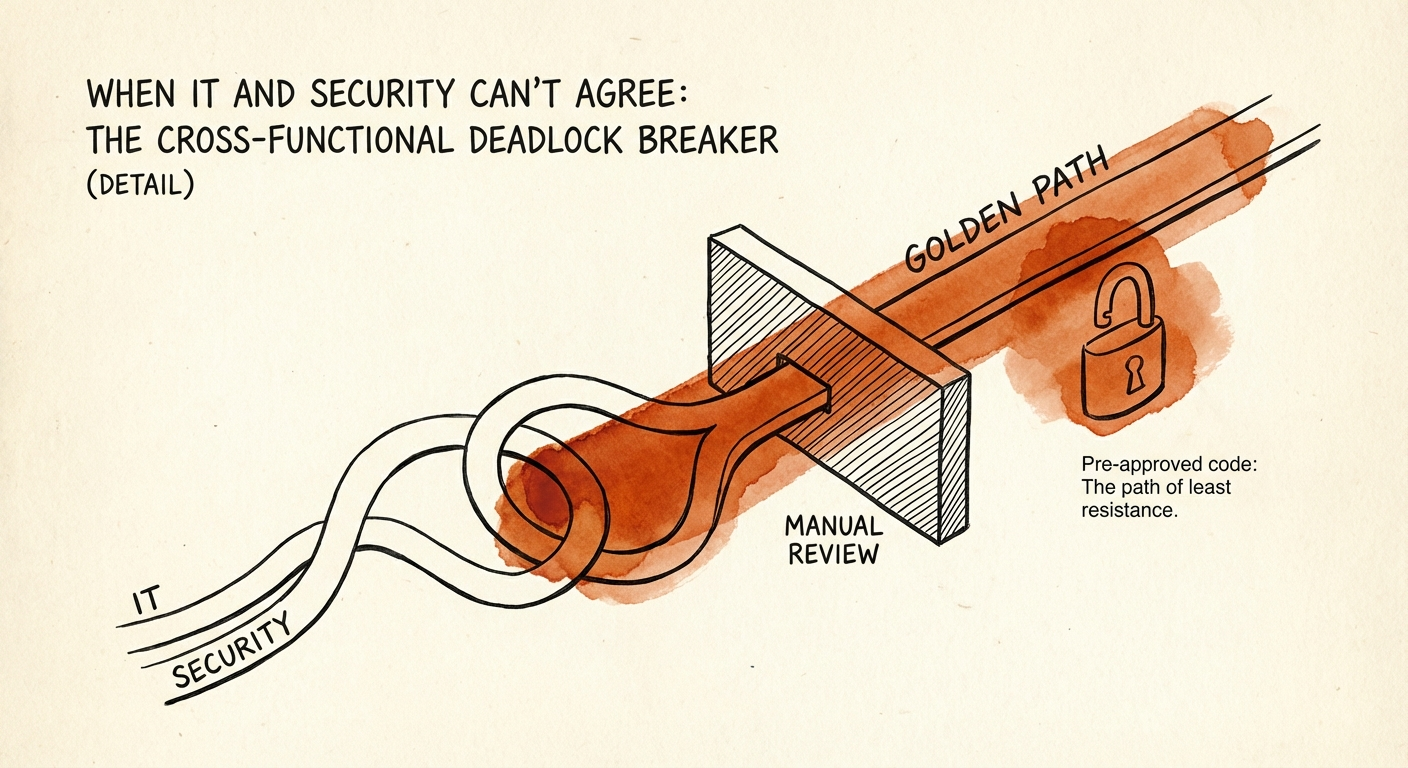
To break the deadlock, you must move from "permission-based" governance to "policy-based" governance. This is often called the "Golden Path" or "Paved Road" approach.
Instead of asking developers to follow a 200-page security PDF, you provide them with pre-approved infrastructure templates (Terraform/CloudFormation) that already comply with your security standards. If they use the pre-approved path, they get a fast lane to production with minimal review. If they go off-road, they face the full manual audit.
This aligns incentives. IT gets the speed they crave, but only if they adopt the controls Security mandates. Security gets the compliance they need, without having to manually review every line of code.
The 30-Day Deadlock Breaker Plan
If your flagship project is currently stalled, you don't have time to build a full internal developer platform. You need a triage plan to get the release moving while satisfying the CISO's requirements. Here is the 30-day governance fix.
1. The Joint Risk Register (Days 1-7)
Stop arguing over emails. Force IT and Security to populate a single spreadsheet of "Blockers." Every security concern must be quantified by Risk Impact (Low/Med/High) and Remediation Effort (Hours).
Result: You will usually find that 80% of the "blockers" are low-risk items that can be remediated after go-live, and only 2-3 are true showstoppers.
2. The "Condition of Release" Treaty (Days 8-14)
Broker a deal. IT agrees to fix the 3 showstoppers immediately. Security agrees to sign off on the release if IT commits to a remediation roadmap for the lower-priority items within 60 days. This turns an indefinite "No" into a conditional "Yes."
3. Embed the Auditor (Days 15-30)
Physical proximity reduces political distance. Take your lead security engineer and physically (or virtually) embed them in the deployment team for the final sprint. Give them commit access. Make them responsible for fixing the security configurations, not just pointing them out. When the CISO's own person helps build the solution, approval becomes a formality.
Conclusion: Governance is an Engineering Problem
The organizations that win in 2026 won't be the ones with the strictest compliance manuals; they will be the ones that automate compliance out of existence. Your job as the executive is to stop mediating the argument and start building the systems that make the argument unnecessary. If IT and Security are fighting, you haven't engineered the process well enough.