
The practical answer
- Short answer
- 2026 IT spend benchmarks for mid-market tech: 7-8% of revenue, $8k-$13k per employee, and the 27% of cloud spend most firms waste. Stop bleeding EBITDA.
- Best fit
- Industry: Technology / SaaS. Function: Finance & IT
- Operating path
- Financial Infrastructure → Commercial Performance → Valuations
- Key metric
- $8k-$13k Target IT spend per employee for mid-market tech
The "Keep the Lights On" Fallacy
For most Founder-CEOs, the IT budget is a source of profound anxiety. It is the line item that grows reliably every quarter, regardless of revenue performance, populated by acronyms (API, AWS, ERP, SOC2) that defy simple interrogation. When you ask why the Azure bill jumped 18% last month, you receive a technical explanation about "reserved instances" or "container orchestration" that effectively shuts down the conversation.
Here is the reality for most founder-CEOs: you are likely operating with a dangerous blind spot. You are either bleeding EBITDA through unchecked SaaS sprawl, or worse, you are starving your engineering team of the tools they need to ship product, creating a hidden deficit we call "Technical Debt as Financial Debt."
The generic industry benchmark—telling you to spend 3.6% of revenue on IT—is a trap. That number applies to manufacturing firms and dental chains. For a B2B technology company, where your "factory floor" is a cloud environment and your "assembly line" is a CI/CD pipeline, adherence to low-margin industry averages is a surefire way to kill innovation. Conversely, treating IT as an unbudgeted "innovation slush fund" is how you wake up to a Rule of 40 violation during due diligence.
The Two Buckets of Tech Spend
To diagnose your health, you must first mentally bifurcate your spend:
- Corporate IT (The Cost Center): Laptops, email, Zoom, HRIS, basic security. This should be ruthlessly optimized.
- Production IT (The Value Driver): Cloud hosting, DevOps tools, R&D infrastructure. This scales with revenue and user count.
If you conflate these two, you cannot manage them.
If your IT spend is $4k/head at a SaaS company, your developers are building on workarounds. If it's $25k/head, you're bleeding EBITDA. The sweet spot is a discipline, not a guess.
The 2026 Numbers: What "Good" Looks Like
Let's cut through the noise with data from the 2025/2026 reporting cycle. While general industries average roughly 3.6% to 5% of revenue on IT, high-growth technology mid-market firms should target 7-8% of revenue. If you are below 5%, you are likely accumulating technical debt that will require a massive remediation check later. If you are above 10%, you are inefficient unless you are in the midst of a major platform migration.
Benchmark 1: Spend Per Employee
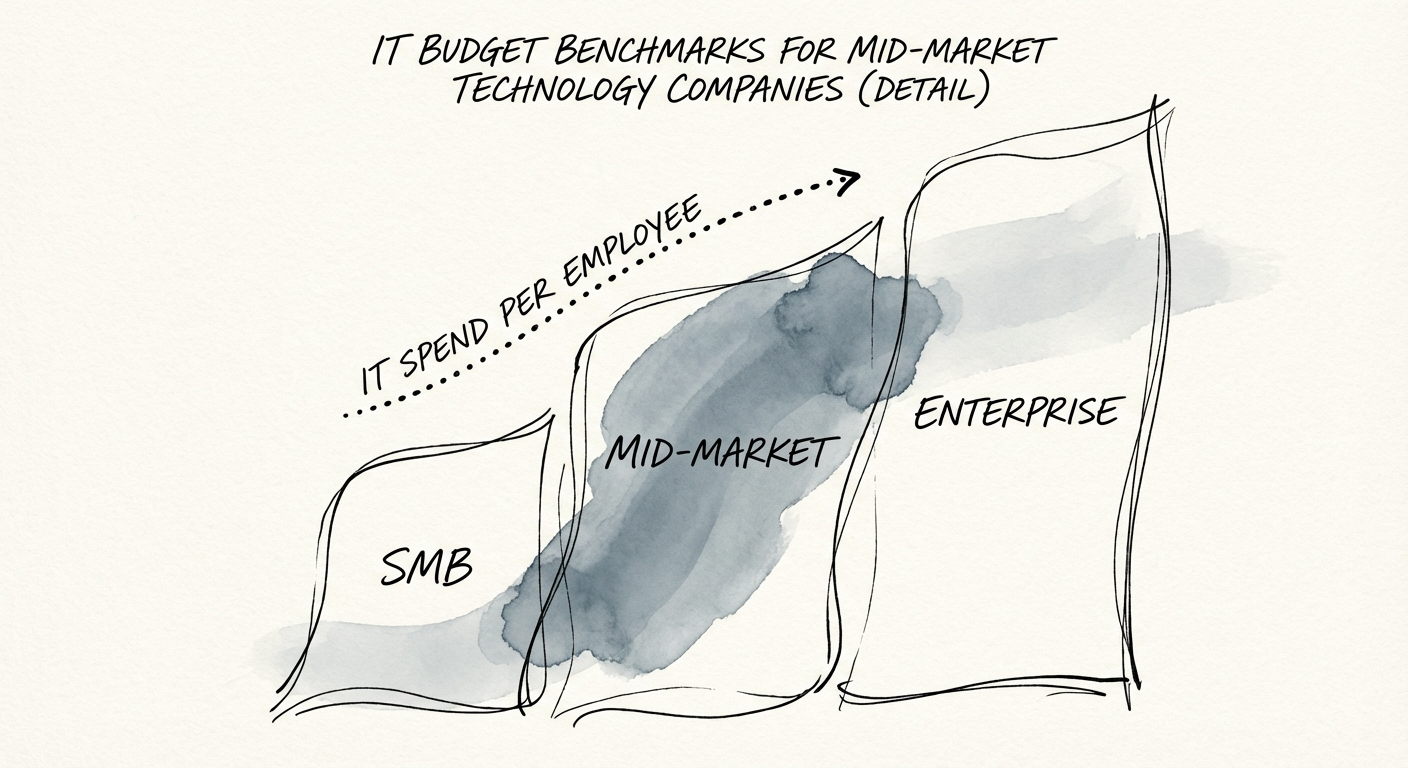
This is often the most diagnostic metric for mid-market firms ($10M-$50M revenue). Recent data indicates a clear band for healthy organizations:
- SMB Generalist: $3,000 - $8,000 per employee.
- Mid-Market Tech Firm: $8,000 - $13,000 per employee.
- Enterprise/Heavy R&D: $13,000 - $20,000+ per employee.
If your spend is $25k/head, you have a governance issue. If it's $4k/head at a SaaS company, your developers are likely building on workarounds that pose a security risk.
Benchmark 2: The SaaS Wasteland
The shift from CapEx (buying servers) to OpEx (renting SaaS) has created a visibility crisis. 27% of cloud spend is wasted, according to Flexera's State of the Cloud report. This waste comes from:
- Zombie Licenses: Seats paid for but not logged into for 90+ days.
- Shadow IT: Marketing buying their own automation tools without IT vetting.
- Over-Provisioning: Buying premium tiers for users who only need read-only access.
For a company with $20M in revenue spending 8% on IT ($1.6M), a 27% waste rate implies you are lighting $432,000 of EBITDA on fire annually. That's not a rounding error; that's your entire bonus pool.
Benchmark 3: The Security Tax
In 2026, security is no longer optional insurance. It is a license to operate. Healthy firms now allocate 10-15% of their total IT budget specifically to cybersecurity (up from 5-7% in 2022). If you are selling to enterprise clients who demand SOC 2 or ISO 27001, under-investing here will stall your deal flow faster than a bad sales pitch.
The Diagnostic Action Plan
You do not need to become a CIO to fix this. You need to become an Operational Engineer. Here is the playbook to align your budget with your growth goals.
1. The 30-Day Audit (FinOps Implementation)
Stop accepting "variable cloud costs" as a fact of life. Implement a FinOps review immediately. Connect your accounts to a spend management platform (like Cledara or a native cloud cost tool). Identify every SaaS subscription with <50% utilization and cut them. We routinely see companies recover 15% of their IT budget in week one simply by turning off auto-renew on unused tools.
2. Separate Run vs. Grow
Restructure your P&L reporting. Do not bury AWS costs in "General & Administrative."
- Cost of Goods Sold (COGS): Hosting, customer-facing support tools, production licenses. This impacts your Gross Margin.
- OpEx (R&D): Developer tools, staging environments.
- OpEx (G&A): Office Wi-Fi, laptops, ERP.
This clarity allows you to see if your Gross Margin is compressing due to inefficient code—a classic sign of technical debt masking as operational cost.
3. The Governance Mandate
Establish a "Tech Procurement Desk." No credit card expense over $500/month for software gets approved without a usage review. This stops the "credit card sprawl" where every department head buys their own project management tool. Centralize to negotiate enterprise volume discounts.
Summary
Your IT budget is a reflection of your operational discipline. In the mid-market, you cannot afford the bloat of the enterprise nor the starvation of the startup. Aim for 7-8% of revenue, keep your per-head spend in the $8k-$13k band, and treat every dollar of waste as a direct theft from your exit valuation.