
The practical answer
- Short answer
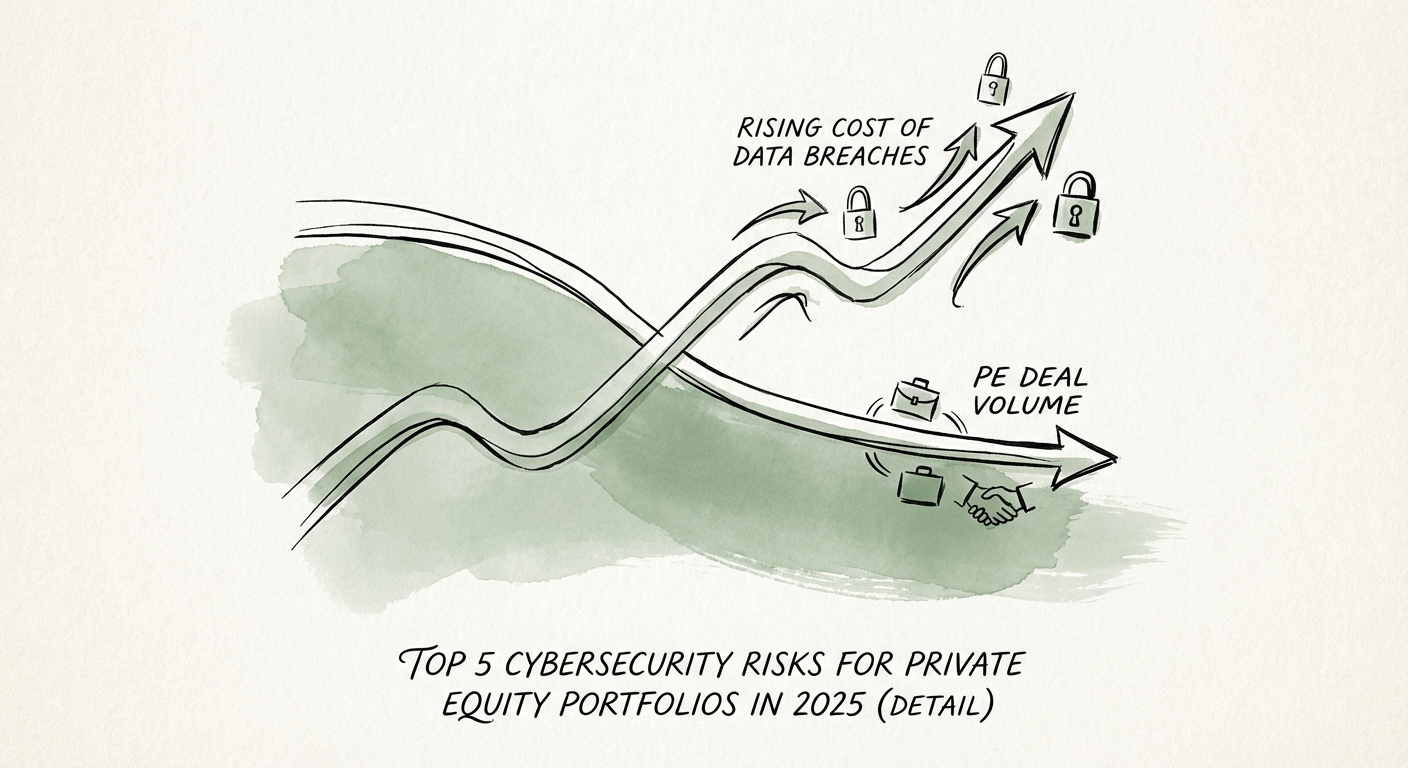
- The 5 cybersecurity risks that reprice PE deals in 2025: $4.88M average breach cost and the 52% of firms that find major risks only after close.
- Best fit
- Industry: Private Equity / Technology. Function: Risk & Security
- Operating path
- Compliance & Security → Turnaround & Restructuring → Turnaround & Restructuring Services
- Key metric
- $4.88M Average global cost of a data breach (IBM)
The Era of "Check-the-Box" Security is Dead
For decades, cybersecurity in Private Equity was a line item in the IT budget—a nuisance fee paid to ensure email servers didn't crash. In 2025, that mindset is a liability. It is a direct threat to EBITDA and exit multiples.
The market has shifted violently. We are no longer discussing theoretical risks. We are looking at hard valuation impacts. According to recent industry data, 73% of dealmakers now consider an undisclosed data breach an immediate deal-breaker. Why? Because the cost of remediation is spiraling out of control.
The 2024 IBM Cost of a Data Breach Report reveals that the global average cost of a breach has hit $4.88 million, a 10% increase year-over-year. For U.S.-based firms, that number nearly doubles to $9.88 million. In the context of a mid-market portfolio company, a single incident can wipe out a year's worth of margin improvement initiatives.
Private Equity sponsors face a unique convergence of pressures in 2025: aggressive regulatory enforcement, sophisticated AI-driven threat actors, and a portfolio of acquired companies often sitting on "technical debt" that acts as a ticking time bomb. This report outlines the five specific vectors that will threaten your returns this year.
The most dangerous risk isn't the hacker you see; it's the vulnerability you bought. When you acquire technical debt, you inherit a breach.
The 5 Critical Risk Vectors for 2025
1. The "Post-Close" Surprise (Legacy Technical Debt)
The most dangerous risk isn't the hacker you see; it's the vulnerability you bought. Surveys indicate that 52% of acquirers discover major cybersecurity risks only after the deal closes. This is a failure of due diligence. Standard diligence checklists often miss deep-seated legacy vulnerabilities—outdated infrastructure and unpatched software—that act as open doors for attackers. When you acquire a company with significant technical debt, you are effectively inheriting a pre-existing breach condition.
2. Regulatory Crosshairs: The New SEC Mandates
The regulatory landscape has hardened. The SEC's amendments to Regulation S-P, finalized in 2024, are not suggestions. They mandate rigorous incident response programs and require covered institutions (including many private funds) to notify customers of data breaches within 30 days. Non-compliance is no longer just a legal headache; it is a reputational crisis that will be broadcast publicly, directly impacting your firm's ability to raise future funds.
3. AI-Driven Social Engineering
Phishing has evolved. We are now seeing "Deepfake" voice cloning and AI-generated social engineering attacks targeting wire transfers and capital calls. Attackers use publicly available audio of executives to synthesize voice commands, bypassing traditional authorization protocols. This moves the threat from the IT room to the CFO's desk.
4. Third-Party Supply Chain Contagion
Gartner predicted that by 2025, 60% of organizations will use cybersecurity risk as a primary determinant in third-party transactions. Your portfolio companies do not exist in a vacuum. They rely on a web of vendors, MSPs, and cloud providers. A breach in a critical vendor—like a payroll processor or cloud host—can paralyze a portfolio company's operations for weeks, even if their own systems are secure.
5. Ransomware 2.0: Double Extortion
Ransomware is no longer just about encryption; it is about extortion. Attackers now steal sensitive data (IP, customer lists, internal emails) before locking systems, threatening public release if the ransom isn't paid. This "double extortion" tactic targets the firm's reputation directly. For PE firms, the release of sensitive deal data or LP information is a catastrophic scenario that insurance alone cannot fix.
The Executive Action Plan
Passive oversight is negligence. To protect portfolio value in 2025, PE sponsors must move from "monitoring" to "mandating."
1. Deep-Dive Cyber Diligence
Stop relying on self-attestation questionnaires during the M&A process. Deploy active scanning and outside-in vulnerability assessments before the LOI is signed. If you don't know the cost of the technical debt, you are overpaying for the asset.
2. Standardize the Reporting Framework
You cannot manage what you cannot measure. Implement a standardized cybersecurity dashboard across all portfolio companies. Metrics should not be technical jargon; they should be business risk indicators: Time to Patch, Phishing Click Rates, and Vendor Risk Scores.
3. Verify Incident Response Plans
A binder on a shelf is not a plan. Mandate annual tabletop exercises for every portfolio company, specifically simulating a ransomware event. Ensure that communication protocols (legal, PR, insurance) are pre-scripted.
Conclusion
Cybersecurity is not an IT problem; it is a capital preservation problem. The firms that treat it as a core component of their value creation strategy will protect their multiples. Those that don't will find their exits dictated by their vulnerabilities, not their performance.