You didn't buy a company; you bought a data set, a customer list, and a liability. In the current vintage, where holding periods have stubbornly settled near 6 years, the old playbook of "integrate slowly" is a death sentence for IRR. The math is brutal: traditional integration strategies yield failure rates between 66% and 75%.
The root cause isn't cultural mismatch; it's technical paralysis. While operating partners obsess over org charts, the IT estate is bleeding value. Research confirms that over 50% of total deal synergies are directly dependent on technology integration—yet most firms treat IT as a back-office utility rather than a value driver. If you miss the IT integration window, you miss the margin expansion.
Beyond value destruction, there is existential risk. The moment a deal is announced, the target asset becomes a beacon for threat actors. Data shows a 400% increase in phishing attempts on acquired companies in the months following a deal announcement. If your 90-day plan doesn't prioritize immediate cyber-containment, you are effectively underwriting a breach that will wipe out your first year of EBITDA gains.
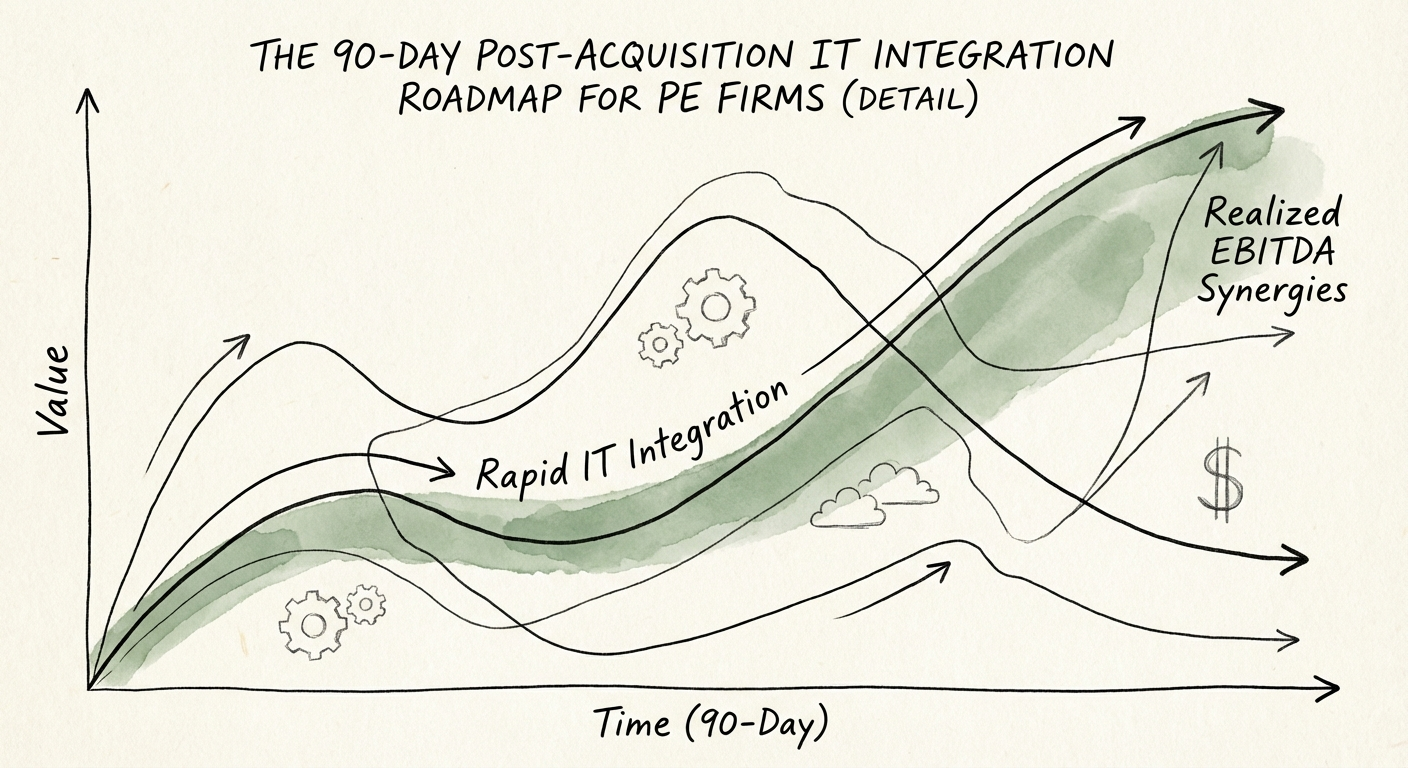
Stop planning for a "perfect" integration in Year 2. Execute a "functional" integration in Quarter 1. The goal is not IT utopia; it is a unified P&L and a secure perimeter.
Your first move is defensive. Do not touch the ERP yet. Focus entirely on Identity and Access Management (IAM) and perimeter defense.
Now, attack the redundant spend. This is where you capture the "low hanging fruit" to fund the rest of the roadmap.
By month three, the focus shifts to revenue visibility. You need a single source of truth for the Board deck.
Portfolio Paul, your exit narrative starts on Day 91. A "clean asset" in 2026 is defined by three metrics: unified data visibility, zero high-severity vulnerabilities, and a single operational cost structure. If you are still running parallel ERPs in Year 2, you are paying a "complexity tax" that will degrade your exit multiple.
Speed is the only currency that matters in the first quarter. Imperfect action beats perfect planning every time.