If you ask your VP of Sales about their win rate, they might proudly report 29%. In the broader B2B market, they aren't wrong to be proud. According to 2024 HubSpot data, the average B2B win rate hovers around 21%. Against that backdrop, 29% looks like outperformance.
But you are not running a VC-backed moonshot where 70% growth covers a multitude of efficiency sins. You are running a PE-backed asset where Quality of Earnings (QoE) and EBITDA margin dictate the exit multiple. In this context, a 29% win rate means your sales team is spending 71% of their time, budget, and engineering resources on revenue that never materializes.
Let’s look at the math that typically hides below the Board deck line items. In a standard mid-market tech firm with a $100k+ ACV (Annual Contract Value), a "Lost" deal isn't zero cost. It is a sunk cost of:
When you allow a 29% win rate to persist, you are effectively accepting that for every $1 of new bookings, you are lighting $0.40 on fire in wasted Customer Acquisition Cost (CAC). This inefficiency bleeds directly into your EBITDA, extending your CAC payback period well beyond the 12-month safe zone.
Why do most portfolio companies get stuck in the 20-30% trap? It is rarely a product problem. It is almost always a selection and process problem. We see three consistent root causes in firms struggling to break the 30% ceiling.
Mediocre sales teams confuse activity with progress. They measure success by the number of proposals sent, rather than deals closed. If your team is sending proposals to prospects who haven't confirmed budget, authority, and timeline, you don't have a pipeline; you have a wish list. Elite firms stop the proposal spam by gating the proposal stage behind strict exit criteria.
In many lower mid-market acquisitions, the high win rates of the past were driven by the founder's charisma and "heroics," not a repeatable system. As you scale and hire new reps, that founder-led magic dilutes. The new reps are pitching features, while the founder was selling vision. The result is a steep drop in conversion rates at the bottom of the funnel.
The most profitable word in sales is "No," provided it comes early. A "No" at the Qualification stage costs $0. A "No" at the Final Negotiation stage costs $15,000 in sunk time. Your 29% win rate exists because your team is afraid to disqualify bad deals early. They hoard "zombie opportunities" to make their pipeline coverage look healthy for the Monday morning commit call.
Moving from 29% to 60%+ isn't about sales training; it's about operational engineering. At Human Renaissance, we deploy a specific playbook to fix this leak within 90 days.
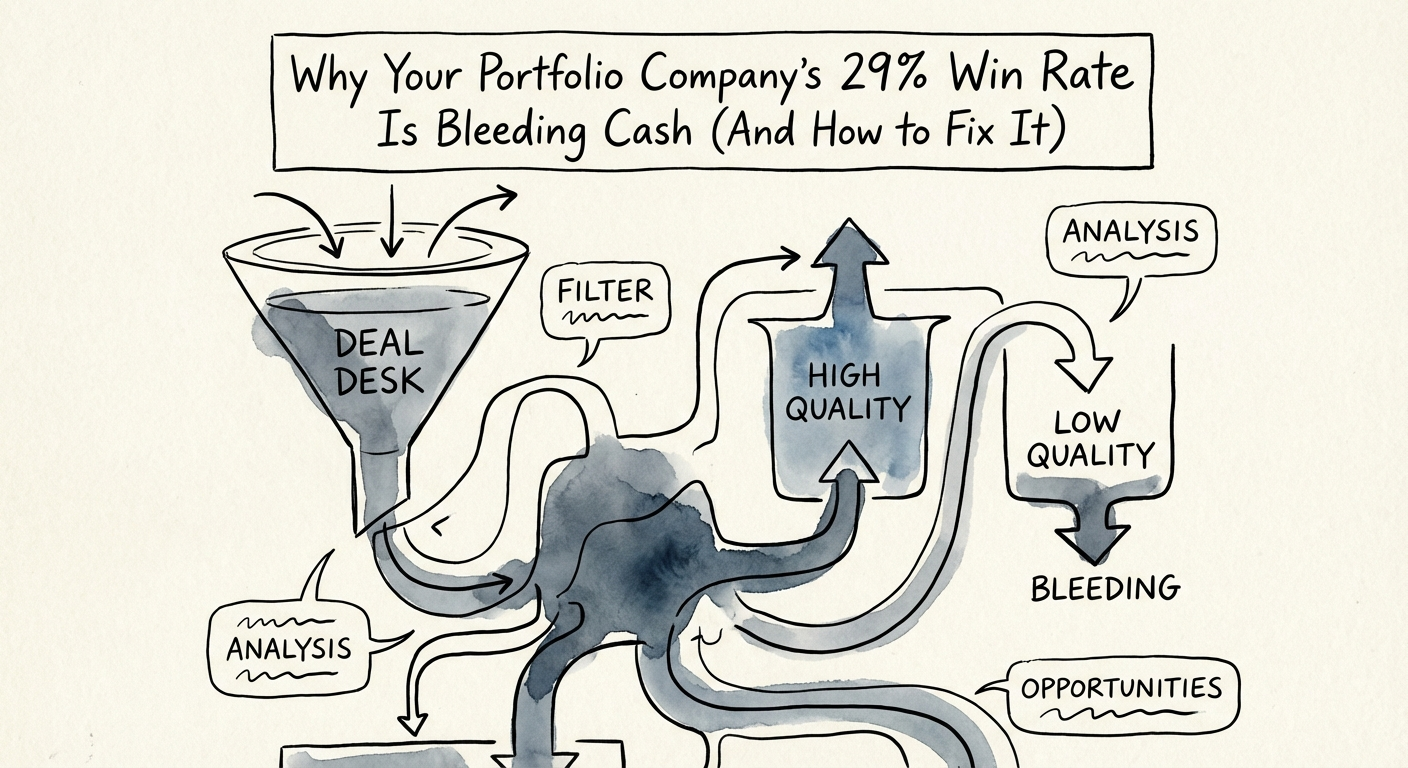
Stop letting sales reps self-police their pipeline. Implement a Deal Desk—a weekly review where a neutral operator (Sales Ops or Finance) audits every late-stage deal against a strict framework (like MEDDIC). If the rep can't name the Economic Buyer or the Decision Criteria, the deal is moved back to "Qualification" or killed. This artificially shrinks the pipeline in Month 1, but skyrockets win rates and forecast accuracy in Month 3.
Institute a hard rule: No proposal without a "Give-Get." We do not send pricing or scope unless the prospect gives us access to the decision-maker or agrees to a mutual close plan. If they refuse, they are price-shopping, and we walk away. This single policy often cuts proposal volume by 40% while increasing closed revenue.
Shift your board-level reporting. Stop asking "How much pipeline coverage do we have?" (which encourages bloating). Start asking "What is our stage-to-stage conversion rate?" and "What is our win rate on qualified opportunities?" As McKinsey notes, a focused improvement in win rates can drive 4-12% topline growth without adding a single new lead.
The Verdict: A 29% win rate is not a sales problem; it's a discipline problem. By narrowing the focus to the deals you should win, you stop bleeding cash on the deals you will lose.