Here is the brutal truth of lower-middle market M&A: Buyers do not buy people. They buy transferable cash flow. If your revenue depends on your personal relationships, your undocumented "genius," or a founder-led sales process that exists only in your head, you are not selling a business. You are selling a job that no one wants.
We call this the Transferability Gap. When a Private Equity sponsor looks at a CIM (Confidential Information Memorandum), they are calculating risk. Undocumented processes represent maximum risk. According to data from Breneman Advisors, buyers often apply a 20% discount to valuations simply because earnings, while real, cannot be verified or replicated without the founder present. That is a massive haircut on enterprise value simply for lacking a playbook.
The cost of poor documentation isn't just a lower price—it's often no deal at all. Harvard Business Review data suggests that 70% to 90% of M&A deals fail to meet their financial objectives, with "poor due diligence" cited as a primary cause. When a buyer asks for your Customer Success SOPs and you hand them a blank stare, the deal momentum dies. They aren't looking for perfection; they are looking for institutional memory that survives your exit.
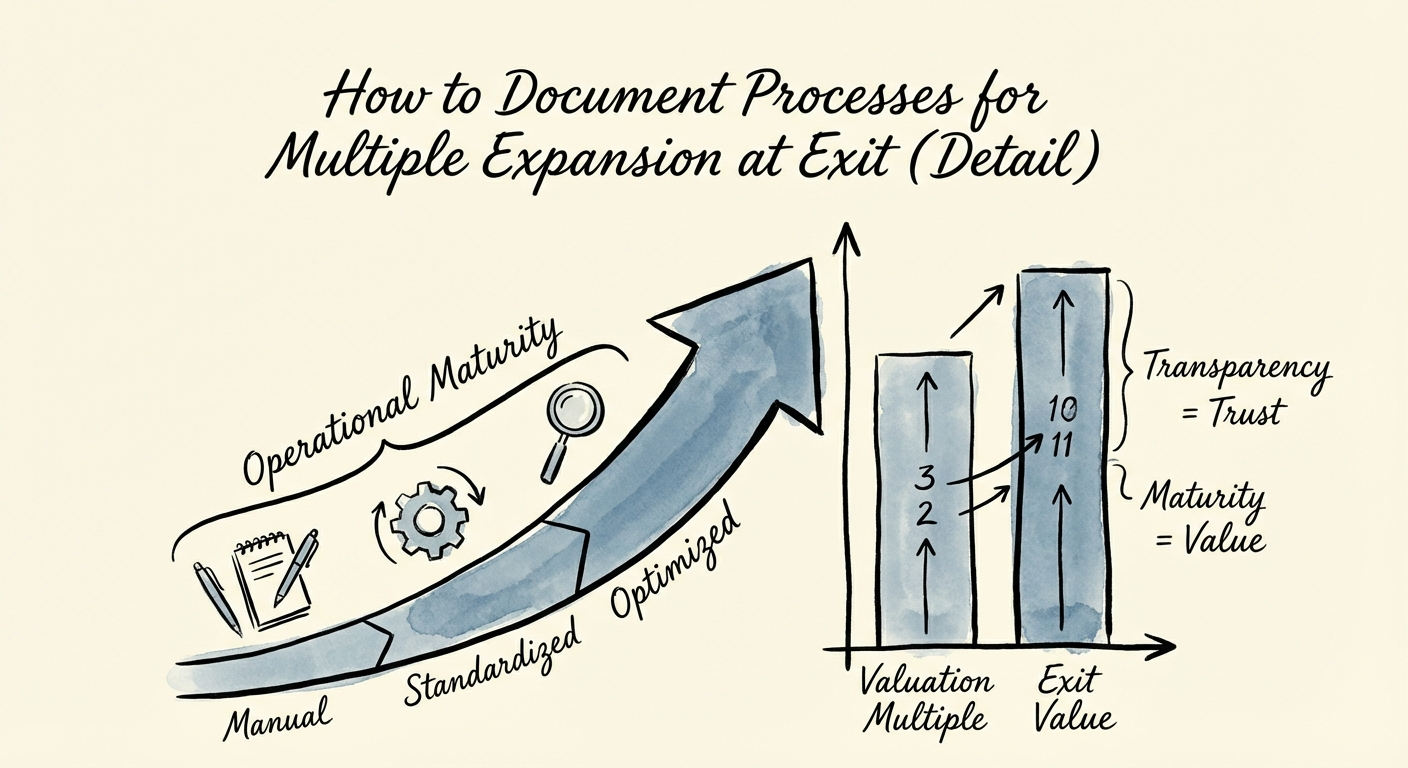
Do not document everything. Most founders fail because they try to create a 500-page manual for changing the printer toner. That is a waste of EBITDA. To drive multiple expansion, you must document the 20% of processes that generate 80% of your equity value.
We use a "Minimum Viable Documentation" (MVD) framework for exits:
Research from McKinsey & Company reveals that organizations with clearly defined Standard Operating Procedures (SOPs) outperform competitors by 31%. Why? Because consistency breeds scalability. In a sale scenario, a "turnkey" business—one where the buyer can see the operating manual before they wire the funds—commands a Control Premium. This premium, typically ranging from 20% to 40% above standard multiples, is paid for de-risked assets. You are literally being paid more to make yourself obsolete.
If you are planning an exit in the next 12-24 months, stop writing manuals. Start recording.
Written SOPs are obsolete the moment they are saved. Instead, mandate a "Record It" culture. Use tools like Loom or Microsoft Stream. Have your department heads record their screen while explaining their core workflows. This creates an indisputable video library of your IP.
Take those raw videos and run them through enterprise transcription tools to generate step-by-step text guides. This turns a 5-minute video into a searchable, indexable SOP without a human typing a word.
One month before you go to market, force a key executive to take a totally disconnected week off. If the business breaks, you are not ready to sell. Fix the broken process, document the fix, and try again. As FE International data shows, firms with prepared documentation see success rates as high as 94.1%, compared to the industry average of roughly 50%. Your documentation is your insurance policy against a failed close.