
The practical answer
- Short answer
- A clean EBITDA number won't save a lumpy revenue base. Here's the exact revenue-quality audit Operating Partners run 18 months out so the QoE team finds nothing.
- Best fit
- Industry: Private Equity. Function: Office of the CFO
- Operating path
- Exit Readiness → Operational Excellence → Transaction Advisory Services
- Key metric
- 106% Median NRR for Venture-Backed SaaS (2025)
The day the 12x became a 6x
The model said 12x. EBITDA was up 20% to $15M, the board deck was clean, and someone on the IC had already done the carry math. Then the buyer's Quality of Earnings team delivered their first read, and one line did the damage: roughly 40% of the year's "growth" traced back to a single Q4 implementation fee — a one-time professional-services booking that the founder had timed to clear the EBITDA target. The buyer didn't argue. They just re-cut the offer to 6x on the recurring base and called the rest a bonus. The seller had three weeks of exclusivity left and no time to fix anything.
That gap — between the number you reported and the number the buyer will underwrite — is where mid-market exits go to die. You were managing the quantity of revenue. The QoE team was auditing the durability of it, and durability is the only thing a lender will lend against.
This is not a fringe risk. DealPotential (2025) puts the share of M&A deals that miss their objectives at 70-90%, with thin diligence on revenue sustainability named as a primary driver. The pattern I see most often isn't fraud — it's optimism. A services-heavy company convinces itself that "customers who keep coming back" is the same thing as "revenue we can promise next year." A diligence team will not extend that courtesy.
Why the buyer pays up for boring
Here's the part founders resist: buyers will pay more for less. They would rather buy $10M of boring, predictable, high-retention revenue than $15M of heroic, one-time project wins — because predictable revenue is what services the debt in a leveraged deal. The acquirer's whole return depends on the cash flow showing up on schedule. Lumpy revenue doesn't just discount the multiple; it shrinks the amount of debt the deal can carry, which compresses the buyer's equity return and the price they can justify.
Clearly Acquired (2025) pegs the gap at 2-3x higher multiples for genuine recurring-revenue models versus one-time-sale businesses. If you're prepping a portfolio company and you audit its legal exposure harder than its revenue base, you've inverted the risk. The legal stuff rarely kills a deal. The revenue base does it quietly, in a footnote, after the price is already in the room.
Buyers will pay more for less. They would rather buy $10M of boring, predictable, high-retention revenue than $15M of heroic, one-time project wins.
The three findings that re-trade a deal
When I walk into a portfolio company 18 months out, I don't open with the growth plan. I run the revenue-quality audit first, because it sets the ceiling on every other number. We strip out the adjusted-EBITDA storytelling and pressure-test three things a QoE team is guaranteed to find. Fix these and the growth plan compounds. Skip them and growth just adds more fragile revenue to the pile.
1. NRR — and why 100% is now a red flag
Gross retention keeps the lights on. Net Revenue Retention decides whether you're an asset or a leaky bucket. NRR captures whether your existing book expands enough to outrun churn, which makes it the cleanest proxy a buyer has for pricing power and stickiness — without taking your sales team's word for it.
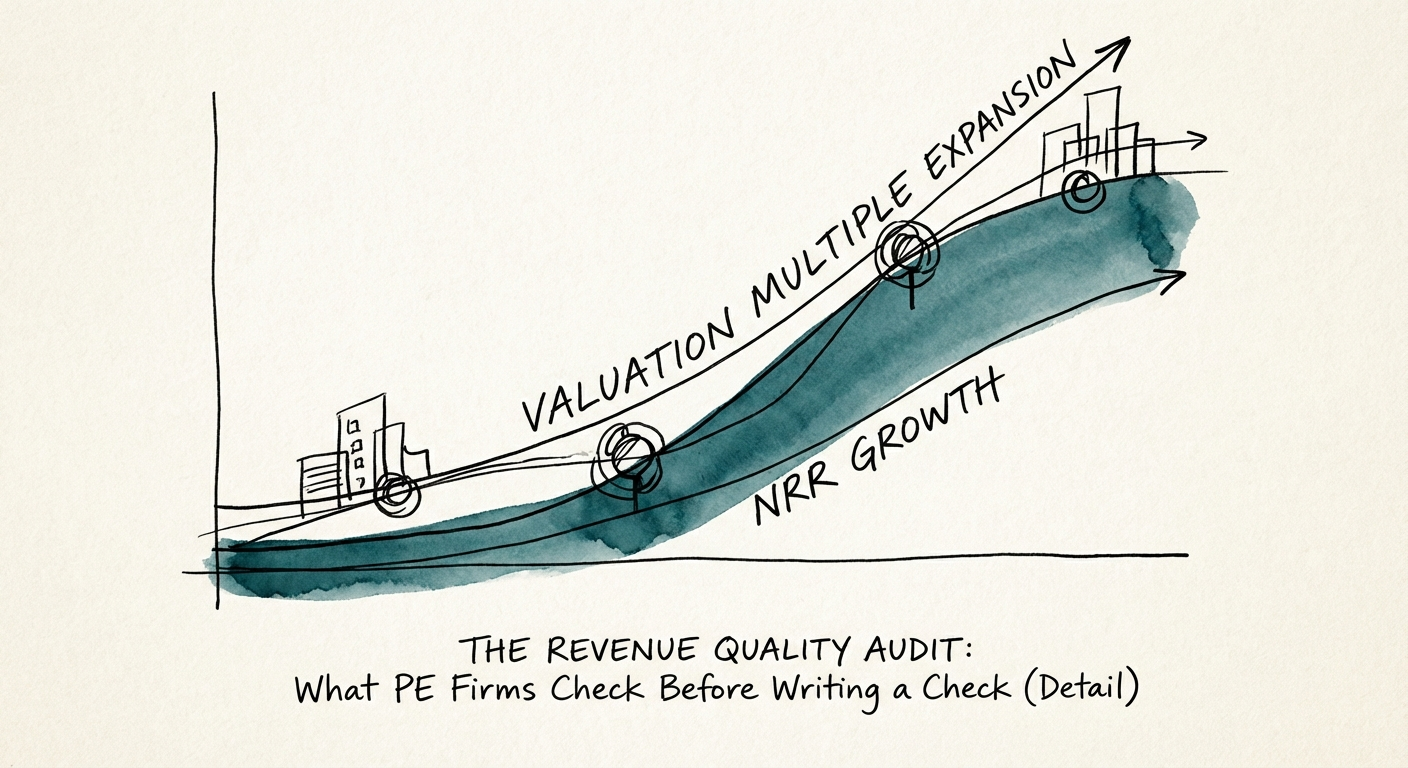
The bar moved. A few years ago, 100% NRR passed. Today it signals stagnation. Optifai's 2025 benchmark puts the median for venture-backed SaaS at 106%, and the curve above that is steep: companies clearing 120% NRR command a 63% valuation premium over the median. That premium isn't sales output — it's customer-success mechanics showing up as multiple expansion. So before you reach for EBITDA add-backs to dress up the number, fix the expansion motion underneath it. One is a footnote a buyer will challenge; the other is durable.
2. The whale trap
Picture a $40M services firm growing 25% — a clean story until you sort the revenue and find 38% of it sitting in two logos. That's the whale trap. Founders love whales because they're cheap to service. Buyers see binary risk: lose one of those accounts and the model breaks in a single quarter.
The thresholds a diligence team applies are blunt. Any single customer over 10% of revenue, or a top five over 25%, and you stop getting a valuation discount and start losing optionality — lenders cap the debt against a concentrated base, and capped debt kills the buyer's structure. If you can't diversify the book before market, the fallback is to work the concentration thresholds directly: lock the whales into multi-year contracts with real cancellation penalties so the durability is contractual, not anecdotal.
3. The "recurring" lie
The most common mid-market sin is filing re-occurring revenue under recurring. The distinction is the whole ballgame:
- Recurring: a contractual obligation to pay — a subscription, a signed retainer.
- Re-occurring: a habit — the client usually calls every March, and probably will again.
A QoE team won't accept the habit. They run a contract-coverage analysis: what share of revenue is contractually guaranteed versus likely-to-repeat. If only 60% of your "ARR" is actually under contract, your 10x revenue multiple quietly collapses onto the covered 60% — and the uncovered 40% gets valued like the project work it is. That single reclassification can vaporize more value than a year of growth created.
Engineering durability before you go to market
You cannot manufacture revenue quality inside a 60-day exclusivity window. The work takes 12-18 months, and it's operational, not cosmetic. Here's the sequence I run with Operating Partners to turn lumpy earnings into a base a QoE team signs off on.
Run the contract-conversion campaign
Pull your top re-occurring accounts — the ones who reliably buy every year but do it on purchase orders, with no commitment past the current job. Build a deliberate campaign to move them onto multi-year subscriptions. The trade is straightforward: offer a 10% discount for a three-year commitment. You give up 10% of top-line on that stream and convert it from project revenue into contracted revenue that carries a materially higher multiple. That's the services-to-recurring pivot, and it's worth more than any deal you'll book this quarter.
Re-point the comp plan at quality
If a rep earns the same commission for a one-year deal with a 90-day out as for a three-year lock, your incentive structure is funding the exact fragility the buyer will penalize. Reweight it. Pay materially more on multi-year terms, attach bonuses to NRR targets, and let the team feel the difference. A $100K deal with a 90-day escape clause is a liability dressed as a win; a $90K deal locked for three years is an asset on the balance sheet.
Run your own QoE first — and make it brutal
Don't let the buyer's accountants be the first people to read your revenue honestly. Commission a sell-side Quality of Earnings report a full year out and give the firm a mandate to be merciless: surface the one-time adjustments, the contract gaps, the revenue leakage, the "R&D" that's really maintenance. Finding it yourself means you fix it on your timeline at your price. Finding it in their data room means you fix it on theirs, with the multiple already moving against you.
The spread between a 6x and a 12x exit is rarely the product. It's whether the revenue engine is predictable enough to underwrite. Stop accepting "lumpy but growing." Engineer for boring, contracted, and durable — that's the only quality the wire pays for.