
The practical answer
- Short answer
- Data shows Staff Augmentation firms trade at 0.6x revenue, while Managed Delivery firms command 2x+. Here is the diagnostic to determine which model scales.
- Best fit
- Industry: Tech Services. Function: Operations
- Operating path
- Process Documentation → Operational Excellence → Transaction Execution Services
- Key metric
- 3x Valuation Multiple Gap (Managed vs. Staffing)
The $10M Revenue Ceiling: Why Adding More Bodies Stops Working
You hit $10 million in revenue by saying "yes." A client needed a Java developer? You found one. They needed a DevOps engineer? You deployed one. This is the Staff Augmentation trap, and for founders, it is the most dangerous phase of company growth.
On paper, your growth looks real. Headcount is up, revenue is up, and your recruiters are busy. But your P&L tells a different story. Gross margins are stuck at 25%, and your days are consumed by "heroics"—managing client escalations because the contractor you placed isn't performing, or scrambling to backfill a key role after a resignation.
The fundamental flaw of the Staff Augmentation model is linearity. To grow revenue by 20%, you must grow headcount (and recruitment costs, and management overhead) by 20%. There is no leverage. You are not building a company; you are running a high-end temp agency. And the market knows it.
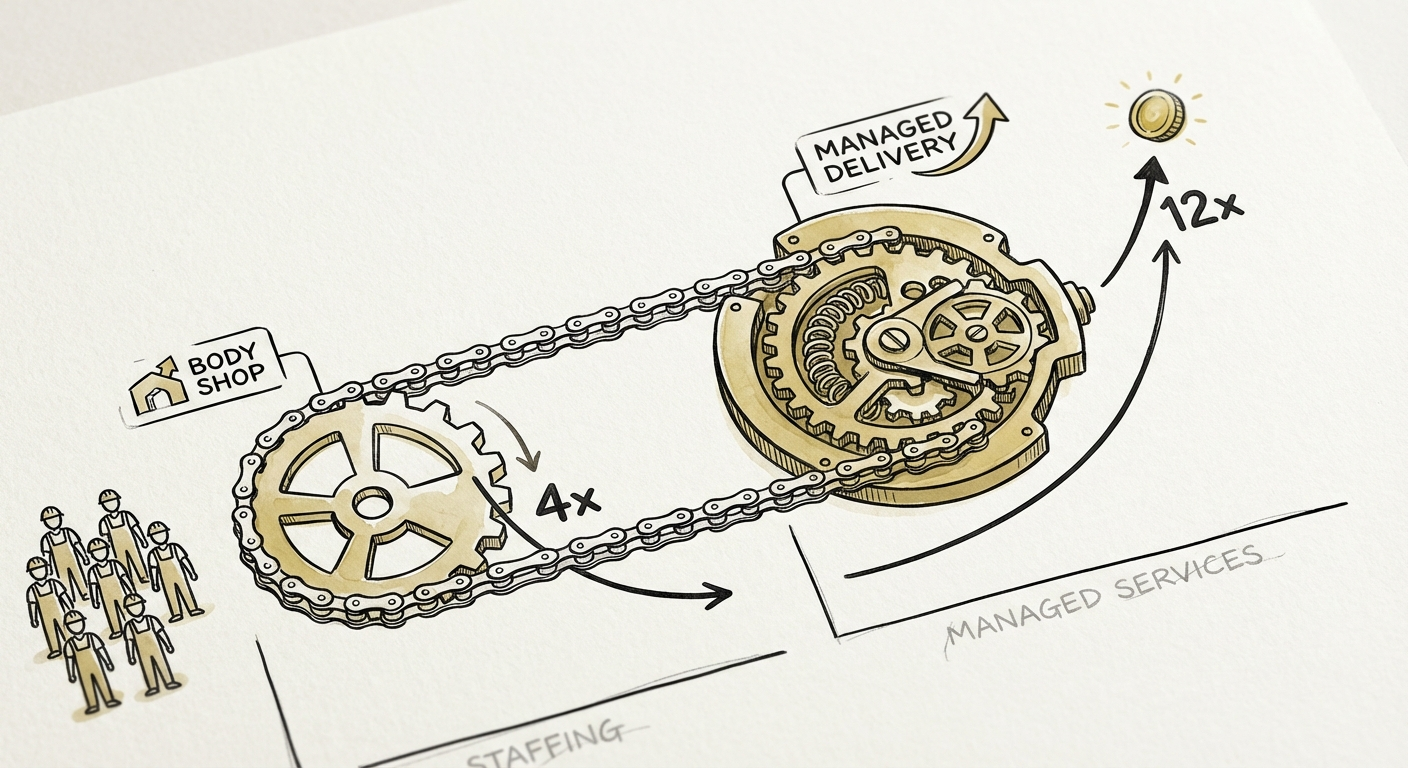
According to 2024 valuation data, pure-play staffing firms often trade at 0.5x to 0.6x revenue (or ~4x EBITDA). In contrast, tech-enabled Managed Services firms—those that sell outcomes rather than hours—routinely trade at 1.5x to 3x revenue (or 10x+ EBITDA). Same revenue, dramatically different enterprise value.
The difference isn't the talent. It's the process. In Staff Aug, the process lives in the individual's head. In Managed Delivery, the process lives in your company's IP. As long as you are selling resumes, you are building a low-margin, low-valuation business that relies entirely on your ability to out-hustle the churn.
Misalignment between delivery model and talent almost doubles the chance of missing ROI targets.
The Diagnostic: Are You Building a Firm or a Roster?
Most founders believe they offer "Consulting" or "Managed Services" when, in reality, they are selling bodies with a markup. To determine if your delivery model is scalable, look at your Revenue per Employee (RPE) and Gross Margins against industry benchmarks.
1. The Margin Ceiling
Data from SPI Research's 2025 Professional Services Maturity Benchmark reveals a stark contrast. The industry average for EBITDA margin dropped to 9.8% in 2025, dragged down by firms relying on low-leverage staffing models. High-maturity Managed Delivery firms, however, maintain EBITDA margins of 20-25%.
- Staff Augmentation: You pay a contractor $80/hr and bill them at $110/hr. Your Gross Margin is ~27%. It never improves because you cannot charge more without "better" people, who cost more.
- Managed Delivery: You charge $20,000/month for an outcome (e.g., "99.9% Uptime"). You deliver this using a mix of senior architects, junior staff, and automation. Your effective cost may be $10,000. Your Gross Margin is 50%+.
2. The Churn Tax
In Staff Augmentation, turnover is an existential threat. If your star engineer leaves, the revenue leaves with them. In Managed Delivery, the system provides the value. A tribal knowledge audit often reveals that 80% of your "value" walks out the door every evening. This creates a fragile revenue stream that acquirers discount heavily.
3. The Client Management Burden
Who manages the quality? In Staff Aug, the client manages the resource. If the work is bad, they blame the individual (and fire your firm). In Managed Delivery, you manage the result. This shifts the risk to you, but it also shifts the pricing power to you. As noted in The Valuation Gap, acquirers pay a premium for firms that own the delivery risk because it proves they have a replicable engine.
The Pivot: From Selling Resumes to Selling Systems
You cannot switch from Staff Aug to Managed Delivery overnight. The transition requires a deliberate "Productization" of your services. The goal is to move from "We have a great React developer" to "We have a React Modernization Playbook."
Step 1: Document Your "Secret Sauce"
Your best people are already doing Managed Delivery unconsciously—they have a way of working that gets results. Your job is to extract that. Use our Process Documentation Guide to capture the SOPs, templates, and decision trees your top performers use. This documentation becomes the product.
Step 2: Change the Contract Unit
Stop quoting hourly rates. Start quoting Monthly Recurring Revenue (MRR) for a set scope of work. Instead of: "40 hours of DevOps at $150/hr." Pitch: "Cloud Infrastructure Management: Includes 24/7 monitoring, weekly patch management, and CI/CD optimization. $8,500/month."
This decouples revenue from time. If you become twice as efficient via automation, your margins double. In Staff Aug, if you become twice as efficient, your revenue halves.
Step 3: Enforce Governance
Managed Delivery fails without strict governance. You need a "Delivery Lead" who is not billable but is responsible for ensuring the team follows the playbook. This overhead cost is an investment in scalability. It allows you to use more junior (less expensive) talent to execute the documented processes while the senior lead ensures quality.
The Verdict
If you want cash flow today, stick to Staff Augmentation. It is easier to sell and requires less operational maturity. But if you want enterprise value—an exit at 10x EBITDA instead of 4x—you must undertake the hard work of building a Managed Delivery engine. The market does not pay a premium for a roster of contractors; it pays for a machine that generates predictable outcomes.