If you are Scaling Sarah, you are likely obsessed with utilization. You have a dashboard showing 78% utilization and you feel safe. You shouldn't.
Utilization measures busyness, not value. In 2024, the tech consulting sector faced a brutal reality check. According to the 2025 SPI Professional Services Maturity Benchmark, average billable utilization dropped to 68.9%, dragging EBITDA margins down to a five-year low of 9.8%.
But here is the data point that should keep you awake: the average Revenue Per Employee (RPE) for billable consultants has plummeted to $199,000. If your firm is sitting near this average, you are running a low-margin staffing agency, not a premium consultancy. You are efficiently processing low-value work.
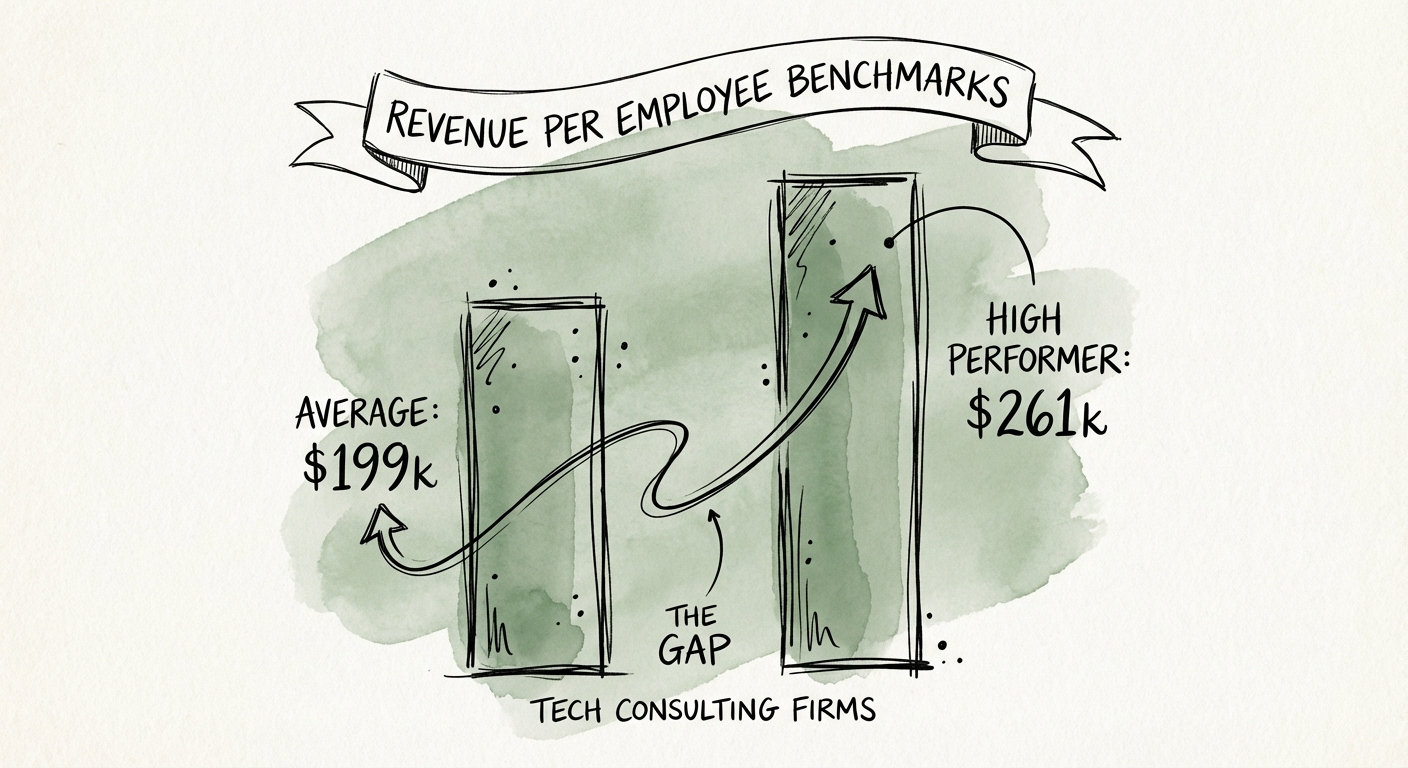
The difference between an average firm and a High-Performing Organization (HPO) is not subtle. It is mathematical. Research from Service Performance Insight (SPI) reveals that HPOs generate 31% higher revenue per billable consultant than their peers. When we apply this uplift to the 2024 average of $199k, the target for elite firms becomes clear: $261,000+ per employee.
Why the gap? It is not just higher bill rates. It is Revenue Leakage. High performers have 20% lower revenue leakage because they use integrated PSA (Professional Services Automation) tools to capture every billable minute and forecast accurately. They don't just work harder; they capture more of the value they create.
To move from $199k to $261k, you must shift your operational focus immediately.
Utilization is useless if you write off 15% of the hours. Calculate your Realized Rate (Revenue / Total Billable Hours). If this is below 85% of your standard rate card, you have a scoping problem, not a sales problem.
The SPI Research data is clear: firms with higher RPE often have lower distinct client counts per partner. They go deep with high-margin accounts and shed the noise.
Firms using AI-driven resource management see 10% higher billable utilization and 28% higher EBITDA. Stop using spreadsheets to guess who is available next month. Implementation of predictive tech is no longer optional; it is the primary driver of the efficiency gap.