
The practical answer
- Short answer
- A blown SLA didn't lose the account. The silence after the fix did. Here's the post-mortem a B2B founder sends in 48 hours to turn a churn threat into a renewal.
- Best fit
- Industry: B2B Tech/Services. Function: Operations
- Operating path
- Process Documentation → Operational Excellence → Transaction Execution Services
- Key metric
- 33% Increase in customer loyalty after a successfully resolved service failure (Harvard Business Review).
The fix was the easy part
Picture a 60-person B2B software company, post-Series B, with one logo that represents a fifth of ARR. On a Tuesday afternoon, a bad deploy takes that client's production integration down for nine hours. Engineering is heroic — root cause found, hotfix shipped, rollback procedure documented internally by 11 PM. The bug is dead.
Two weeks later the renewal stalls. Procurement goes quiet. The champion who used to reply in minutes now takes three days. Nobody on your team can point to a single thing you did wrong — you fixed it fast — and that is exactly the trap. The outage was a moment. The thing that lost you the account was the email you sent the next morning: "We've identified the issue and put measures in place to ensure it won't happen again." Confident, vague, and completely unfalsifiable.
A client who pays you six or seven figures does not read "measures in place" as reassurance. They read it as a vendor who handled the symptom and has no idea whether the disease comes back. The unsettling truth in B2B is that clients almost never churn over the failure itself. They churn over the suspicion that you got lucky catching it — that next time, you won't.
Why the recovered relationship beats the flawless one
There is a well-documented effect here. Harvard Business Review's research on service recovery found that customers who hit a failure and then receive an excellent resolution can end up roughly 33% more loyal than customers who never had a problem at all. That sounds backwards until you sit with it: a relationship that has never been tested is just an assumption. A relationship that broke and got rebuilt — visibly, with evidence — is a proven structure. Your client has now seen what happens when things go wrong, and the answer was "the system held."
But you do not unlock that 33% with an apology, and you definitely don't unlock it with "measures in place." You unlock it with a specific artifact built for the client to read, not for your engineers to file. Call it the Commercial Post-Mortem.
Clients rarely fire you for the outage. They fire you for the email that says "we've addressed it" and proves nothing. The fix buys you forgiveness; the document buys you the renewal.
What separates a Commercial Post-Mortem from an RCA
Your engineers already write a Root Cause Analysis. It identifies the broken line of code, the misconfigured queue, the missing retry. It is correct, and it is useless to a CFO weighing whether to re-sign. An RCA is written for the compiler. A Commercial Post-Mortem is written for the person who controls the budget — and the two have almost nothing in common in tone, content, or audience.
The version that actually saves a B2B account has three parts, and the order matters:
- The timeline, told against you. A minute-by-minute account of the incident with timestamps — including the parts that make you look bad ("17:40 — alert fired; 17:52 — on-call acknowledged but misdiagnosed; 18:30 — correct root cause identified"). The instinct is to compress the embarrassing middle. Don't. The unflinching timeline is what makes a guarded client lower their guard, because nobody fabricates a story that incriminates themselves.
- The process gap, not the person. "An engineer pushed an untested change" terrifies a client, because that engineer still works for you and will push again next quarter. "Our deploy pipeline had no staging gate for changes touching the third-party billing integration" reassures them, because a pipeline is a thing you can fix permanently. Name the systemic hole, never the human who fell through it.
- The lock — with proof it's already installed. Not "we plan to add validation." The actual screenshot of the new required staging check, the new alert threshold, the runbook line that now blocks that exact class of deploy. Past tense. Already shipped. This is the only paragraph the client truly weighs, because it's the only one that's about the future instead of the past.
The number that makes this a board-level conversation, not a support ticket
Founders treat a single account wobble as an operational annoyance. The math says otherwise. Bain & Company's retention research shows a 5% lift in retention can raise profits by 25% to 95%, while landing a new customer costs five to twenty-five times what it costs to keep one you already have. When that at-risk logo is a fifth of your ARR, a "hide it and quietly patch it" reflex is you betting the most expensive line on your P&L on the client simply forgetting. They won't. They'll just renew somewhere else when the contract lapses.
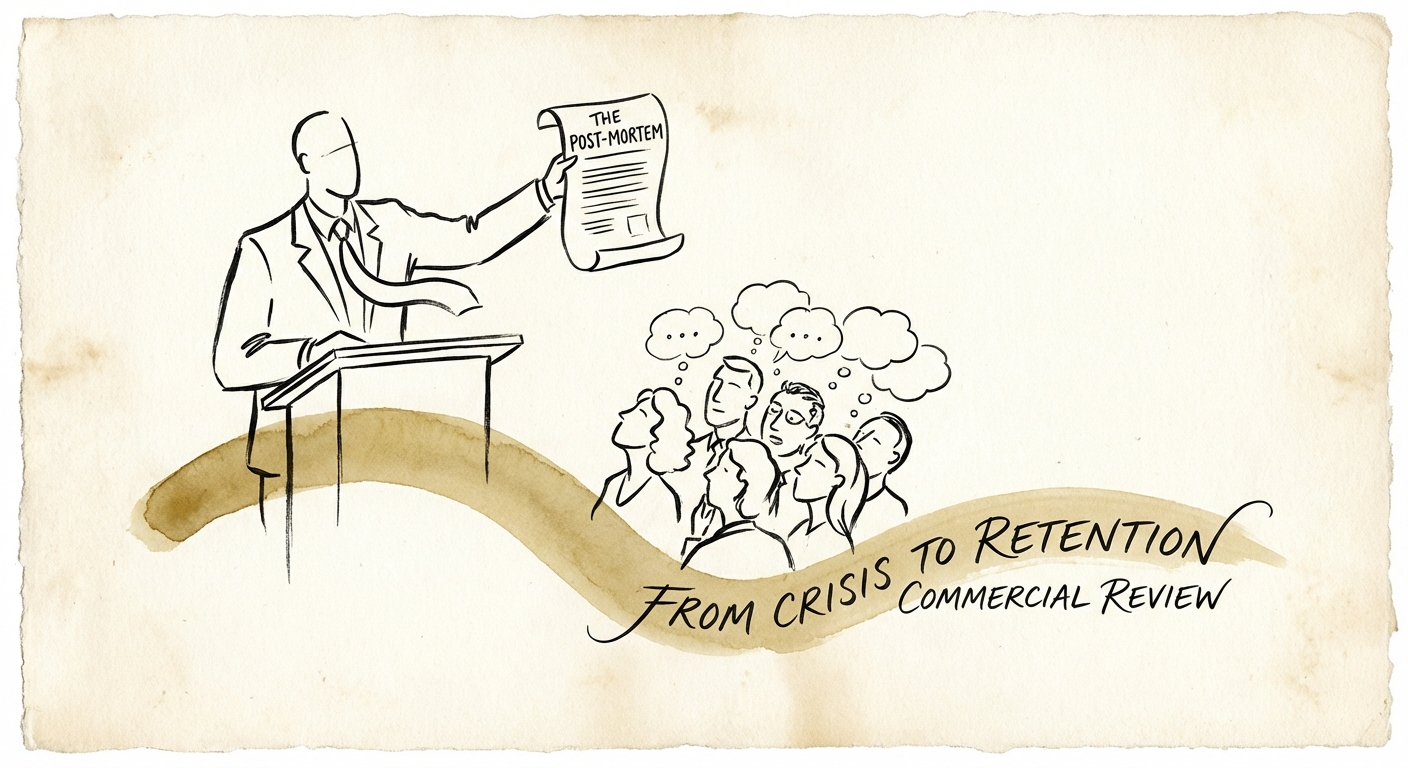
Don't email it. Walk them through it.
Here is the move most founders get wrong even when they write a good document: they attach the PDF to an email and hit send. That turns a trust-rebuilding artifact into one more thing in an inbox, skimmed for the word "credit" and forgotten. The document is the script, not the deliverable.
Book 30 minutes with the stakeholder who went quiet. Don't title it "Apology" or "Incident Follow-up" — title it "Process Correction Review," because the framing tells them you arrive as an operator, not a vendor groveling for forgiveness. Then walk the timeline live. Show the staging gate you added on screen. Let them ask "what about X?" and have the answer be another line already in the runbook. You are making one argument, out loud: we broke, here is precisely why, here is the system change that closes that failure mode, and the company you're renewing with is more reliable than the one you signed.
The window is shorter than you think
Speed is not a nice-to-have. Salesforce's research on customer expectations found the strong majority of customers will forgive a company a mistake when the recovery is excellent — but that goodwill decays fast, and every day of silence reads as either an excuse you're rehearsing or a problem you can't actually explain. Deliver the Commercial Post-Mortem within 48 hours of resolution. Sooner than 24 and it reads as a panic draft written before you understood the failure; later than 48 and it reads as a vendor stalling.
One more thing this buys you beyond the renewal: a reusable asset. Every incident you document this way becomes a piece of operational turnkey documentation instead of tribal memory living in your head — which is exactly the muscle a founder needs to build on the road to getting the business to run without them. And if the failure traced back to the seam between what sales sold and what delivery shipped, fix that seam too; that handover gap is where a disproportionate share of these incidents are born.
So here's your Monday move: pull your last real incident — the one you patched and never explained — and draft the three-part document for it now, before the next one forces you to. Own the failure on paper, prove the lock is installed, and present it across a desk. That's how a cancellation threat becomes a multi-year renewal.