
The practical answer
- Short answer
- Data shows some IT projects can put the company at risk. Learn the 3 specific exit signals that identify an unrecoverable project and the governance framework to exit gracefully.
- Best fit
- Industry: Enterprise Tech. Function: IT Strategy
- Operating path
- Project Recovery → Turnaround & Restructuring → Transaction Execution Services
- Key metric
- 17% of large IT projects threaten the company's existence (McKinsey)
The Mathematics of the Stalled Project
There is a specific moment in every failing enterprise implementation where the project stops being a technical initiative and becomes an organizational stalemate. The code is unstable, the integrators are still billing hourly, and the steering committee is reluctant to acknowledge that the $5M already spent may not produce a usable system.
As a CIO or VP of Engineering, you know the feeling. The status reports oscillate between "Green" and "Amber" for six months, despite no deployable code reaching production. You are not just fighting technical debt; you are fighting the Sunk Cost Fallacy. The cost of losing that fight can be material.
Research on large IT projects has found that a meaningful minority go badly enough to threaten the business. These are not just missed deadlines; they can become liquidity events. Yet leaders hesitate because ending a project feels like failure. In 2026, ending an unrecoverable project is an act of operational competence, not defeat.
The market is already shifting toward disciplined capital allocation. Gartner predicts that 30% of Generative AI projects will be abandoned after proof-of-concept by the end of 2025. These leaders are cutting losses to preserve EBITDA. If you are holding onto a 12-month ERP migration that is 18 months late, you may be tying up capital that could be used for higher-confidence initiatives.
The goal of this diagnostic is to give you an objective way to make that call. We will look at three exit signals and a governance framework to exit without turning the decision into a blame exercise.
Ending an unrecoverable project is not an admission of defeat. It is an act of rigorous capital allocation. You are trading a future $10M loss for a $2M write-off today.
The Diagnostic: Three Unignorable Exit Signals
Subjective optimism is the enemy of project recovery. Your Systems Integrator (SI) may say they are "one sprint away" from a breakthrough. Instead, look for these three hard data signals. If you see two or more, the project is likely unrecoverable in its current form.
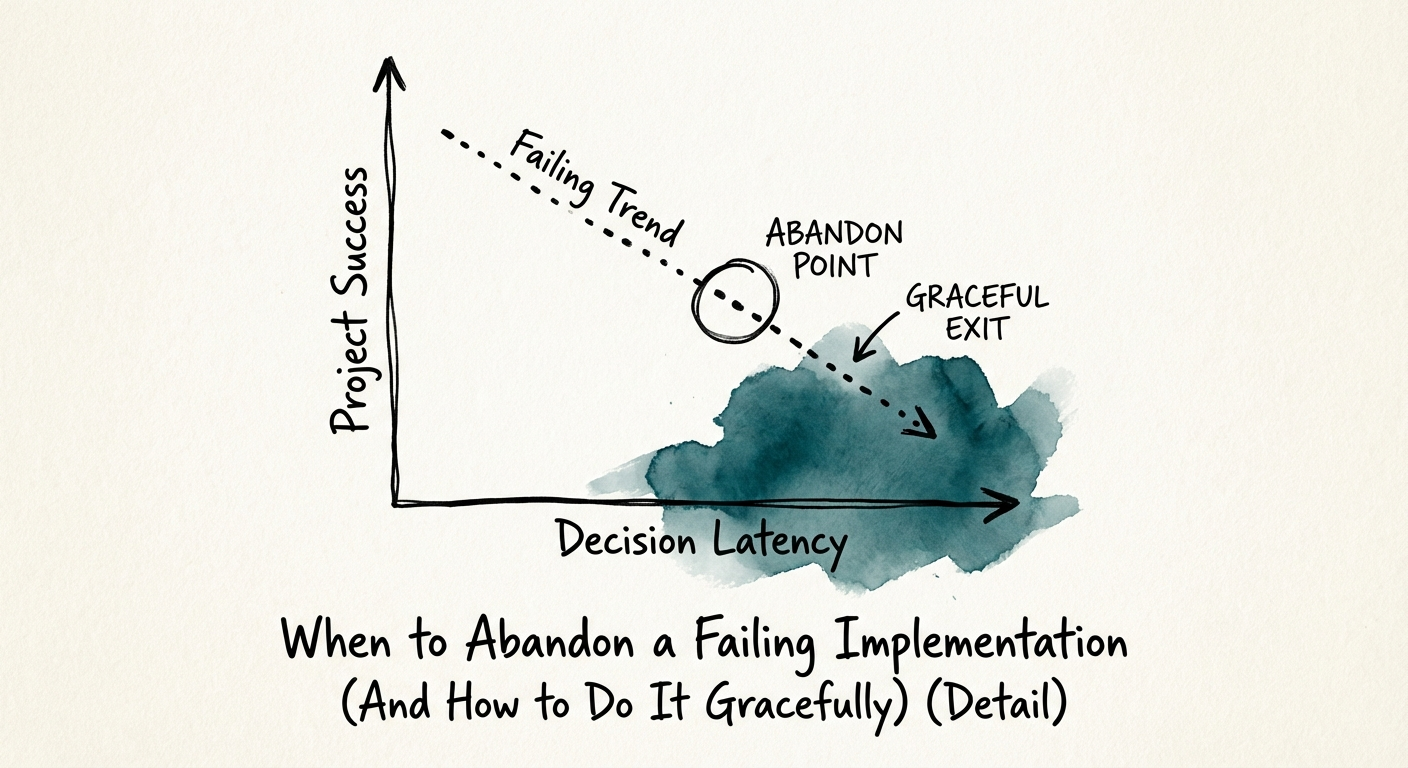
1. The Decision Latency Lag (>5 Hours)
Project velocity is a function of decision speed. When a project enters a failure pattern, stakeholders stop making decisions because they fear accountability. A study by ScrumInc and Plaky noted that when leadership decision latency drags from 1 hour to 5 hours, project success rates can fall materially. If your steering committee takes three weeks to approve a change order or API schema pivot, the governance layer has become part of the problem.
2. The Scope/Budget Divergence (>20%)
It is normal for scope to evolve. It is dangerous when scope expands while the budget remains fixed, or conversely, when the budget is burned without scope completion. If you have consumed 80% of your budget but have completed less than 60% of your requirements (verified by QA, not self-reported), you have a mathematical deficit. You cannot recover it without a major reset.
3. The "Green-Red" Oscillation
In healthy projects, status indicators move linearly: Red (blocked) → Yellow (mitigating) → Green (resolved). In failing projects, statuses flip-flop. A module is marked "Complete" in October, then "At Risk" in November due to integration failures. This indicates deep, systemic technical debt or a fundamental misunderstanding of the requirements. If the same milestone has been marked "Green" twice and "Red" twice, it is not under control.
The financial impact of ignoring these signals is significant. The Consortium for Information & Software Quality (CISQ) estimates that failed projects and poor software quality cost the U.S. economy $2.41 trillion annually. Your job is to keep your P&L from becoming part of that pattern.
The Graceful Exit: A 30-Day Triage Framework
You have identified the stop signals. Now, how do you pause the project without creating panic? The key is to reframe cancellation as a Strategic Pause & Audit. You are not reacting emotionally; you are creating evidence for the next decision.
Step 1: The Governance Freeze (Days 1-7)
Announce a 10-day governance freeze. Stop new development and limit contractor activity to stabilization work. The stated reason should be clear and businesslike: strategic realignment, budget re-forecasting, or verification of the delivery plan. This slows spend while preserving optionality.
Step 2: The Non-Technical Audit (Days 8-20)
Bring in a neutral third party, not the current SI, to conduct a governance and code audit. You need objective data to present to the board. The audit may show that the architecture was over-engineered, requirements were unstable, or dependencies were underfunded. The goal is not blame; it is a decision-ready fact base.
Step 3: The Pivot Proposal (Day 30)
Do not go to the board with only a cancellation. Present a pivot with clear options:
- Option A (Continue As Is): Continue the current path, including incremental budget, timeline, and confidence level.
- Option B (Strategic Pivot): Preserve the parts that work, retire the work that does not support the business case, and refocus resources on a smaller module that can produce value in 90 days.
By framing the decision this way, the board becomes a partner in the operating choice rather than an audience for bad news. This is how you escape committee deadlock.
Conclusion: ROI Is in the Stopping
Stopping a failing project can be the highest-ROI decision you make this quarter. It frees up your best engineers, slows unnecessary OpEx, and restores credibility with the business. The goal is not to defend sunk cost. The goal is to protect the next dollar of investment.