The practical answer
- Short answer
- CTO turnover is 18%, higher than any other C-suite role. Here is the 48-hour crisis protocol to secure IP, stabilize engineering, and prevent a $1.2M mis-hire.
- Best fit
- Industry: B2B SaaS. Function: Engineering Leadership
- Operating path
- Team & Hiring → Operational Excellence → Transaction Execution Services
- Key metric
- 18% CTO Turnover Rate (Higher than any other C-Suite Role)
The Monday Morning Heart Attack
It’s 9:00 AM. Your CTO, the person who built your MVP, holds the keys to your AWS root account, and knows where every skeleton is buried in the code, just handed you a resignation letter.
You are not alone. CTO turnover is currently sitting at 18%, significantly higher than the 13% average for other C-suite executives. For a founder like you, this feels less like a personnel change and more like a structural failure. You rely on them to translate your vision into product velocity. Without them, you fear the roadmap will grind to a halt.
But the immediate danger isn't a stalled roadmap. It’s security and continuity. 33% of organizations take more than 24 hours to fully offboard an ex-employee, a delay that leaves a massive window for data exfiltration or malicious damage. When that employee is a super-admin with unchecked privileges, the risk profile is existential.
Panic leads to two mistakes: rushing to counter-offer (which rarely works for long) or rushing to hire a replacement (which is expensive). Your priority right now is not the long-term replacement. It is the 48-Hour Stabilization Protocol. You need to stop the bleeding before you can perform surgery.
We didn't think we needed a search partner until the wrong hire cost us 9 months of momentum and nearly $1.2M in lost opportunity.
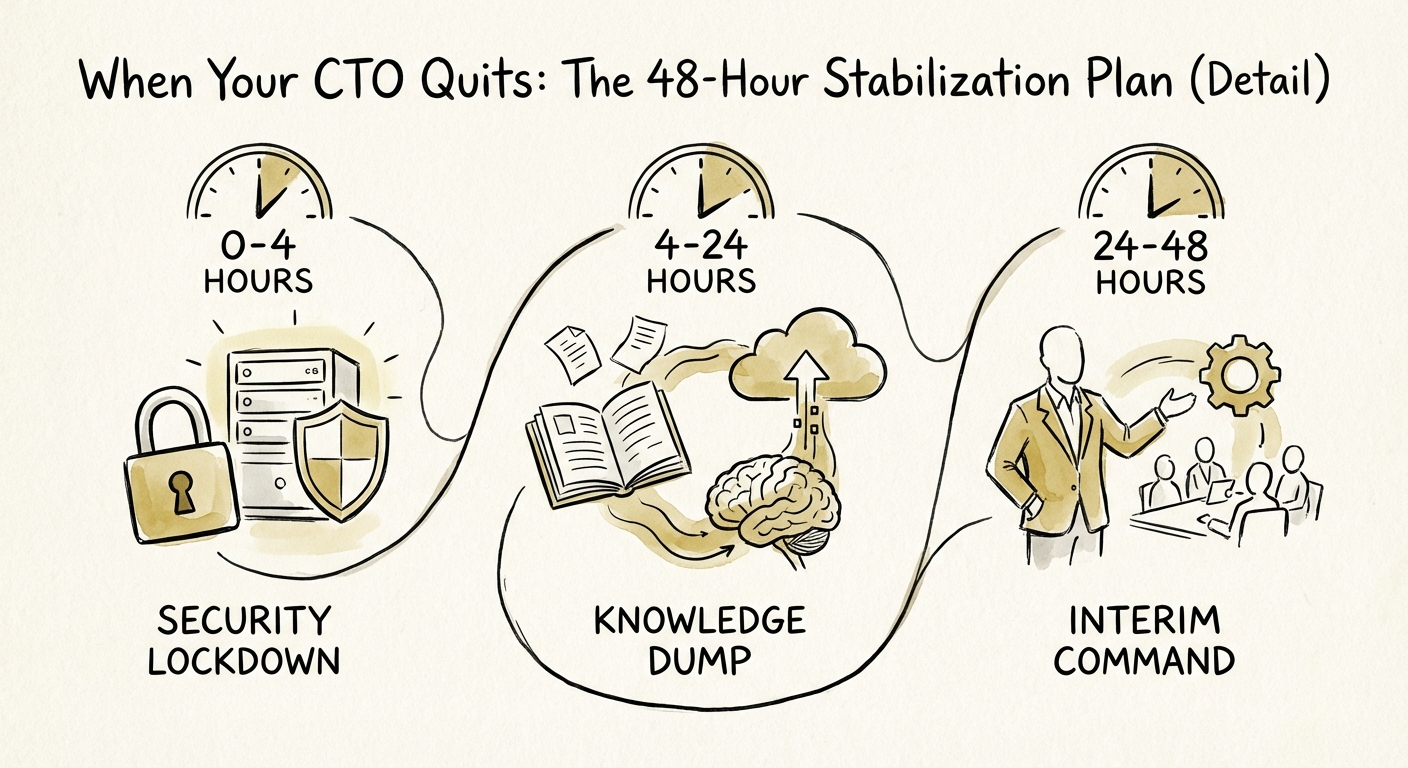
The 48-Hour Stabilization Protocol
Phase 1: The Security Lockdown (Hours 0-4)
Before you announce the departure to the team, you must secure the perimeter. This is not about mistrust; it is about fiduciary duty. 97% of executives access work accounts on personal devices, meaning your IP is walking out the door in their pocket.
- Rotate the "Keys to the Kingdom": Immediately rotate root passwords for AWS/Azure, database admin credentials, and domain registrars. Do not wait for the exit interview.
- Audit Third-Party Access: Revoke OAuth tokens for GitHub, CircleCI, and deployment pipelines. A forgotten API key is a backdoor waiting to stay open.
- Device Quarantine: If you use MDM (Mobile Device Management), initiate a selective wipe of corporate data on personal devices.
Phase 2: The Knowledge Dump (Hours 4-24)
Once access is secured (but while they are still cooperative during the notice period), you shift to extraction. Do not ask for generic "documentation." You need a Founder Extraction style download of operational reality.
Ask these three specific questions:
- "What manual process do you personally run that will break if you don't do it next week?" (e.g., renewing SSL certificates, approving payroll runs).
- "Who is the 'Shadow CTO'?" Identify the lead engineer who actually answers the team's technical questions.
- "Where are the unmitigated security risks?" Demand a list of the technical debt that keeps them up at night.
Phase 3: The Interim Lieutenant (Hours 24-48)
You cannot effectively lead an engineering team while running the company. You need a "Wartime Lieutenant." This is usually your VP of Engineering or your most senior Staff Engineer. Do not give them the interim CTO title immediately. Instead, give them the mandate of "Stabilization Lead."
Their sole OKR for the next 30 days is: Maintain ship velocity and zero downtime. This buys you the breathing room to avoid a panicked hire.
The Recovery: Don't Rush the Replacement
The most dangerous decision you can make right now is to hire the first resume that looks good. A typical executive search for a CTO takes 8 to 16 weeks. Rushing this process leads to disaster. Data shows that the cost of a bad C-suite hire is approximately 213% of their annual salary—and when you factor in lost momentum and broken product cycles, the impact can exceed $1.2M.
The Interim Option
This is why 72% of CEOs plan to increase their use of fractional or interim executives in the coming year. An interim CTO allows you to:
- Audit the code and team without political baggage.
- Keep the lights on while you search for the perfect long-term fit.
- Avoid the "rebound relationship" where you hire a CTO who is just a clone of the previous one, rather than what the company needs for its next stage.
Turn Crisis into Opportunity
A CTO departure is often a blessing in disguise. It reveals the hidden costs of tribal knowledge and forces you to build systems that survive key people. Use this transition to professionalize your engineering operations.
If you are staring down a resignation letter today, stop worrying about the roadmap for next year. execute the 48-hour plan. Secure the assets. Stabilize the team. Then, and only then, go find the leader who will take you to Series C.