
The practical answer
- Short answer
- The average Series B VP of Sales lasts 18 months. The cause is rarely competence — it's stage mismatch. Here's the diagnostic and the scorecard to hire the right one.
- Best fit
- Industry: B2B Tech. Function: Sales
- Operating path
- Founder Extraction → Operational Excellence → Interim Management
- Key metric
- 18 Months Average tenure of a VP of Sales in high-growth tech firms.
Month 14: The Board Deck Where Everyone Already Knows
The number on the slide says $4.1M against a $10M plan. Nobody in the room is surprised. Your VP of Sales — the one you pulled out of a company twenty times your size, the one whose LinkedIn made your investors nod — is walking the board through "pipeline coverage" and "ramp curves" with the calm of someone who has given this exact presentation before, at a company that actually had the systems to back it up. You hired the deck. You did not hire the person who can build the thing the deck describes.
Four months later you let them go. And here is the part that should keep you up at night: you'll probably do it again, because you'll diagnose the failure as "wrong person" when it was actually "wrong stage."
The data backs the pattern. The average tenure of a VP of Sales at a Series B/C company has compressed to 18 to 19 months — barely longer than the ramp time you needed them to fix. The replacement cost runs an estimated 213% of annual salary in hard dollars. But for a revenue leader, the hard dollars are the rounding error. The real bill is the lost year: a plan that called for $10M in net-new ARR and delivered $4M. Run that $6M miss through your revenue multiple and the single lost year erased somewhere between $30M and $60M in enterprise value — more than the entire cost of every sales hire you'll ever make.
The Logo Trap
The most common way founders detonate this hire is what I call the Logo Trap: you recruit for the company name on the résumé instead of the operating stage in front of them. The VP who ran a 200-rep org inside a $500M machine did not build that machine — they inherited it. They walked into a loaded marketing funnel, a real RevOps team, a brand prospects recognized, and a comp plan someone else had already debugged across three fiscal years. You're handing them a 14-rep team, an inbound number close to zero, a CRM that's half opinion and half wishful thinking, and a brand your mother has heard of. They don't freeze because they're weak. They freeze because the job they're good at does not exist at your company yet. This is the quiet killer inside most founder-led sales transitions.
A VP of Sales is not a closer you rent. They are an architect you hire to build a revenue machine that runs when you leave the room.
Four Sales Leaders, And You Only Need One of Them Right Now
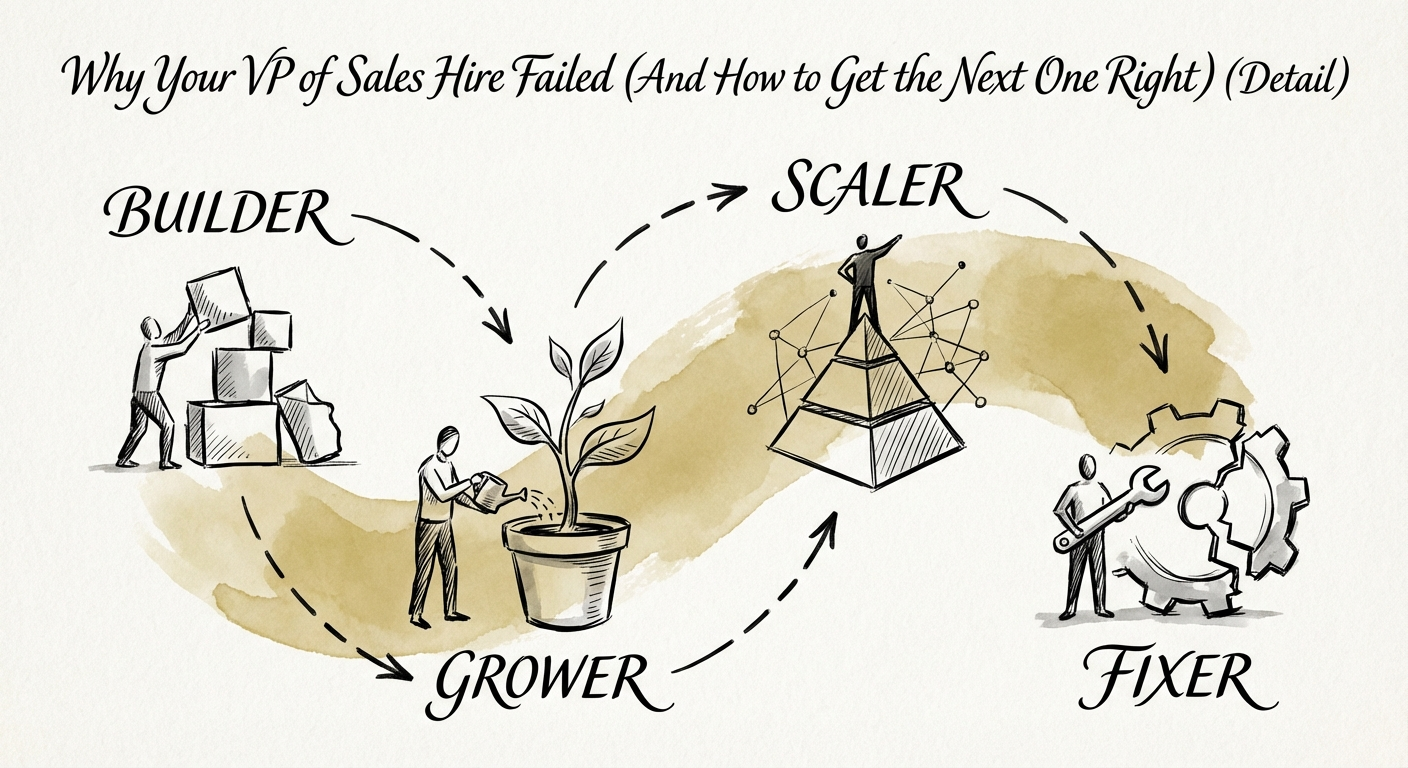
Stop the revolving door by diagnosing the type of leader your stage demands before you write a single line of the job spec. In the stalled sales orgs I've gone in to repair, the leaders sort cleanly into four archetypes — and hiring across the boundary is what burns the quarters.
- The Builder (roughly $0–10M ARR). Still carries a bag. Writes the first playbook on a whiteboard, not a dashboard. Thrives in ambiguity and hires their first three reps personally. Drop a corporate executive into this seat and watch them wait for a system that isn't coming.
- The Grower (roughly $10–50M ARR). The seat where Series B founders most often guess wrong. The Builder has hit the ceiling of what one person can sell. Now you need someone to install a real methodology, build the first layer of front-line managers, and turn heroics into a repeatable process — without strangling the deals already in flight.
- The Scaler ($50–200M ARR). Manages managers. Master of territory carving, comp design, and board optics. The exact profile most Series B founders over-hire — brilliant at running a machine, lost when asked to build one from a CRM full of duplicate contacts.
- The Fixer (distressed). Comes in to reset: cut territories, exit underperformers, restructure for cash. The right call when you're defending runway, the wrong one when you're trying to grow.
The Glorified AE You Promoted Out of Fear
The second failure mode never shows up as a bad hire because it walks in the door already employed. Your top rep — the one whose departure would torpedo the quarter — gets the VP title because you're terrified of losing them. Six months in, the team hasn't grown, the forecast is still vibes, and you've quietly let gut-feel hiring and a missing process bleed straight into margin.
The mechanism is predictable. A rep asks for help on a stuck deal; the Glorified AE says "move over, I'll close it." Every closed deal proves the title was deserved and guarantees nobody else learns to close without them. You haven't hired a leader. You've capped your sales team's output at one person's calendar.
The Real Reason They Fail — And Why You See It Late
Sales leaders rarely crater over the product. They crater over missing structured leadership skill and situational mismatch — and the scoreboard hides it. You judge them on the lagging number (revenue) while the leading indicators that actually predict the miss — hiring velocity, time-to-ramp, pipeline hygiene — degrade in plain sight for two full quarters. By the time the ARR slide turns red, the failure already happened in the spring. You're just reading the receipt in the fall.
The Scorecard That Gets It Right 92% of the Time
Treat this hire like an engineering project, not a chemistry experiment. The reason "gut feel" fails on sales leaders specifically is that the best ones are professional interviewers — selling is the job, and you are the prospect. Here's the process we install at portfolio companies to push hiring accuracy toward 92%.
1. Write the outcomes, not the title
Delete the generic job description. Replace it with five concrete outcomes for the first 12 months, each measurable: "Hire and fully ramp 6 AEs," "Convert founder-led selling into a documented playbook the team can run without me," "Tighten forecast accuracy to within ±10%." If a candidate can't point to a time they did these specific things at your stage, the résumé logo is irrelevant. It's a pass.
2. Run a mock board meeting before the offer
Never hire a revenue leader off conversation alone — you'll just measure how well they sell themselves. Hand finalists real, anonymized data from your CRM and give them 30 minutes to present it as if to your board. Then watch what they reach for. Do they surface the forecast holes and ask about lead velocity and ramp? Or do they paper over thin data with buzzword slides? This single exercise tends to eliminate the half of candidates who interview beautifully and think shallowly.
3. Back-channel the references they didn't give you
Candidate-supplied references are friends performing a favor. Useless. Go find a rep who reported to them two or three years ago and ask two questions: "When a deal was stuck, did they help you close it or just ask for an update?" and "Would you work for them again tomorrow?" Anything short of an immediate, unforced "yes" is a no.
The One Reframe That Breaks the Cycle
Founders hire for the problem they have today — deals that need closing — when they should hire for the problem they'll have in nine months: onboarding, ramp, territory design, manager bench. The right VP of Sales is not a hero you bring in to rescue the number. They're an architect who builds a machine that hits the number after you've stopped watching. Run the stage diagnostic, then run the scorecard. Stop renting closers and start hiring the person who makes closers unnecessary to you specifically.