
The practical answer
- Short answer
- New 2025 data reveals 74% of target codebases contain high-risk vulnerabilities. See the actual benchmarks PE firms use to price technical debt.
- Best fit
- Industry: Private Equity. Function: Technology
- Operating path
- Technical Debt → Turnaround & Restructuring → Transaction Advisory Services
- Key metric
- 74% Codebases containing high-risk open source vulnerabilities (Synopsys)
The Era of "Check-the-Box" Tech Diligence Is Over
For the last decade, technology due diligence in the lower middle market was often a formality. You hired a third-party firm, they ran a few automated scans, interviewed the CTO for an hour, and handed you a Red/Yellow/Green report that was almost always mostly Green.
That playbook is now a liability. In 2025, the gap between perceived technical health and actual code quality has become a valuation killer.
We are seeing a fundamental shift in how sponsors view technical assets. It is no longer just about "Will it scale?" It is about "How much will it cost to fix what they built?" The data is alarming: 70% of technology investments now fail to hit value creation targets due to technical issues that were discoverable during diligence.
If you are an Operating Partner inheriting a new portfolio company today, you aren't just buying revenue. You are buying their technical debt, their open-source liabilities, and their security shortcuts. And if you didn't price that into the LOI, that debt is coming out of your EBITDA.
The Hidden Cost of "Good Enough" Code
Founders are incentivized to move fast. They trade long-term stability for short-term features. This is rational for them, but high-risk for you. When you acquire a firm where 91% of components are more than 10 versions out of date, you aren't acquiring a platform; you're acquiring a remediation project.
We recently saw a deal where the target had $15M in ARR and a "modern" stack. Diligence revealed that skipping a deep code audit would have cost the sponsor $4M in immediate re-platforming costs post-close. That's not a technical detail; that's a 4x EBITDA hit.
If you are an Operating Partner inheriting a new portfolio company today, you aren't just buying revenue. You are buying their technical debt.
The 2025 Due Diligence Benchmarks
Stop relying on the CTO's word. You need to benchmark your target against market realities. Based on data from over 1,000 commercial codebases audited in late 2024 and 2025, here is what "normal" looks like—and what should trigger a re-trade.
1. Open Source Risk is Exploding
The reliance on open source is absolute, but the management of it is negligent. According to the 2024 Open Source Security and Risk Analysis Report by Synopsys, the density of risk has hit critical mass:
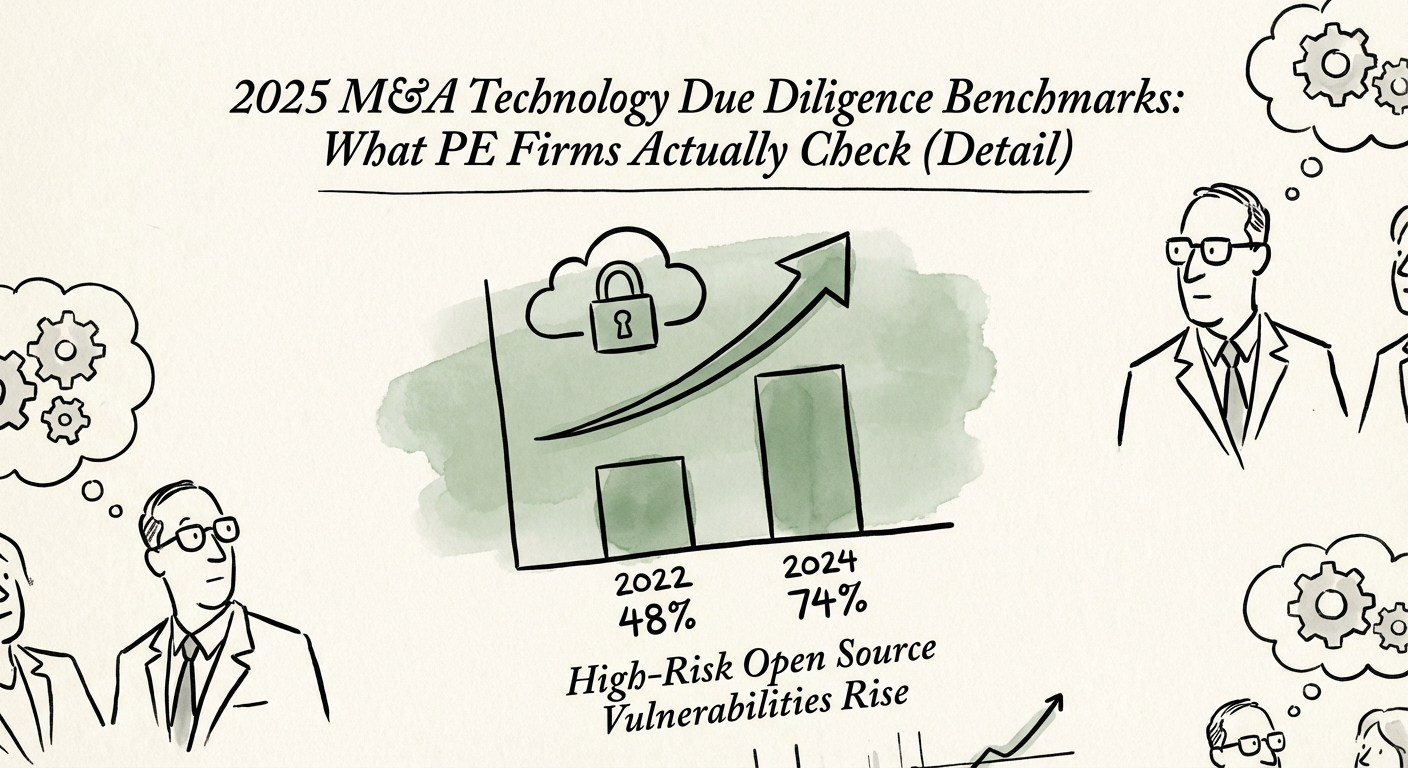
- 74% of codebases contain high-risk vulnerabilities (up from 48% just two years prior).
- 84% of codebases contain at least one known vulnerability.
- 53% of codebases contain license conflicts that threaten IP ownership.
The Takeaway: If your diligence report doesn't explicitly list high-risk CVEs and license conflicts, it's incomplete. You must assume every target has significant exposure until proven otherwise.
2. The "Stale Code" Problem
Software requires maintenance. Yet, benchmarks show that 49% of codebases contain components that have seen no development activity in the past two years. This is "stale code"—abandoned by the community, unpatched, and rotting inside your product. Bringing this up to modern security standards is not a maintenance task; it's a migration project.
3. The Remediation Multiplier
Why does this matter to the deal model? Because fixing it post-close is exponentially more expensive. Industry data suggests the cost of technical debt remediation post-investment is 3-5x higher than if identified pre-investment. If you find $500k of tech debt in diligence, you can deduct it from the purchase price. If you find it six months later, it costs you $1.5M-$2.5M in lost velocity and consulting fees to fix.
We advise sponsors to use quantifiable technical debt assessments to adjust valuations. "We need to rewrite the billing module" is an opinion. "The billing module relies on a library deprecated in 2019 with 12 critical vulnerabilities" is a negotiation lever.
The New Standard for Operator-Led Diligence
You cannot rely on financial engineering to generate returns in this vintage. You must apply operational engineering from Day 0. Here is the revised playbook for 2025.
1. Demand a "Bill of Materials" Before the LOI
Do not wait for the exclusive window. Request a Software Bill of Materials (SBOM) early. If they can't produce one, that is your first red flag. It implies they don't know what is in their own software.
2. Price the Fix, Not Just the Risk
Don't just list risks. Quantify the remediation timeline. If a target requires a major security overhaul to be compliant with 2025 cybersecurity standards, build that timeline into your 100-day plan. If it takes 6 months to fix the security debt, your roadmap is frozen for 6 months. Adjust your growth projections accordingly.
3. Validate the "Key Person Dependency"
Tech debt often lives in the head of one founding engineer. With 70% of deal failures linked to tech issues, a key driver is often the departure of the one person who knew how the legacy spaghetti code worked. Diligence must include a "Key Person Dependency" map. If the CTO leaves the day after the check clears, does the platform grind to a halt?
Conclusion: Diligence is Defense
In 2025, technical diligence is the strongest defensive moat you have against margin erosion. The benchmarks are clear: the average target is technically distressed. Your job is not to avoid these companies, but to price them accurately.
When you speak fluent EBITDA and fluent DevOps, you stop buying other people's problems at a premium. You start buying fixable assets at a discount.