
The practical answer
- Short answer
- Project shops clear ~1.3x revenue; firms with recurring revenue and no founder dependency hit 2.5x. Seven checks that separate a real exit from a fire sale.
- Best fit
- Industry: Professional Services. Function: Operations
- Operating path
- Exit Readiness → Operational Excellence → Transaction Advisory Services
- Key metric
- 2.5x Revenue Multiple for Recurring vs. 1.3x for Project Firms
Two firms, same revenue, twice the price
Picture two professional services firms across the table from the same buyer. Both bill around $14M a year. Both are profitable. One owner walks away with an offer at roughly 1.3x revenue, loaded with a three-year earnout. The other clears north of 2.5x, mostly in cash at close. Same top line, very different life.
The difference isn't talent or even growth rate. It's what the buyer thinks happens the morning after the wire clears. In the first firm, the founder still scopes the big engagements, the margin lives in their head, and the renewal pipeline is "a lot of good conversations." In the second, the founder could miss a quarter and nobody would notice. One is a company. The other is a very well-paid job with payroll attached.
That spread is real, not rhetorical. First Page Sage's 2025 service-company multiple data shows productized, recurring-revenue services firms trading well into the double digits on EBITDA while traditional expert-for-hire shops scrape the bottom of the range — often with chunks of the price deferred until you prove the revenue sticks.
I've sat in on more than fifty diligence processes in the last two years. The buyer is never asking "is this firm good?" They're asking "what survives the founder leaving?" Below are the seven things they actually check before they decide whether you own a system or just a really demanding client list. Score yourself honestly — 7-for-7 means call a banker, under 4 means you have a year of high-return homework before you list.
The gap between a 4x and a 12x exit isn't usually revenue growth. It's transferability. If I can't hand the keys to a new operator without the engine stalling, I'm not buying the car.
The four signs a buyer checks before they fall in love
1. No single client can blow up the deal
Landing a whale feels like winning. At exit it reads as a fuse. Focus Investment Banking documents how concentration above roughly 30% of revenue routinely triggers a 20-35% valuation haircut — and sometimes kills the deal entirely. The buyer's logic is cold: if that account churns post-close, the debt covenants they used to finance you break, and they own a smoking crater. Run the math today. If your top client is north of 15% of revenue, or your top five clear 40%, that's the first thing diligence flags. Start deliberately diluting it now; you can't fix concentration in the 60 days before a sale.
2. Your revenue doesn't reset to zero every January
Ask yourself the ugly question: on January 1, how much of this year's revenue is already contracted? If the answer is "we go re-sell it," you're a project shop, and project shops trade around 1.0x to 1.4x revenue. Firms with embedded retainers, managed-services tiers, or subscription-like delivery command roughly 2.3x to 2.5x revenue instead — the premium buyers pay for predictability over a forecast that's really a hope. You don't need to become a SaaS company. You need a contracted base a buyer can underwrite. Converting even a third of your project work to recurring retainers can re-rate the whole firm. See how to trade $1 of project revenue for $5 of enterprise value.
3. You've already fired yourself from delivery
Here's how this one actually dies. The buyer's team interviews your second layer — your VPs and senior PMs — without you in the room. They ask, "Who signs off on a proposal over $200K?" If three people independently say "we run it by the founder first," the deal is done, regardless of your numbers. They've just learned the firm is you. The fix isn't a title chart; it's evidence. Pull yourself off your two largest accounts for a full quarter before anyone does diligence, and let your bench show it can hold the relationship and the margin without you.
4. Your delivery lives in documents, not in people's heads
When a buyer asks for your "playbook," they don't want the HR handbook. They want the standard operating procedure for the work itself: how you onboard a client, how you scope, how you price a change order, how a new hire reaches billable competence. If Project Manager A does it one way and Project Manager B another, you've told the buyer your margin is a personality trait, not a process — and personalities don't transfer in an asset sale. Documented delivery is the proof that your gross margin holds as headcount doubles. It's also why acquirers pay a premium for documented processes.
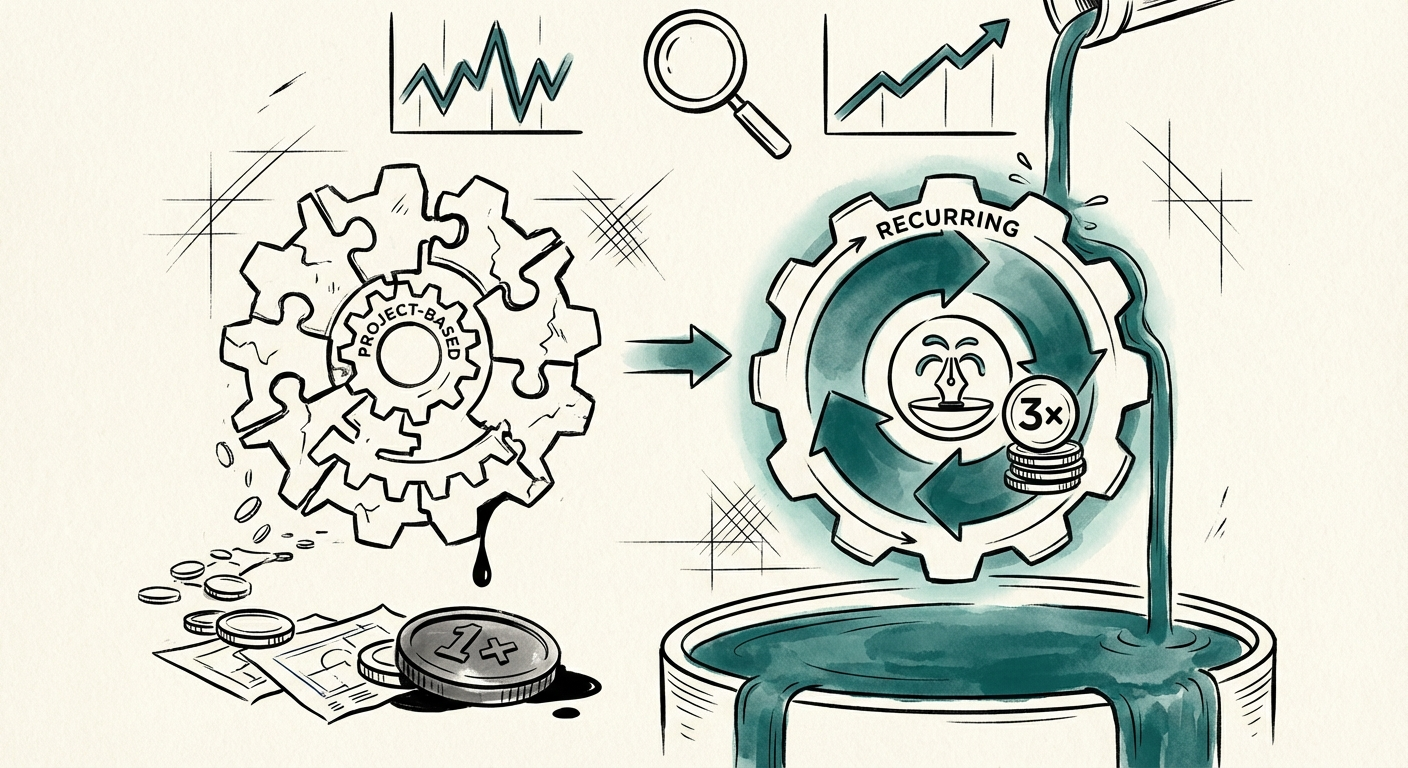
The three signs a buyer checks before they sign
5. Your books survive a Quality of Earnings teardown
Nothing kills a deal faster than a QofE report that quietly shaves a chunk off your EBITDA in the final weeks. The usual culprits in services firms: the founder's car and "consulting" travel run through the P&L, and cash-basis accounting that lets you book a project payment in the month the check landed instead of the month you did the work. Buyers expect accrual financials that match revenue to the period it was earned. Get to clean accrual statements at least a year before you list — re-traded EBITDA at the eleventh hour is how a 2.5x becomes a 1.8x.
6. You know your margin per client, not just your total
Founders quote total revenue. Buyers price gross margin and utilization. A firm doing $20M at 35% gross margin is worth meaningfully less than one doing $15M at 55%, because the second one keeps more of every dollar and proves its delivery model works. You need margin per project, per client, and per consultant — and you need to know which "prestige" logos you're actually subsidizing with your profitable accounts. The buyer's analyst will find the loss-makers in week two of diligence and simply delete their revenue from the model. Better you find them first and either reprice or fire them.
7. Your pipeline is arithmetic, not optimism
"We've got a strong quarter coming" is not a pipeline a buyer can value. "We have $9M in late-stage opportunities, and over the last twelve months our close rate from that stage is 41%" — that's a forecast capital can underwrite. The discipline of stage-weighting your pipeline against your own historical conversion turns your growth story from a gamble into an asset. If you can speak in those numbers, you've already separated yourself from most of the firms a buyer sees.
Where you actually stand
Tally it. Seven of seven, you're in rare air — call your banker and run a process. Four to six, you're sellable but leaving real money on the table; pick the lowest-scoring sign and attack it this quarter. Under four, don't list yet — every concentration point you trim, every process you document, every cash-basis habit you kill compounds straight into enterprise value, and that work pays far better per hour than the work that's currently keeping you busy.
The goal was never to build something you can sell. It's to build something a competent operator would be reckless not to buy. When you're ready to map the full sequence, work through our PE exit-readiness assessment.