
The practical answer
- Short answer
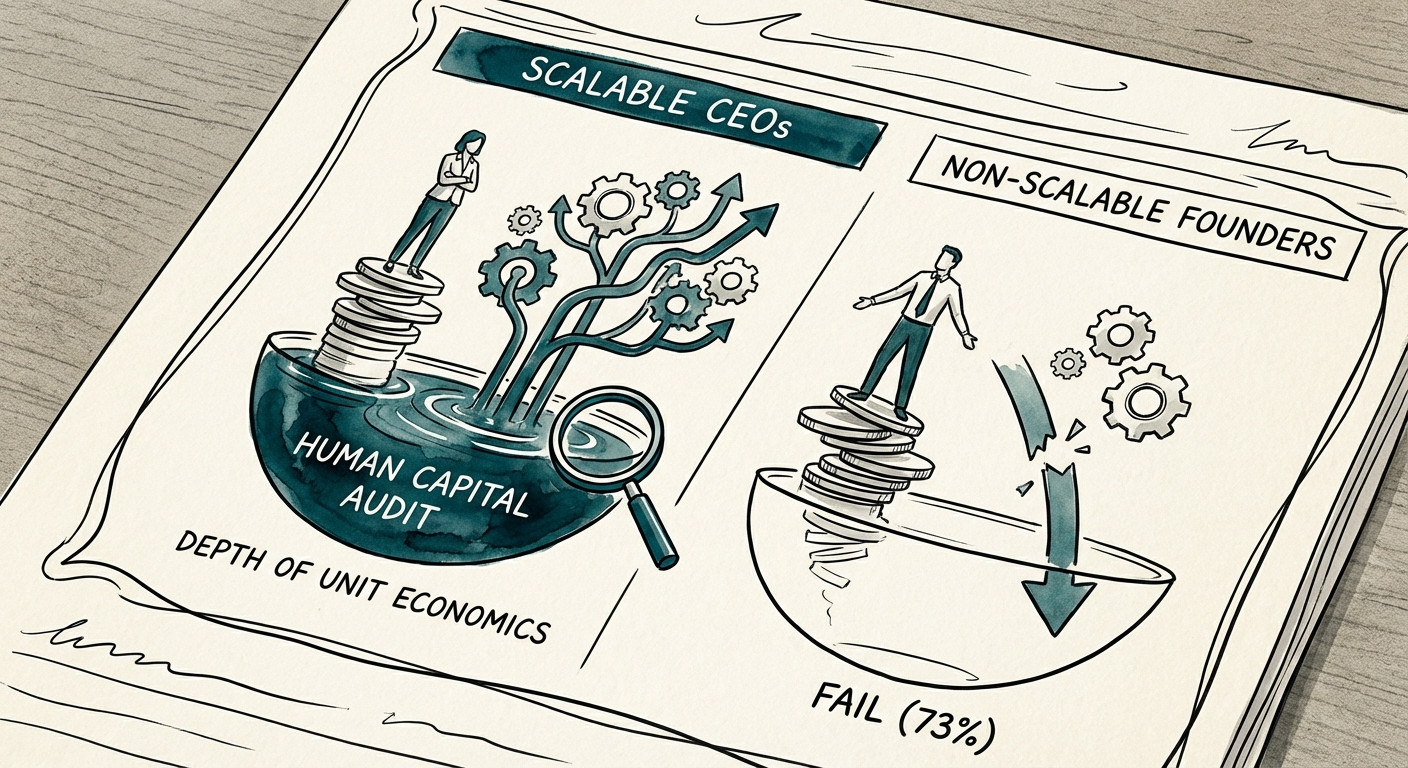
- 73% of portfolio CEOs get replaced during the hold. Here is the 5-day capability audit that runs alongside your QoE and tells you who scales before you sign.
- Best fit
- Industry: Private Equity. Function: Human Capital
- Operating path
- Team & Hiring → Operational Excellence → Transaction Execution Services
- Key metric
- 67% Of Returns Attributed to Management Quality
You will spend 400 hours on Quality of Earnings and 90 minutes on the people running the company
Think about how a typical deal allocates diligence attention. The QoE gets a team and a deadline. Legal gets a data room and a checklist. Tech gets a vendor and a scorecard. And the management team — the variable that actually decides whether the model happens — gets two dinners, a polished management presentation, and a partner saying "I like them, they get it" on the drive home.
The math punishes that asymmetry. AlixPartners' 2025 leadership survey found that roughly 73% of portfolio company CEOs are replaced during the hold period, and about 58% of those exits happen inside the first two years. A CEO swap is not a personnel line item — it freezes value creation for six to nine months while the new hire learns the business, relitigates the strategy, and rebuilds the bench they trust. If your thesis leans on multiple expansion, a stalled year isn't a setback. It's the difference between the deal you underwrote and a recap.
The uncomfortable part is that the dinner usually goes great. Founders who got a company to $20M in revenue are, almost by definition, persuasive in a room. Catalysis Advisory's 2025 work on mid-market deals calls the standard people-check a "comforting delusion" precisely because likability is the one trait the founder has already optimized for — it tells you nothing about whether they can run the business at the next size. When FMG Leading and HBR pin the majority of value-creation outcomes on leadership quality, they are describing the single input most firms refuse to underwrite with the same rigor as a working-capital adjustment. So stop assessing whether you'd hire this person as a dinner companion. Start auditing whether they can run the math.
Financial diligence tells you what the asset is worth. Management diligence tells you whether anyone in the building can go get it.
Five days, four tests, run alongside the QoE — not after it
This isn't a personality inventory. You don't need to know if the CEO is an introvert. You need to know whether they can take revenue from $20M to $50M without the unit economics quietly inverting. Here are four tests you can run inside the diligence window, each designed to surface a specific failure mode that the management presentation is built to hide.
Day 1 — Make them whiteboard their own machine
Close the deck. Hand the CEO a marker and ask them to draw their unit economics from acquisition cost to contribution margin, by channel. The tell isn't whether they get it perfect — it's where their eyes go. A CEO who turns to the CFO when you ask for CAC payback by channel, or who can't say what the last release did to gross margin, is selling a vision they don't operate. That gap becomes a mis-hire the day growth requires a decision they don't have the numbers for.
Day 2 — Audit who they hired, not who they are
A-players recruit people who outclass them; insecure operators recruit people who won't threaten them. Pull the org chart and the LinkedIn histories of the last five senior hires. Are these up-levelers who've already done the job one size bigger, or is the VP of Sales a former college roommate and the CTO someone who's never managed past a team of ten? A bench built from comfort instead of capability is a tell — you're looking at a founder-extraction situation, and you should price the cost of rebuilding the leadership layer into your model now, not in month four.
Day 3 — Give them a real assignment with a brutal clock
Hand the team something small, valuable, and time-boxed: customer churn broken out by signup cohort, due in 24 hours. This is not make-work — it's a live test of their data infrastructure and their operating reflexes. A team that returns a clean cohort model in four hours has systems and instincts. A team that stalls for three days and hands back a hedged slide just told you exactly how they'll move when you need a defensible board deck during a bad quarter.
Day 4 — Find out if engineering is a factory or a magic trick
A working product is not evidence of a healthy engineering org. The recurring trap is the hero CTO who hand-built the MVP, won't document it, and treats CI/CD as bureaucracy — fine at $5M, a liability at $50M. Run a structured non-technical engineering audit and ask one direct question: "Walk me through your technical-debt paydown schedule." If the answer is a blank stare, you've found a key-person dependency wearing a CTO title.
Sort them into Scale, Support, or Swap — before you close, not after
Diligence produces a decision, not a feeling. By the time you're at signing, every leader you assessed should sit in one of three buckets, and the bucket should already be priced into the deal.
- Scale (about 1 in 5): The metrics command, the bench out-levels them, the team moved fast on the timed assignment. Fund them, then get out of the way. The risk here is yours — over-managing a team that's already operating at the next size.
- Support (roughly half): A genuine product founder who knows their operational gaps and isn't defensive about them. This is a coachable profile, and the move is to budget the fix pre-close — a COO injection or a first professional CFO wired into the LOI, not floated as a "first 100 days" idea. You're backing the driver and building the chassis around them.
- Swap (call it 3 in 10): Defensive in the unit-economics session, surrounded by people who won't push back, running a "0 to 1" reflex in a "1 to 10" company. If you still want the asset, price the full cost and calendar of a C-suite replacement into the model. Then check the most important number: if the return breaks under a nine-month execution gap, that's not a fixable problem. That's a pass.
"We back people" is the most expensive sentence in private equity, because most firms actually back past performance and hope it repeats. The fix isn't more conviction — it's evidence. When you've watched a CEO defend their own business logic under pressure, you stop being surprised by the outcome. You may still replace them. But you'll have the bucket assigned, the cost in the model, and the search warm before the wire clears. For the operating-partner side of this work, the engineering and leadership audit framework is where to start Monday.