
The practical answer
- Short answer
- 80% of PE portfolio CFOs are replaced during the hold period. Here is the playbook for installing a finance leader who speaks fluent EBITDA.
- Best fit
- Industry: PE Portfolio. Function: Finance
- Operating path
- Financial Infrastructure → Commercial Performance → Valuations
- Key metric
- 80% CFO Replacement Rate Over Hold Period
The Six-Month Lag That Kills Multiples
You know the pattern. You close the deal on a promising $20M ARR platform. The founder is staying on as CEO, and they’ve got a "CFO" who has been with them since the garage days. This person is loyal, hardworking, and knows where every skeleton is buried. They managed the due diligence data room reasonably well.
So, you decide to give them a shot.
Six months later, you’re in a board meeting. The monthly reporting pack is three weeks late. The EBITDA bridge is unexplainable. The cash flow forecast was "mostly accurate" (which means it was wrong). You realize, with a sinking feeling, that you don't have a CFO—you have a glorified Controller.
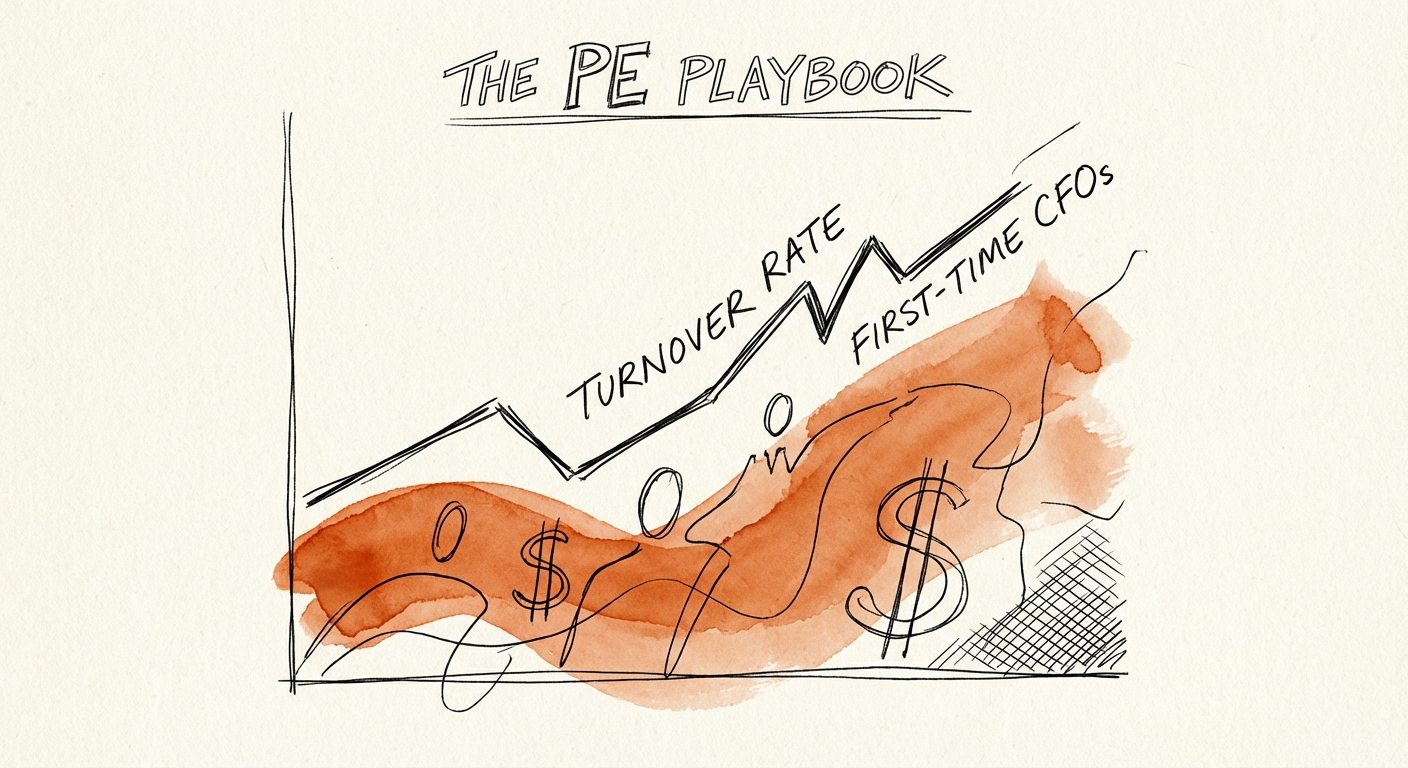
This isn't an anomaly; it's the industry standard failure mode. Data from Deloitte reveals that nearly 80% of CFOs in PE-backed companies are replaced over the investment lifecycle. More alarmingly, roughly 50% are exited within the first 18 months. The cost of this churn isn't just recruitment fees; it's the six to nine months of lost visibility while you wait for the incumbent to fail, followed by the three to six months it takes to find and seat a replacement.
The "Controller Trap"
The fundamental disconnect is role definition. In a founder-led business, the finance lead's job is preservation: keep cash in the bank, file taxes, and prevent the founder from spending too much. In a PE-backed asset, the job is acceleration. We need board reporting that predicts the future, not just records the past. We need a strategic partner who can model the impact of a 5% price increase on churn and EBITDA, not just someone who can balance the ledger.
In PE, the finance function is the cockpit of the plane. You can't afford a pilot who is still reading the manual while you're trying to climb.
The Profile: Accountant vs. Operator
To break this cycle, Operating Partners must stop hiring for "accounting correctness" and start hiring for "operational fluency." The skills that get a company through an audit are not the skills that get a company through a chaotic integration or a pricing overhaul.
The Three Pillars of the PE CFO
When assessing a candidate—or deciding if the incumbent can make the leap—measure them against these three non-negotiable pillars:
- 1. Cash & Working Capital Aggression: A Controller monitors cash. An Operator CFO actively manages working capital cycles to fund growth. They don't just report DSO (Days Sales Outstanding); they implement the dunning process that reduces it by 12 days to free up $2M in liquidity.
- 2. The Data Supply Chain: In the mid-market, data is often a mess. The CFO must own the "Data Supply Chain"—ensuring that what happens in Salesforce actually translates to what appears in NetSuite. If they can't bridge the gap between bookings and revenue recognition without a spreadsheet error, they aren't ready for the hold period.
- 3. Forward-Looking CAPEX/OPEX Logic: Can they build a finance function that scales? The test is simple: Ask them to model the P&L impact of doubling the sales team next quarter. If they just double the salary line, they fail. If they model ramp times, quota attainment assumptions, and commission drag, they pass.
The 18-Month Danger Zone
Research from Russell Reynolds highlights that portfolio CFO turnover is twice as high as public company CFO turnover. This is often because the "Series B CFO" who is great at raising capital is terrible at the rigorous, grind-it-out margin expansion required in a PE hold. The "First-Time" PE CFO often fails because they underestimate the pace. In a public company, you have 90 days to close the quarter. In PE, if the flash report isn't on your desk by Day 4, you're lacking operating visibility.
The Installation Playbook: The First 100 Days
If you are installing a first-time CFO—or giving an incumbent a probationary window—you cannot rely on "sink or swim." You need a structured installation plan that forces value creation immediately.
Phase 1: The Trust Architecture (Days 1-30)
The new CFO's only goal in the first month is data integrity. They must audit the existing reporting stack and establish a "Single Source of Truth." If the Board Deck says one number and the CRM says another, trust evaporates instantly. Mandate: A weekly 13-week cash flow forecast, delivered every Monday by noon, with variance analysis against the previous week.
Phase 2: The KPI Lock-In (Days 31-60)
Once the numbers are right, the context must be established. The CFO must work with the CRO and COO to define the 5-7 metrics that actually drive the business (e.g., CAC Payback, NRR, Utilization). This isn't about reporting; it's about definition. Does everyone agree on how "Churn" is calculated?
Phase 3: Operational Interlock (Days 61-90)
The final phase is shifting from "Scorekeeper" to "Business Partner." The CFO should be leading the monthly business review (MBR), not just attending it. They should be challenging the Head of Sales on pipeline coverage and pushing the CTO on cloud spend efficiency.
The Verdict
You don't have time for a learning curve. If your CFO hasn't uncovered a material insight or fixed a broken process by Day 90, they likely never will. In Private Equity, the finance function is the cockpit of the plane. You can't afford a pilot who is still reading the manual while you're trying to climb.