
The practical answer
- Short answer
- 2025 B2B sales cycle benchmarks by ACV: ~40 days under $10k, 75 at mid-market, 120 for $50–100k, 220+ at enterprise. See where your deals stall.
- Best fit
- Industry: B2B SaaS. Function: Sales
- Operating path
- GTM Execution → Commercial Performance → Performance Improvement
- Key metric
- 25% Increase in sales cycle length since 2020
The 25% Drag on Your Forecast
If your forecast accuracy has plummeted in the last three quarters, stop blaming your VP of Sales for being a "bad guesser." The physics of the B2B deal have fundamentally changed, and your historical data is likely lying to you. In 2024 and entering 2025, the average B2B sales cycle lengthened by approximately 25% compared to five years prior. The era of the "handshake deal" for anything over $20k is dead, replaced by a maze of CFO scrutiny, security questionnaires, and committee consensus.
For Scaling Founders, this elongation is the silent killer of cash flow. You forecast a deal for Q3 because "the champion loves us," but it slips to Q4 (or Q1) because you failed to account for the new normal: the 10-person buying committee. Forecasting based on gut feel rather than these new velocity benchmarks leads to missed board numbers, frozen hiring, and panic-induced discounts.
Why Deals Are Stalling
The elongation isn't random; it's structural. Three factors are driving the drag:
- The "CFO Veto" is Ubiquitous: Discretionary budgets have vanished. Even $30k deals now often require CFO sign-off, adding 2-3 weeks of financial review to what used to be a departmental decision.
- Stakeholder Bloat: The average B2B buying committee has expanded to 6-10 people. For enterprise deals, it can reach 17. Every additional stakeholder adds an estimated 20% to the cycle time.
- The "No Decision" Crisis: With win rates dropping to ~19-21% industry-wide, the biggest competitor isn't another vendor; it's the status quo. Fear of Messing Up (FOMU) is causing buyers to stall indefinitely.
To fix your revenue predictability, you first need to audit your velocity against reality. Below are the definitive benchmarks for 2025.
The days of quick handshake deals are gone. Today's buyers are cautious, committees are bigger, and every purchase gets scrutinized like a Supreme Court nomination.
The 2025 Sales Cycle Benchmarks by ACV
Stop using a blanket "90 days" for your entire pipeline. Velocity is dictated by Average Contract Value (ACV). A $15k tool and a $150k platform are not sold; they are navigated, and the navigation speeds differ wildly. Based on aggregated data from 2025 reports including Ebsta, Outreach, and Focus Digital, here are the median sales cycle lengths you should be modeling.
The Velocity Bands
- <$10k ACV (Transactional): 25 - 40 Days
These are credit card swipes or single-approver decisions. If these drag beyond 45 days, you have a qualification problem, not a sales problem. - $10k - $50k ACV (Mid-Market): 75 Days
The "Danger Zone." This is too big for a credit card but often too small to get serious attention from legal/procurement quickly. These deals die in the inbox. - $50k - $100k ACV (Growth): 120 Days
This is the new battleground. At this level, you are a line item on a budget review. You need a formal business case. Pipeline coverage models must account for this 4-month reality. - $100k - $250k ACV (Enterprise Lite): 170 Days
Requires multi-threading. You will likely face a security review, legal redlines, and a procurement negotiation. - >$250k ACV (Strategic Enterprise): 220 - 270+ Days
These are fiscal-year aligned purchases. If you enter the cycle off-cadence with their budgeting season, you will wait until the next fiscal year regardless of how "urgent" the problem is.
The "Top Performer" Delta
The gap between median and elite is widening. Top-performing organizations are closing deals 42% faster than the median. How? They don't just sell harder; they engineer the deal differently. They use deal desks to parallel-process legal and security while the champion is still selling internally. They don't wait for the "Yes" to send the contract; they send the Mutual Action Plan (MAP) after the first demo.
The Acceleration Playbook: Compressing the Cycle
You cannot force a buyer to move faster than their internal process allows, but you can remove the friction you control. If your $60k deals are taking 180 days instead of 120, you are reducing EBITDA. Here is the operational fix.
1. Institutionalize Multi-Threading
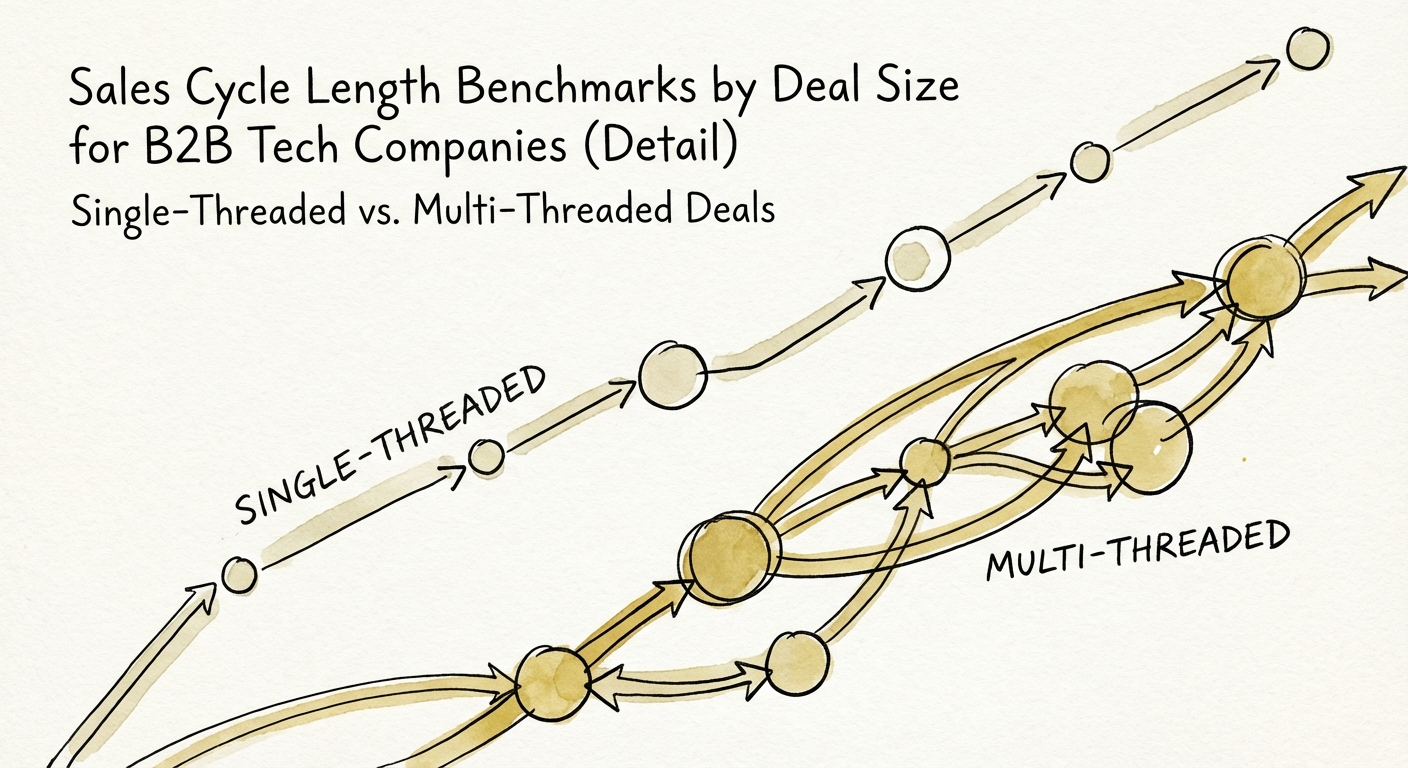
Single-threaded deals are 50% more likely to stall. Data shows that involving just one additional contact increases close probability by 37%. You must mandate "Executive Bridging"—your CEO talks to their CEO, your CTO talks to their VP Engineering. Do not let your rep hoard the relationship. If a deal enters the "Verbal Commit" stage without at least three stakeholders engaged, flag it as "At Risk."
2. Why a Mutual Action Plan (MAP) Is Mandatory
For any deal over $50k, a MAP is non-negotiable. This is not a list of what you want to do; it is a shared project plan working backward from the client's go-live date. If the client won't agree to a MAP, they aren't buying—they're shopping. Disqualify them and save your team the cycles.
3. Front-Load the "Boring" Stuff
Stop waiting for the verbal "Yes" to introduce the MSA. In 2025, legal and security reviews take 3-6 weeks. Introduce your "standard terms" and security packet during the solution validation phase. Frame it as: "To ensure we hit your August 1st launch date, I'm sending our security pack over now so your team can review it in parallel." This parallel processing is the single biggest lever for cutting 20 days off a 120-day cycle.
Summary
Time changes deals. In a high-interest, low-risk-tolerance market, every day a deal sits in "Negotiation" is a day it risks being cut by a nervous CFO. Audit your pipeline against the 120-day benchmark for mid-market deals. If you are lagging, stop blaming the market and start fixing your sales engineering.