The practical answer
- Short answer
- Stop treating SOC 2 as a cost center. New 2025 data shows compliance-ready firms see 28% faster sales cycles. Here is the CEO's guide to using security.
- Best fit
- Industry: B2B SaaS. Function: Operations
- Operating path
- Compliance & Security → Turnaround & Restructuring → Turnaround & Restructuring Services
- Key metric
- 54 Days Increase in average B2B decision timelines (2021-2024)
The 54-Day Delay You Can't Afford
If you are a B2B founder with $10M-$50M in revenue, you have likely felt the shift. A few years ago, you could close a mid-market deal on a handshake and a solid product demo. Today, your sales team is hitting a wall of silence after the proposal stage.
You aren't imagining it. The average B2B decision timeline has increased by 54 days between 2021 and 2024. Why? Because the buying committee has exploded to 6-10 stakeholders, and the loudest voice in the room is no longer the champion who loves your product—it's the CISO who doesn't trust your infrastructure.
For scaling companies, this is the "Compliance Cliff." You have graduated from selling to risk-tolerant startups to selling to risk-averse enterprises. These buyers don't just prefer security; they mandate it. Recent 2025 data reveals that 66% of B2B buyers now demand SOC 2 reports before they will even consider a vendor partnership. If you don't have that report ready in your data room, you aren't just losing the deal; you are often disqualified before you even get on the call.
The mistake most founders make is treating SOC 2 as a "check-the-box" tax—a cost center managed by a reluctant CTO or an outsourced consultant. This defensive mindset is why your sales cycle is dragging. You are treating compliance as a hurdle, while your fastest-growing competitors are using it as a tool.
You can either let compliance be the anchor that drags you down, or the engine that speeds you up. The data is clear: the winners are choosing speed.
The Economics of Trust: Why Compliant Firms Win Faster
Let’s look at the math of manual compliance versus automated trust. In a non-compliant organization, a security questionnaire arrives like a grenade. It contains 300+ questions. It requires input from Engineering, Legal, and HR. It consumes an average of 15 hours of highly paid leadership time per deal. While you scramble to find answers, the deal stalls.
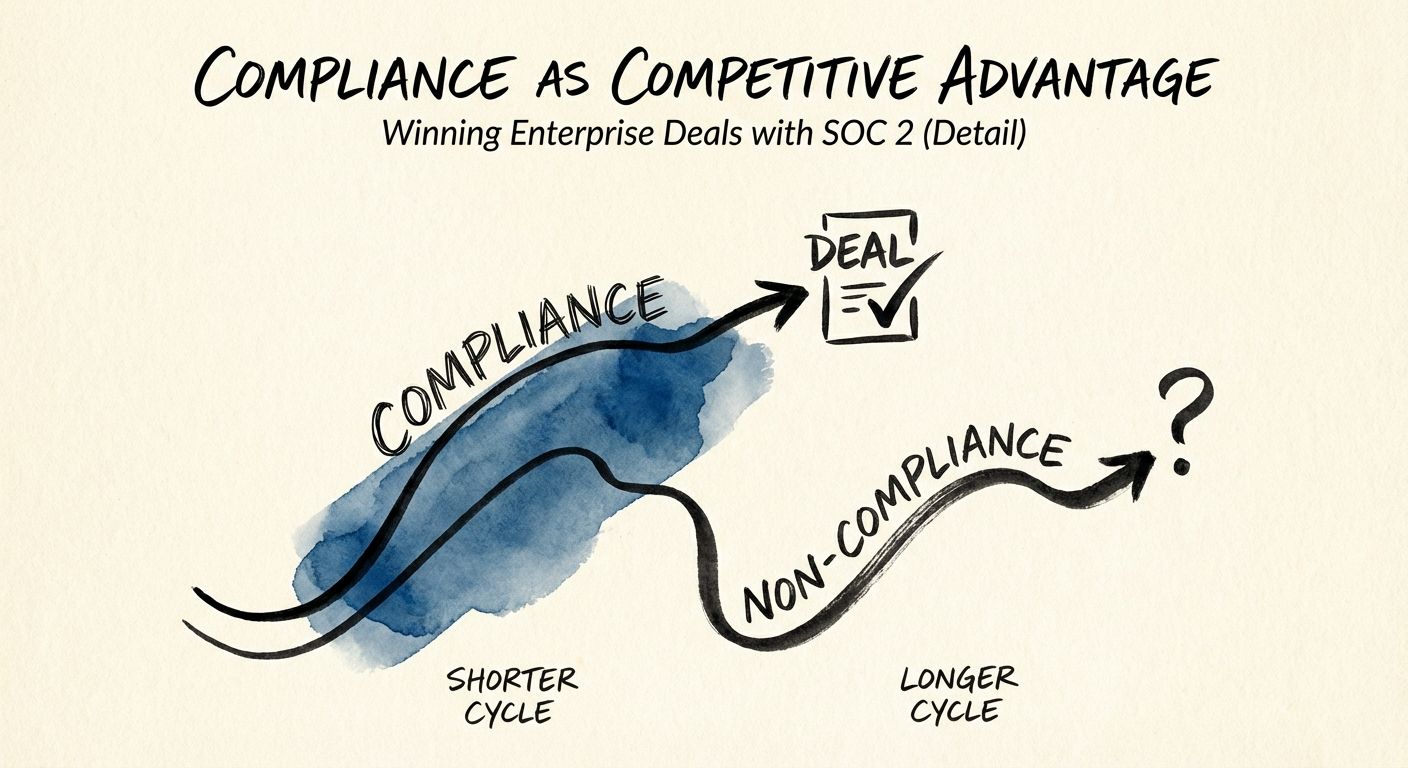
Contrast this with the "Trust Center" approach. Instead of a reactive scramble, you present a public-facing or NDA-gated portal that hosts your SOC 2 Type II report, penetration test results, and sub-processor lists. Data from 2025 indicates that companies utilizing Digital Sales Rooms and Trust Centers see sales cycles shorten by 28%.
Why is the impact so dramatic? Because you are removing the friction of verification. When a buyer can self-serve your security credentials, you bypass the initial "trust gate" without a single meeting. You are signaling maturity. You are telling the enterprise buyer, "We are ready for you."
The Hidden Cost of "Security Debt"
Beyond the sales cycle, the operational cost of manual compliance is significant. Research from Vanta and Sapio shows that teams spend 11 working weeks per year on manual compliance tasks. That is nearly a quarter of a year that your engineering leaders are not building product. SOC 2 accelerated compliance playbooks are no longer just about passing an audit; they are about reclaiming that engineering capacity.
- Win Rate Impact: Enterprise buyers are 85% established in their requirements before they contact you. If "SOC 2" is on their list and not on your website, you are invisible.
- Deal Size Impact: Verified secure vendors command a premium. You aren't just selling software; you are selling risk mitigation.
The CEO's Action Plan: Weaponizing Compliance
Stop delegating compliance to the back office. As CEO, you must position security as a Tier 1 value proposition. Here is how to turn SOC 2 from a cost center into a competitive moat in 90 days.
1. Automate, Don't Administrate
If you are still using Excel for your risk register, you are burning cash. Platforms like Vanta or Drata are mandatory for modern scaling firms. They reduce the audit window from months to weeks and provide the continuous monitoring that enterprise CISOs actually care about. Do not build manual policies that rot on a shared drive; build live controls that prove you are secure 24/7.
2. Build the "Trust Center" Immediately
Do not wait for the next questionnaire. Build a portal (using your compliance platform or a tool like SafeBase) today. Put the link in your website footer and your sales decks. Train your AEs to send this link before the prospect asks for it. This preemptive strike serves as a sales cycle acceleration tactic that disarms the security objection before it is raised.
3. Train Sales to Speak Security
Your sales team doesn't need to be CISSPs, but they must be fluent in your security posture. They should know how to answer "Where is data hosted?" and "Do you encrypt at rest?" without pinging the CTO. When a salesperson answers a security question confidently, they build more trust than any whitepaper ever could. This is a critical component of improving proposal win rates.
Conclusion
In 2026, security is not an IT problem. It is a revenue problem. The difference between a $20M company and a $50M company is often the ability to close the Global 2000. Those deals do not happen without SOC 2. You can either let compliance be the anchor that drags you down, or the engine that speeds you up. The data is clear: the winners are choosing speed.