
The practical answer
- Short answer
- Stop the 12-month compliance drag. Learn how PE operating partners use automation to achieve SOC 2 readiness in 90 days, reducing costs by 60% and unblocking enterprise deals.
- Best fit
- Industry: B2B Tech. Function: Operations
- Operating path
- Compliance & Security → Turnaround & Restructuring → Turnaround & Restructuring Services
- Key metric
- 66% of B2B buyers now mandate SOC 2 reports
The New Gatekeeper of Enterprise Value
For Private Equity Operating Partners, the mandate used to be simple: grow revenue, expand EBITDA margins, and exit. Today, there is a silent killer in the portfolio that stalls all three: Security Debt, specifically the lack of SOC 2 attestation.
In 2026, SOC 2 is no longer a "nice-to-have" badge for your portfolio companies; it is the table stakes for entering the enterprise market. Recent data indicates that 66% of B2B buyers now mandate SOC 2 reports before even engaging in a proof-of-concept. If your portfolio company cannot produce a Type 2 report, they aren't just losing deals—they aren't even entering the room.
The "Compliance Tax" on Exit Multiples
The cost of inaction is quantifiable. B2B sales cycles have lengthened by an average of 54 days over the last three years due to increased vendor due diligence. When a portfolio company lacks verified security controls, they get stuck in "procurement purgatory," answering 300-question security spreadsheets manually while their competitors—who handed over a clean SOC 2 report on Day 1—close the deal.
Furthermore, during exit due diligence, acquirers view a lack of compliance infrastructure as a massive liability. We routinely see acquirers re-trade deals, demanding purchase price reductions for "security remediation" that often exceed the cost of the audit by 10x. The choice is binary: pay a small amount now to build the system, or pay a massive "discount tax" at exit.
If your portfolio company can't produce a SOC 2 report, they aren't just losing deals—they aren't even entering the room.
The 90-Day Sprint: Automating the Dull Work
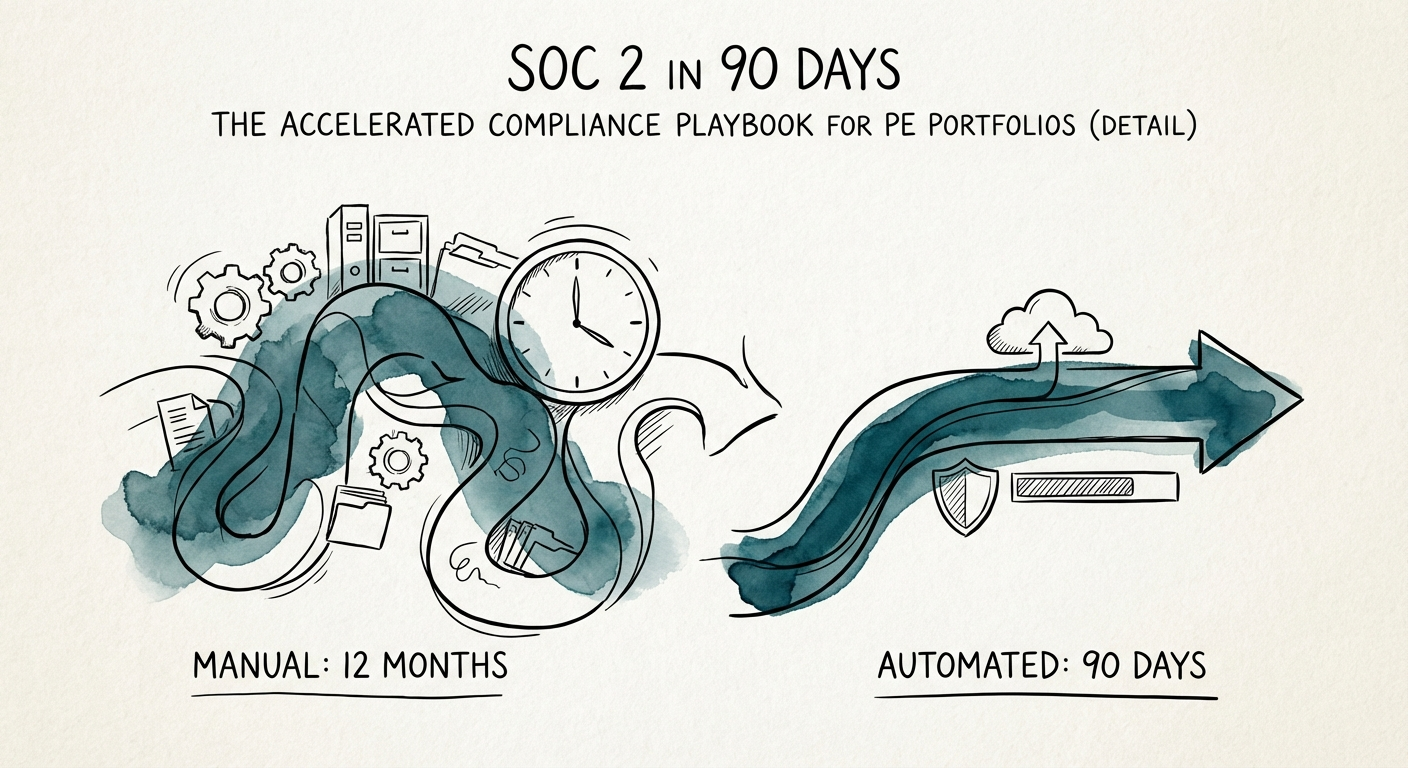
The traditional path to SOC 2 was a nightmare of billable hours: hire a boutique consultant for $50,000, spend six months taking screenshots of laptop settings, and pray the auditor doesn't find a gap. This "manual" approach typically takes 9 to 12 months and costs upwards of $100,000 per asset.
The operator's playbook has changed. By leveraging Compliance Automation Platforms (CAPs) like Drata, Vanta, or Secureframe, we can compress this timeline to under 90 days for Type 1 attestation and readiness for Type 2. These platforms integrate directly with your portfolio company's tech stack (AWS, Google Workspace, GitHub, HRIS) to automatically monitor controls, replacing manual screenshots with continuous API-based evidence collection.
The Math: Manual vs. Automated Compliance
- Time to Readiness: Manual (6-9 months) vs. Automated (3-6 weeks).
- Internal Effort: Manual (400+ hours of engineering time) vs. Automated (40-60 hours).
- Cost Impact: Manual ($80k-$120k total) vs. Automated ($30k-$50k total).
For a PE portfolio operating on a 3-5 year hold, the automated approach is the only one that makes sense. It shifts security from a static, point-in-time audit to a continuous, monitorable asset that actually improves the quality of the business.
The Execution Roadmap
To get a stalled portfolio company compliant in one quarter, follow this 90-day intervention plan:
Phase 1: The Integration (Days 1-14)
Do not start with policies. Start with integrations. Connect the automation platform to the cloud infrastructure and identity providers. This immediately generates a "Gap Analysis" dashboard showing exactly where the company fails (e.g., "Multi-Factor Authentication is disabled for 3 admins"). This turns a vague consulting project into a clear punch list.
Phase 2: The Remediation Sprint (Days 15-45)
Assign a technical lead (CTO or VP Engineering) to burn down the punch list. This usually involves:
- Enforcing disk encryption on all laptops (via MDM).
- Standardizing vendor onboarding checklists.
- Implementing change management tickets for code deployments.
Simultaneously, the platform generates the required policy documents (Acceptable Use, Incident Response). Have the management team review and adopt them. Do not let legal rewrite them from scratch; use the platform standards.
Phase 3: The Audit & Observation (Days 46-90)
By Day 45, the environment is "clean." You can now trigger a SOC 2 Type 1 Audit (which tests design at a point in time). This takes 2-3 weeks. By Day 60-75, you have a Type 1 report in hand—enough to unblock most enterprise sales conversations.
Immediately upon passing Type 1, the "observation window" for Type 2 begins. While the Type 2 report requires 3-6 months of data, you have effectively solved the commercial blocker within the quarter. You can truthfully tell prospects: "We are SOC 2 Type 1 certified and currently in our Type 2 observation period."
The Bottom Line
Compliance is no longer an IT ticket; it is a revenue enabler. By forcing this 90-day acceleration, you aren't just checking a box—you are building a more disciplined, sellable, and valuable asset.