The practical answer
- Short answer
- 88% of account managers think great service drives expansion. The correlation is zero. Here's why Series B/C SaaS stalls at 101% NRR and the fix.
- Best fit
- Industry: B2B Tech. Function: Sales & CS
- Operating path
- Revenue Architecture → Commercial Performance → Office of the CFO
- Key metric
- 101% Median Net Revenue Retention (NRR) for Series B/C
The 101% Plateau Nobody Wants to Talk About
Here is the board slide that makes a Series B founder's stomach drop: new logo growth has cooled, the CAC line is creeping up and to the right, and somebody — usually the CFO — says the quiet part out loud. "Why aren't we expanding the base? We've already paid to acquire these people."
So you task Customer Success with it. The logic feels airtight. The customer trusts the CSM, uses the product daily, and renews without a fight. Selling Module B to a happy user has to be easier than cold-selling Module A to a stranger. Then the next quarter closes and your Net Revenue Retention reads 101%. Expansion is barely outrunning churn. You're not growing the base — you're bailing a boat at exactly the rate water comes in.
The uncomfortable reason: you've confused relief with revenue. A CSM's entire job is to make problems disappear, fast and without friction. You've now asked that same person to manufacture friction — to look a customer in the eye and say "you've outgrown this plan." Those two instincts cancel each other out, and the data shows it. Gartner found that 88% of account managers believe "service above and beyond" is the surest path to account growth. They are wrong. Gartner's own analysis shows roughly zero statistical relationship between service quality and account growth. The customer who loves you most is often the one who feels least pressure to spend more — you've already given them everything they need to be comfortable.
Service relieves tension; sales creates it. The moment you hand a CSM a quota, you've asked them to betray the relationship they were hired to protect. That's why the hybrid role almost always produces mediocre support and zero net new ARR.
The Three Leaks That Keep You at 101%
A stalled expansion engine isn't a motivation problem. It's a structural one, and it almost always leaks in the same three places.
Leak 1: You comp expansion like a consolation prize
Pull your comp plan. If reps earn 10–15% on a new logo and 2–5% on an upsell, you've told the entire sales floor that your existing customers are second-class. They'll chase the new badge every time, because that's where the money is. The expansion that should be your cheapest revenue gets the leftovers of everyone's calendar.
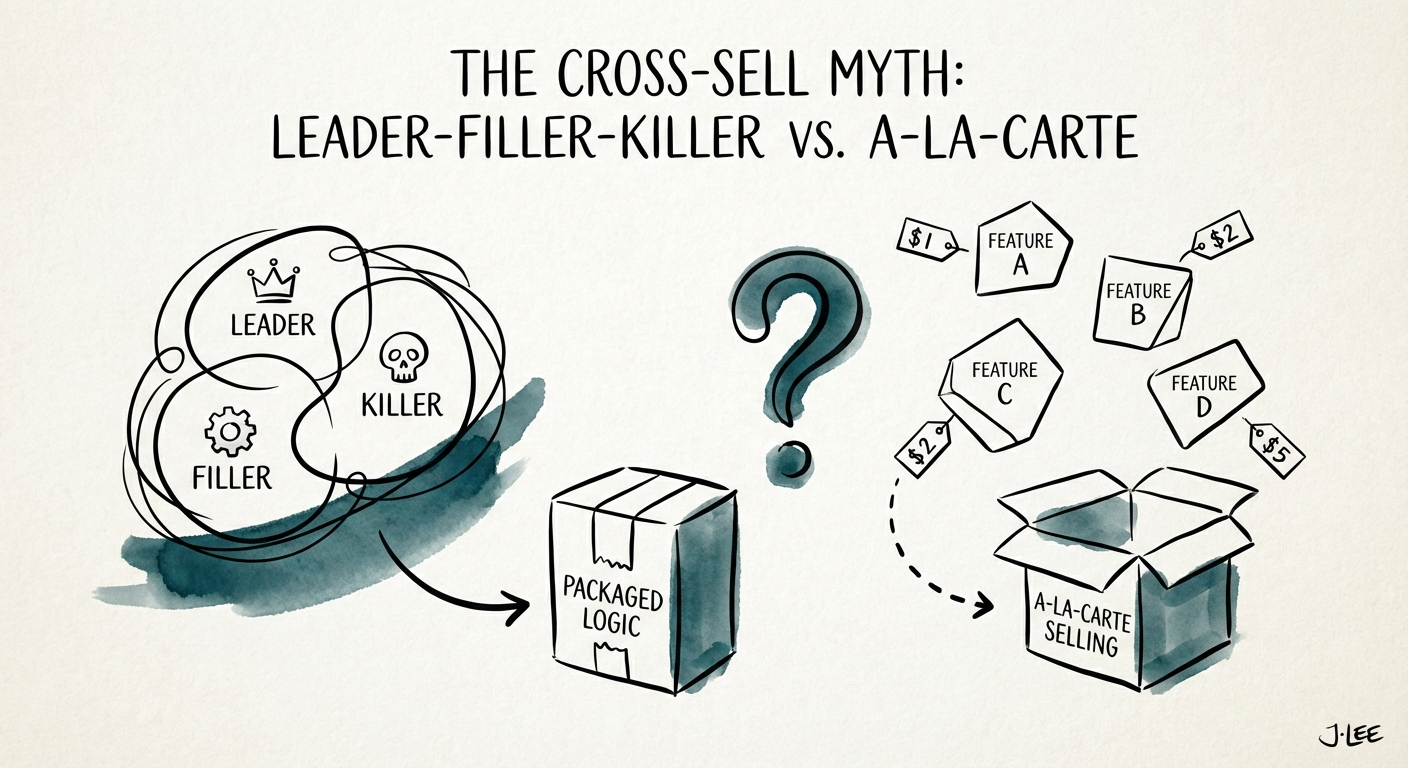
Leak 2: You're selling à la carte when you should be selling tiers
When you ask a customer to make a fresh buying decision for a $500-a-month add-on, you trigger a full procurement cycle over a rounding error. You burn political capital for peanuts, and the buyer learns to associate your name with nickel-and-diming. Pricing teams at firms like Simon-Kucher structure packages so the high-value capability lives inside a "Pro" or "Enterprise" tier — the upgrade is a migration to a stage of maturity, not a line-item purchase. One decision, not twelve.
Leak 3: You have no map of where the money actually is
Ask your head of sales a simple question: "Which of our top 50 accounts have both the budget and the unmet need for Module B?" If the answer is "I think Bob's team might," you've found the leak. There's no White Space matrix — every account scored against every product line by propensity to buy — so your team isn't selling. They're "checking in" and hoping a hand goes up.
Why this is existential at Series B specifically: Benchmarkit's 2025 data shows new-logo CAC can exceed $2.00 for every $1.00 of fresh ARR. Expansion ARR is the only lever that meaningfully drops your blended CAC and stretches runway. And 2025 SaaS benchmarks say expansion should be 35–40% of total new ARR — on $5M of new ARR, that's $2M from the base you already own. Under 20% and investors quietly cap your LTV assumption, which caps your multiple. The 101% plateau isn't a sales miss. It's a valuation discount.
What You Do Monday: Split the Role, Then Fix the Math
The fix is to stop hiring for a person who doesn't exist and start engineering a motion. This is the move from a personality-driven model to an engineered sales model for the installed base.
1. End the hunt for the unicorn CSM
Stop looking for the one human who can debug an integration, calm an angry VP, and close a six-figure upgrade in the same week. Split the seat in two and let each role do one job well. The CSM owns the Happy: measured on adoption, health scores, and logo retention. The Account Manager owns the Money: measured on NRR and expansion bookings. The AM walks into the QBR not to ask "how are things going?" but to present a path — "companies at your growth stage typically move to Enterprise here to unlock X and Y." That's a roadmap conversation, not a sales ambush, and it's one the CSM was never built to have.
2. Re-architect pricing so the upgrade is the easy choice
Audit every feature. If 90% of customers use something you sell separately, it's a tax on your best users — fold it into the base. If a feature is high-value but low-adoption, it's an upsell driver — put it behind a tier. Build a clean Good/Better/Best ladder mapped to customer maturity, so growing means upgrading, not negotiating.
3. Pay for the behavior you actually want
For the next 12 months, run parity commissions — pay the same rate on an expansion dollar as on a new-logo dollar. It costs you margin in the short term and it permanently rewires where your team spends its time, aiming the whole force at the cheapest revenue in the building.
Your customers aren't a piggy bank you smash open every time you miss forecast. They're a market — one you understand better than any competitor, if you'd stop "checking in" and start mapping it. Do the role split, fix the packaging, fund the right behavior, and you turn 101% NRR into a number that actually compounds. For the dashboard that keeps it honest in the boardroom, build a forecastable expansion view. And if churn is the real story hiding under your retention number, start with why NRR below 120% means the expansion motion isn't working yet.