
The practical answer
- Short answer
- 2026 CS headcount benchmarks: SaaS firms with $10M-$50M ARR should target $2M-$4M ARR per CSM. Don't hire more bodies—fix your segmentation.
- Best fit
- Industry: SaaS. Function: Customer Success
- Operating path
- Revenue Architecture → Commercial Performance → Office of the CFO
- Key metric
- $2M - $4M Target ARR per CSM for Series B/C SaaS Companies
The "More Bodies" Fallacy in Customer Success
If you are a Series B or C founder, you have likely hit the "Churn Panic" phase. Your growth has slowed, NRR has dipped below 110%, and your first instinct is to throw headcount at the problem. You look at your Customer Success (CS) team, see them drowning in support tickets and onboarding delays, and you approve three new hires.
This is a mistake. In 90% of the portfolios we audit, the problem isn't a lack of bodies; it's a lack of Revenue Architecture.
When you hire CSMs without a defined segmentation model, you aren't building a retention engine; you're building a concierge service that scales linearly with costs. This destroys your EBITDA margins and, counter-intuitively, often lowers customer satisfaction because your team is reacting to fires rather than driving value.
The EBITDA Drag of "Concierge" CS
For a company between $10M and $50M ARR, the goal is not just retention—it is efficient retention. If your CS costs exceed 15% of ARR, you are dragging down your valuation. Investors in 2026 are scrutinizing Gross Revenue Retention (GRR) and Net Revenue Retention (NRR) efficiency. They want to see that you can retain $1 of revenue for less than $0.10 of CS spend.
If your CSMs are doing everything—support, onboarding, renewals, and upsells—for every customer regardless of contract value, you don't have a CS team. You have a highly paid support desk. The benchmarks below will tell you exactly where your headcount should be, but be warned: the numbers assume you have the discipline to segment your customers.
Investors in 2026 are scrutinizing GRR and NRR efficiency. They want to see that you can retain $1 of revenue for less than $0.10 of CS spend.
2026 Customer Success Benchmarks: The Hard Numbers
Stop guessing. We've aggregated data from over 1,000 SaaS companies (via SaaS Capital and Gainsight benchmarks) to give you the operational reality for 2026. These numbers reflect the "New Efficiency" mandated by current market conditions.
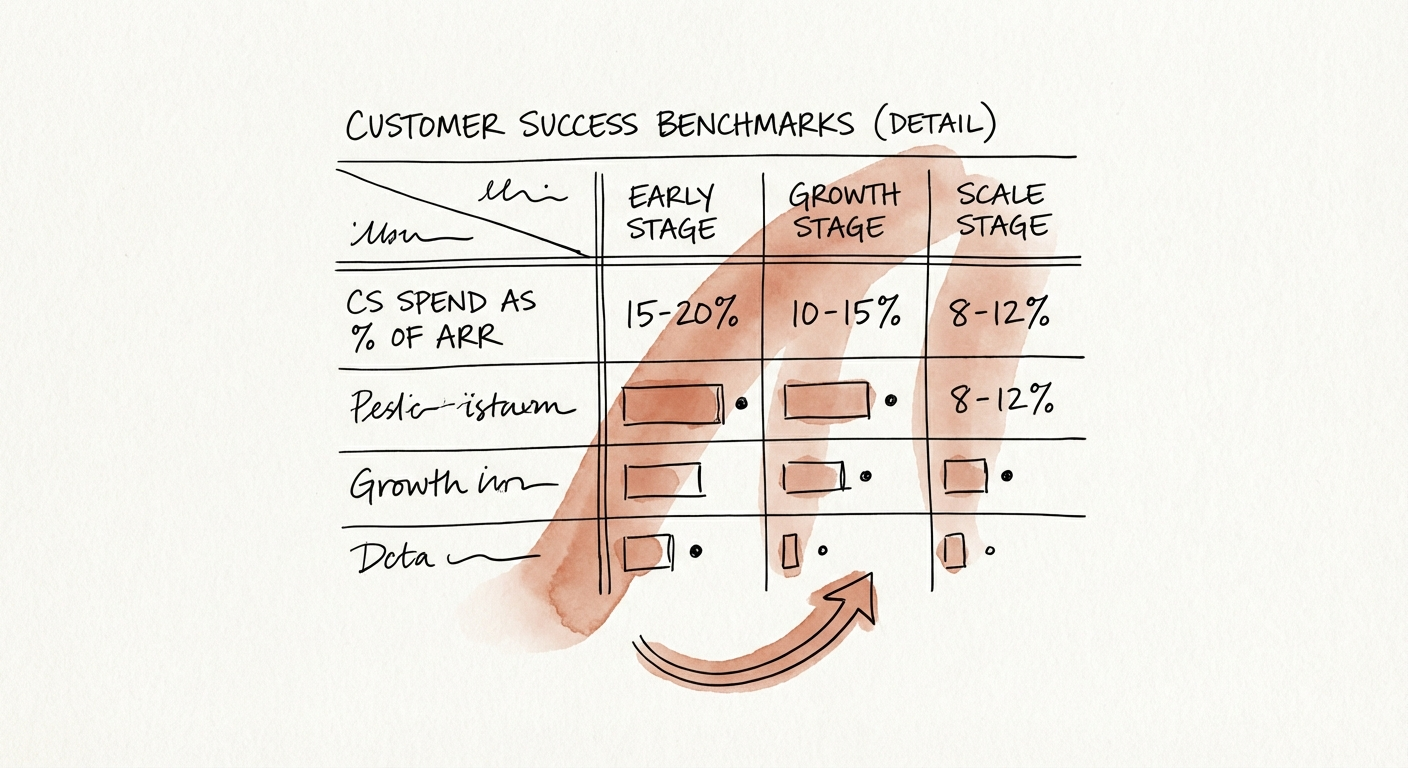
Benchmark 1: CS Spend as % of ARR
This is your top-level efficiency metric. It includes CSM salaries, CS Ops, and CS tooling (but excludes technical support). If you are above these bands, you are over-servicing your revenue.
- Early Stage ($1M - $10M ARR): 10% - 15% (Invest heavily to figure out the playbook)
- Growth Stage ($10M - $50M ARR): 6% - 10% (The founder sweet spot)
- Scale Stage ($50M+ ARR): 3% - 6% (Efficiencies of scale and Digital CS kick in)
Benchmark 2: ARR Managed per CSM
This is the single most important metric for right-sizing your team. It varies heavily by your Average Contract Value (ACV).
| Company Stage | Target ARR per CSM | Context |
|---|---|---|
| Early Stage | $1M - $2M | High-touch, finding product-market fit. |
| Growth Stage (Series B/C) | $2M - $4M | The Target. Process is documented; tooling is in place. |
| Scale Stage | $4M+ | Heavily reliant on "Digital CS" and AI automation. |
Benchmark 3: Accounts per CSM (The Workload Reality)
The "ARR per CSM" metric fails if you don't account for deal size. A CSM can manage $2M in ARR if it's ten $200k customers. They cannot manage $2M in ARR if it's two hundred $10k customers. Use this matrix to assign ratios:
- Enterprise (ACV > $100k): 10 - 15 Accounts per CSM. (Focus: Strategic relationship, QBRs, custom success plans).
- Mid-Market (ACV $25k - $100k): 30 - 50 Accounts per CSM. (Focus: Standardized playbooks, monthly check-ins).
- SMB (ACV < $10k): 100 - 200+ Accounts (or Pooled Model). (Focus: Digital CS, one-to-many webinars, automated risk triggers).
If you have CSMs managing 40 Enterprise accounts, you will see churn. If you have CSMs managing 20 SMB accounts, you are burning cash. If your NRR is below 100%, check these ratios first.
The Action Plan: From Headcount to Revenue Architecture
If the benchmarks above show you are overstaffed or under-performing, do not just fire people or hire more. You need to re-engineer the function.
1. Segment Before You Scale
You cannot afford "High Touch" for everyone. Draw a hard line at $25k or $50k ARR. Below that line, customers get "Tech Touch" (Digital CS). This means automated onboarding emails, access to a knowledge base, and a "pooled" CS team that reacts to inbound risks rather than proactive scheduled calls. This shifts your headcount requirement from linear to logarithmic.
2. Specialize Roles to Protect Margins
Stop asking your CSMs to be support agents and renewal clerks.
- Support: Handle technical break/fix (Cost center, low cost).
- CSM: Drive adoption and value (Value driver, medium cost).
- Account Manager: Handle renewals and upsells (Revenue driver, commissioned).
3. Implement "Digital CS" Now
The 2025/2026 data is clear: 73% of scaling SaaS firms are adopting Digital CS strategies (up from 42%). This isn't just for SMBs. AI-driven "Early Warning Systems" can monitor usage drops for your Enterprise clients better than a human can. Use AI to draft QBRs, summarize tickets, and predict churn. This allows your expensive CSMs to handle $4M books of business instead of $2M.
Conclusion
Your board doesn't want to hear that you need more people to keep customers happy. They want to hear that you have built a machine that turns usage data into retention. Target $2M+ ARR per CSM for your growth stage. If you aren't there, you don't have a staffing problem; you have a process problem.