
The practical answer
- Short answer
- A senior engineer just resigned and owns the billing integration nobody else understands. Here is the operator's protocol for the 10 working days you have left.
- Best fit
- Industry: B2B Tech & Services. Function: Operations
- Operating path
- Process Documentation → Operational Excellence → Transaction Execution Services
- Key metric
- 42% Institutional knowledge unique to specific individuals (Panopto)
The countdown starts the day the letter lands
A Slack message hits at 4:40 on a Thursday: your lead platform engineer wants fifteen minutes. By 5:00 you have a two-week notice and a problem you can't put on the board. She owns the billing integration that reconciles three pricing tiers against the payments processor. Nobody else has touched it. It runs a meaningful slice of recognized revenue every month, and the only documentation is the shape of her memory.
You now have roughly ten working days, minus the goodbye lunches and the handoff meetings that produce nothing usable. This is the worst possible moment to learn that a critical operating capability lives in one person's head. It is also the only moment most companies actually find out.
The reason this keeps happening is structural, not careless. According to the Panopto Workplace Knowledge and Productivity Report, 42% of the knowledge people use to do their jobs is unique to them, never written down, never shared. In a 40-to-200-person B2B tech or services firm that number isn't an abstraction. It's the name of the one person who knows why the renewal logic has a special case for accounts onboarded before a certain date, and what breaks if you remove it.
Two weeks is enough time to capture that person's most dangerous knowledge if you are surgical. It is nowhere near enough to "document everything," and trying to will get you nothing. The job between now and her last day is triage, not encyclopedia-writing.
A resignation letter starts a countdown on knowledge that is worth real money. Spend those days extracting decisions and exceptions, not watching someone narrate happy-path clicks.
Capture decisions and exceptions, not clicks
The instinct is to ask the departing person to "write up everything you do" or to film a screen recording of her doing the job. Both produce artifacts that look like documentation and function like nothing. A recording of someone clicking through the happy path teaches the next person which buttons to press; it does not teach them why she presses them, or what she does on the Tuesday the reconciliation throws a variance she can't explain.
The valuable knowledge lives in the parts of the work that aren't routine. The order matters here, because you're spending a finite budget of the expert's remaining hours:
- Exceptions and edge cases. "What's the weird thing that happens roughly once a quarter, and what do you do about it?" This is the knowledge that has no written home anywhere and the most expensive to rediscover by trial and error.
- Decision logic. Not "run the reconciliation" but "how do you decide whether a variance is a real problem or a timing artifact?" The judgment is the asset. The steps are commodity.
- Access and dependency map. Where every credential, service account, vendor contact, and undocumented permission lives. A surprising amount of operational paralysis after a departure is simply nobody being able to log in.
- Failure modes. "What has gone wrong before, and how did you know it went wrong?" The early-warning signals she reads instinctively are invisible to a successor staring at the same dashboard.
Notice what's not on that list: a narrated tour of the normal workflow. A competent successor can reverse-engineer the happy path from the system itself. What they cannot reverse-engineer is three years of accumulated judgment about when that path quietly lies to you.
There's a hard cost to skipping this. McKinsey Global Institute research found that knowledge workers spend close to a fifth of the workweek hunting for information they need to do their jobs. After an undocumented expert leaves, that tax doesn't stay flat for the team that inherits her work — it spikes, because the answers that used to be a one-line Slack reply now require archaeology. And the departure itself isn't free: Gallup puts the cost of replacing a departing employee at a large fraction of their annual salary once you count recruiting, ramp, and lost productivity. The knowledge you fail to capture is the part of that bill that never shows up on a budget line but lands anyway.
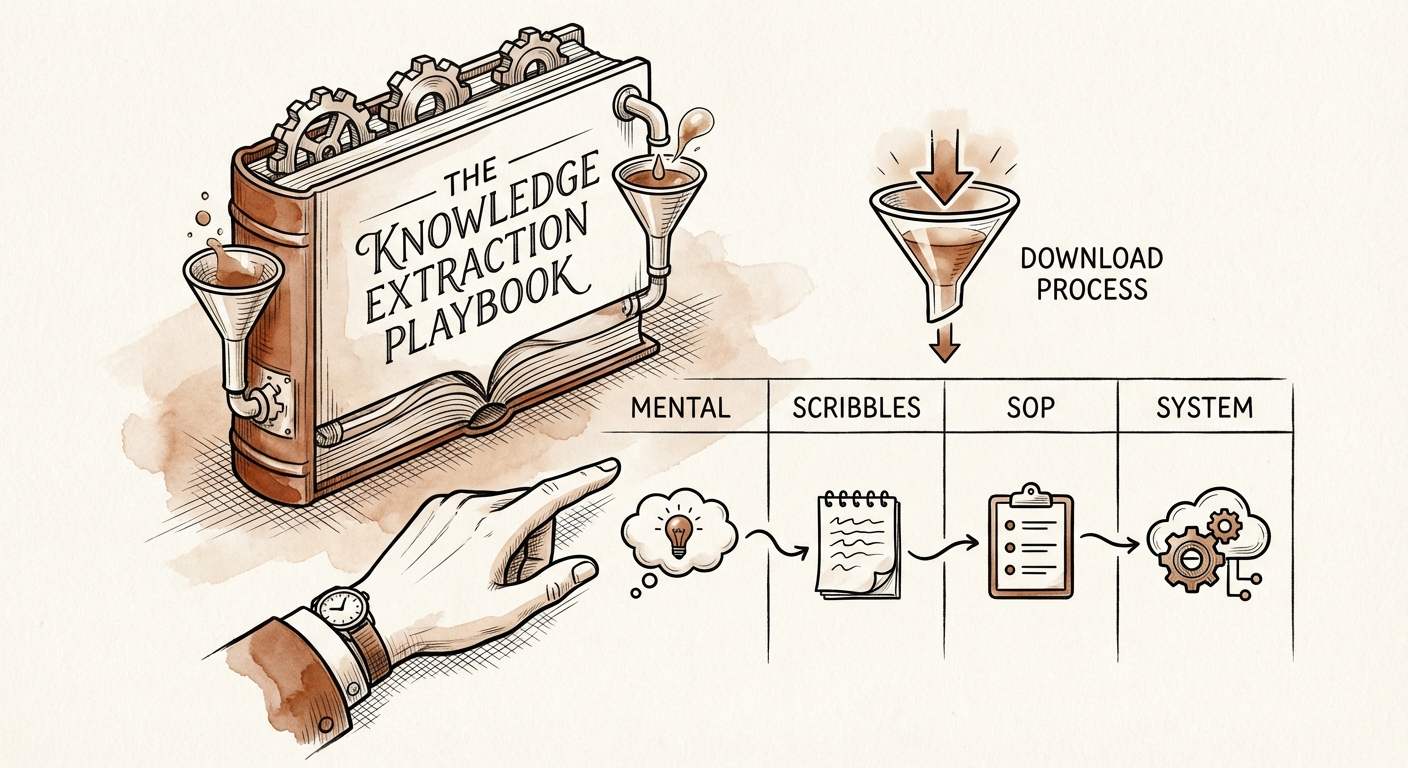
Run the ten days like a project, not a goodbye
Here is the protocol I'd run inside that two-week window, designed to extract the dangerous knowledge while the expert is still being paid to share it.
Days 1-2 — Name the crown jewels. Sit with the departing person and your most likely successor and list the three to five tasks that genuinely only she can do. Be brutally specific. Not "owns billing" — "reconciles the three-tier pricing against the processor at month-end and resolves variances." If you can't name it concretely, you can't capture it. Five real items beats a list of thirty vague ones.
Days 3-7 — Interview, don't dictate. Schedule three sixty-minute working sessions. The successor drives the screen share and does the task; the expert sits beside them answering "why" in real time. Record it, with permission. The questions that earn their keep are the uncomfortable ones: "Where does that credential actually live?" "How do you know this number is wrong?" "What did you do the last time this failed?" You are mining for the exceptions, not the steps.
Days 8-9 — Verify by stranger test. Turn the transcript into a checklist, not a novel. Then hand it to a different employee who has never done the task and ask them to complete it with the expert in the room but silent. Every place they get stuck is a gap in the documentation, and the expert is right there to fill it. This is the single step most teams skip, and it's the only one that proves the knowledge actually transferred instead of just being filmed.
Day 10 — Sign off and store it where it belongs. The expert reviews the finished checklist, confirms it's complete, and it goes into your shared knowledge base — Notion, Confluence, wherever the team already lives — not a folder on a laptop that gets wiped next week.
The strategic point outlasts this one resignation. A revenue engine that depends on specific humans rather than documented systems is a transferability problem, and any acquirer or PE operating partner will price that risk into your valuation or demand you fix it before close. The two-week scramble is the symptom. The cure is building the capture protocol into how you operate, so the next departure is a routine handoff instead of a fire drill. If you want the longer view on how this shows up in diligence, our guide on documenting your way to higher multiples walks through it, and the founder delegation paradox covers the version of this problem where the indispensable person is you.