The practical answer
- Short answer
- New 2026 data shows tech turnover costing 213% of salary. Learn the retention playbook for Series B founders to stop the 'Great Detachment.'
- Best fit
- Industry: B2B Tech. Function: People Operations
- Operating path
- Team & Hiring → Operational Excellence → Transaction Execution Services
- Key metric
- 213% Cost to replace a specialized tech employee (as % of annual salary).
The "Great Detachment" Is More Dangerous Than the Resignation
For the last three years, we've been obsessed with the "Great Resignation." Founders like you watched LinkedIn alerts ping constantly as engineers and sales reps jumped ship for 30% raises. But in 2026, the dynamic has shifted. We aren't seeing a mass exodus; we are seeing a mass detachment.
The market has cooled, and your employees know it. They aren't leaving for a competitor; they are staying seated, collecting a paycheck, and mentally checking out. According to Gallup's 2025 State of the Global Workplace report, employee engagement has dropped to 21%, the lowest level since the pandemic lockdowns. Even worse, manager engagement—the primary driver of team performance—has plummeted to 27%.
The Hidden Tax on Your P&L
You might think, "At least they aren't quitting." That is a dangerous rationalization. A disengaged senior engineer isn't just neutral; they are a drag on velocity. When they do eventually leave—or when you are forced to replace them due to performance drift—the cost is significant. Data from the Center for American Progress indicates that replacing a specialized technical role now costs 213% of the employee's annual salary. For a Senior DevOps Engineer making $180k, that is a $383,000 hit to your EBITDA. That isn't just an HR problem; that is a solvency problem.
For Series B and C companies, where headcount is often 60-70% of OPEX, you cannot afford "quiet quitting." You need a retention strategy that is as rigorous as your sales forecast.
A disengaged senior engineer isn't just neutral; they are a drag on velocity. When they do eventually leave, the cost is significant.
The Diagnostic: Are You Bleeding Talent or Shedding Weight?
First, let's kill the vanity metric of "Total Turnover." If your bottom 10% performers are leaving, that is healthy. That is shedding weight. Panic should only set in when you see Regrettable Attrition—the departure of high-leverage individuals who drive your roadmap or revenue.
2026 Turnover Benchmarks
What does "good" look like right now? Based on cross-industry data from Ravio and Mercer, here is where you should aim:
- Healthy Total Turnover: 10-15% annually. Anything below 5% suggests you are stagnating; anything above 20% means you have a culture leak.
- Regrettable Attrition (Tech): <8%. If you are losing more than 8% of your top-quartile engineers, your product roadmap is fiction.
- AI/ML Specialist Turnover: The danger zone. Mercer reports voluntary turnover in these roles hitting 18%. If you have AI talent, assume they are being recruited weekly.
The "Stay Interview" Protocol
Most founders wait for the resignation letter to ask, "What could we have done differently?" By then, the decision was made three months ago. You need to shift from Exit Interviews to Stay Interviews. This is not a casual coffee chat. It is a structured operational review with your top 20% talent.
The 3-Question Diagnostic:
- "What is the one blocker that makes your job harder than it needs to be?" (Fixing this buys loyalty.)
- "If you were to accept a recruiter's call tomorrow, what would be the primary reason?" (Money? Growth? Boss?)
- "What part of your role do you want to give away in the next 6 months?" (Prevent burnout before it happens.)
The Action Plan: Systems, Not Heroics
You cannot retain people with "culture" alone when the market is uncertain. You retain them with structural clarity. Here are the three levers you must pull immediately.
1. The "Tour of Duty" Framework
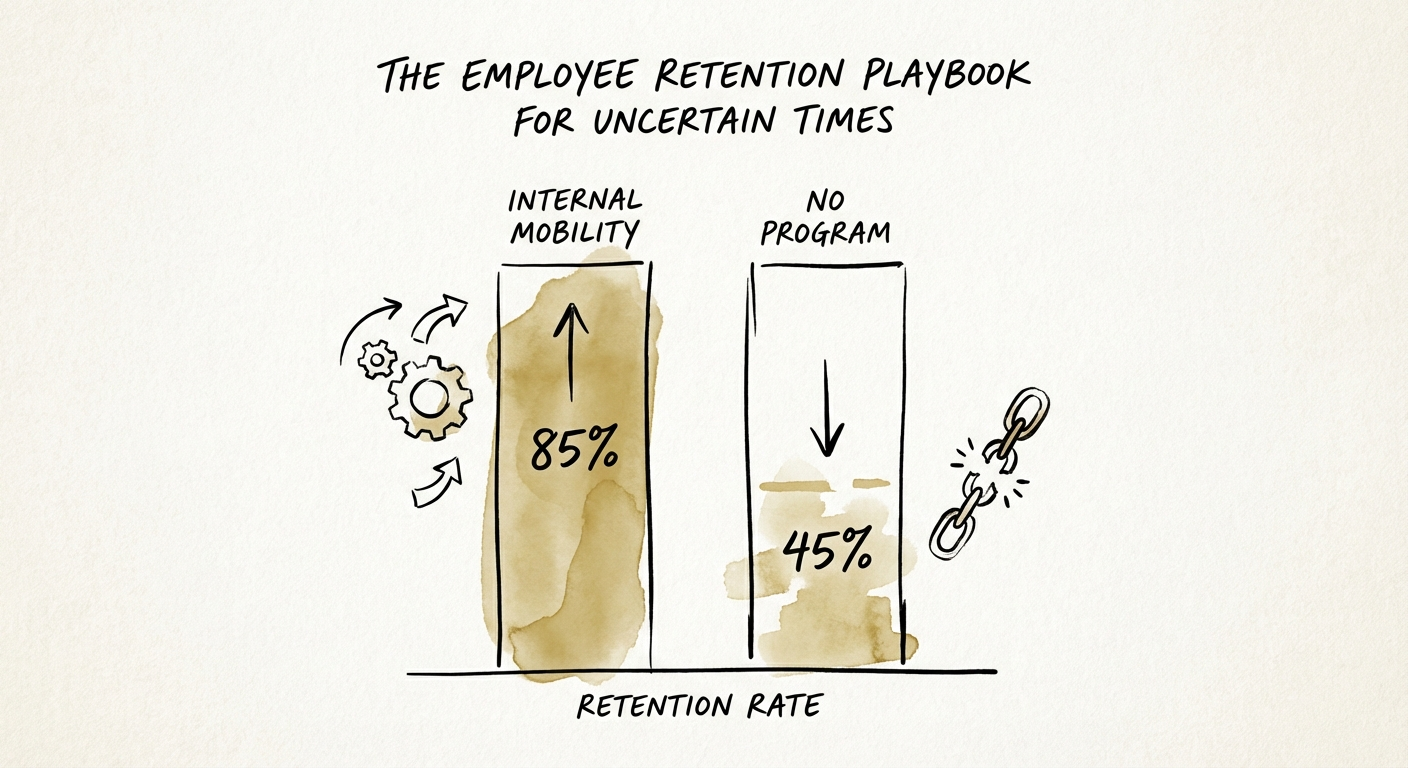
Your flat org chart is a retention killer. Ambitious people leave when they don't see a "next step." But in a 150-person company, you can't invent VP titles for everyone. The solution is the Internal Mobility Pivot.
LinkedIn data proves that lateral moves are nearly as effective as promotions for retention. Employees who move internally stay an average of 3.2 years, compared to 1.7 years for external hires. Create "Tours of Duty"—explicit 18-month assignments where an engineer rotates into Product, or a CSM rotates into Sales Engineering. You get cross-functional agility; they get career growth without leaving.
2. Radical Transparency on Runway
In the absence of data, people invent fear. If you aren't talking about your runway, burn rate, and path to profitability, your employees assume the worst. I've seen founders hide a "short" 18-month runway, causing panic. In reality, 18 months is healthy in this market! Understanding your burn rate vs. growth rate helps you communicate confidence. Open the books (within reason). Show them the math that secures their jobs.
3. Fix the Manager Bottleneck
Your managers are breaking. They are squeezing productivity out of leaner teams while absorbing executive pressure. Gallup found manager engagement is dropping faster than individual contributor engagement. You need to invest in your "Team Leads" and "Directors." Give them the budget and authority to solve problems without your sign-off. If your managers are burnt out, your individual contributors are already looking for the door.
Summary: Retention is an Engineering Problem
Stop treating retention like a soft skill. Measure your Regrettable Attrition. Calculate your Replacement Cost Liability. Engineer a system that moves your best people up or across before they move out. In uncertain times, the team that stays together is the team that wins.