The practical answer
- Short answer
- 58% of founder CEOs are replaced within two years of a PE deal. Learn the operational playbook to survive the transition, align with the board, and drive multiple expansion.
- Best fit
- Industry: B2B Tech & Services. Function: Executive Leadership
- Operating path
- Founder Extraction → Operational Excellence → Interim Management
- Key metric
- 58% Of portfolio CEOs are replaced within two years of acquisition
The Check Has Cleared. Now the Clock Starts.
The closing dinner was a celebration. The wire transfer hit your account. You have successfully taken chips off the table and secured a growth partner. But as the champagne bubbles settle, a colder reality sets in: you are no longer the captain of a speedboat; you are the pilot of a tanker in a fleet, and the admiral demands a very specific course.
For many founders, the first 100 days post-investment are a rude awakening. You built your company on intuition, speed, and “hero heroics”—jumping in to save the deal, fix the code, or calm the client. Your private equity partner bought that history, but they don’t want that future. They want predictability, scalability, and boringly consistent EBITDA growth.
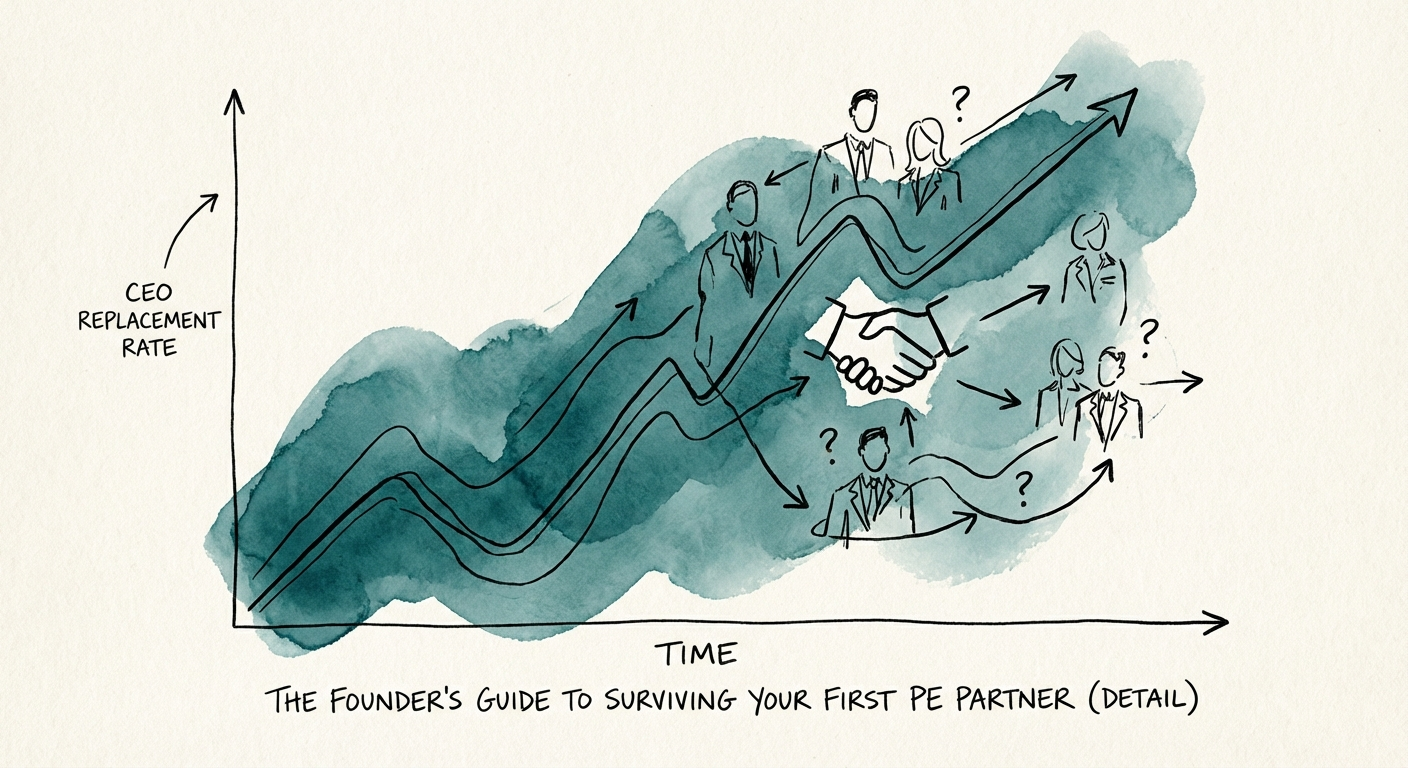
The statistics are sobering. According to AlixPartners, 58% of portfolio company CEOs are replaced within two years of an investment. Over the full investment cycle, that number climbs to 73%. This isn't because founders are incompetent; it's because the skills required to start a company (0 to $10M) are diametrically opposed to the skills required to scale one ($10M to $50M+) under institutional governance.
The “pace of change” conflict
Why do these relationships fracture? It’s rarely about product vision. It’s about operational cadence. In a survey of PE investors, 78% cited “pace of change” as the primary friction point with portfolio CEOs. The firm expects a 100-day value creation plan to be executed with military precision. The founder, used to organic evolution, feels suffocated by the sudden demand for weekly flash reports, 13-week cash flow forecasts, and rigorous KPI tracking.
If you want to survive—and thrive—you must fundamentally alter your operating identity. You must transition from the Chief Hero who saves the day to the Chief Executive who builds the machine.
It’s a lack of due diligence on the CEO. PE firms often do due diligence on all aspects of a company except the leadership. Then they realize they have a problem.
The Language Barrier: Fluent Founder vs. Fluent EBITDA
Your new board speaks a language of risk mitigation and asset appreciation. If you continue to speak the language of product features and “gut feel” sales forecasting, you will be managed out. Surviving the transition requires mastering three specific operational pillars.
1. Professionalize the Financial Function Immediately
In founder-led mode, financial reporting is often “close enough” and cash-basis. In PE-backed mode, this is a fireable offense. Your partners need GAAP-compliant financials to service debt covenants and model exit scenarios. If your Month-End Close takes 20 days, you lack the operating visibility to steer for two-thirds of the quarter.
The Standard: You need a hard close by Day 10, a flash report by Day 5, and a board deck that bridges the gap between bookings and recognized revenue. If your current finance leader is a glorified bookkeeper, you need to upgrade to a strategic VP of Finance or CFO within the first quarter. Do not wait for the board to tell you this.
2. Eliminate Key-Person Dependency
Valuation is a function of transferability. If the revenue stops when you go on vacation, your business has no enterprise value—it only has “founder value.” PE firms fear “key man risk” more than market downturns. They will push you to document processes and hire a layer of management that makes you redundant.
This feels threatening to many founders. It shouldn’t. It is the only path to a “second bite of the apple.” By documenting your sales playbook and extracting yourself from daily operations, you prove that the business is a systemic engine, not a cult of personality. This is how you drive multiple expansion from 4x to 12x.
3. Radical Transparency in Board Reporting
Founders often try to “manage” the board by hiding bad news until they can fix it. This is fatal. PE operating partners hate surprises. If you miss a quarter, that’s a business problem. If you miss a quarter and didn’t warn them, that’s a trust problem.
- Bad News Early: If pipeline coverage drops below 3x, flag it immediately.
- Data, Not Stories: Replace “I think we can close Big Corp” with “Stage 4 opportunity; 60% probability based on procurement status.”
- Ask for Help: Your board members have seen this movie before. Use them as consultants, not just graders.
The Verdict: Evolve or Be Replaced
The high replacement rate of founders is not a conspiracy; it is a reflection of the difficulty of the transition. The operational rigor required to satisfy a PE sponsor is intense, but it is also the discipline that builds massive value. The founders who survive are the ones who stop fighting the process and start leveraging it.
Your 90-Day Survival Action Plan:
- Audit Your Metrics: Implement a KPI dashboard that mirrors your sponsor’s investment thesis. If they bought you for growth, track CAC payback. If they bought you for cash flow, track EBITDA margin.
- Hire Your Successor’s Skillset: Bring in a COO or VP of Operations who loves the “boring” work of process documentation and compliance. Let them handle the integration while you focus on strategy.
- Over-Communicate: In the absence of information, investors assume the worst. Send a weekly Friday email with three bullets: Good, Bad, and Ugly.
Surviving your first PE partner isn’t about retaining control over every decision; it’s about retaining alignment on the outcome. You both want the same exit. The only question is whether you are willing to build the systems required to get there.