
The practical answer
- Short answer
- Founder dependency costs companies a 30-50% valuation haircut. Learn how to transition from heroics to systems and reclaim 9.3 hours/week per employee.
- Best fit
- Industry: B2B Tech & Services. Function: Operations
- Operating path
- Process Documentation → Operational Excellence → Transaction Execution Services
- Key metric
- 30-50% Valuation discount for founder-dependent firms vs. systematized peers.
The High Cost of Being Essential
You know the feeling. It’s 4:45 PM on a Friday. A key client is threatening to churn, a server migration just failed, or a complex proposal needs approval. The team is frozen. They turn to you. You swoop in, make three phone calls, fix the technical glitch, and smooth over the client relationship. You save the day. Again.
In the early days ($1M to $5M ARR), this was your superpower. Your ability to solve any problem through sheer force of will and tribal knowledge was the engine of growth. But now, at $15M or $30M, that same superpower has become your company’s single biggest liability. We call this the Hero Trap.
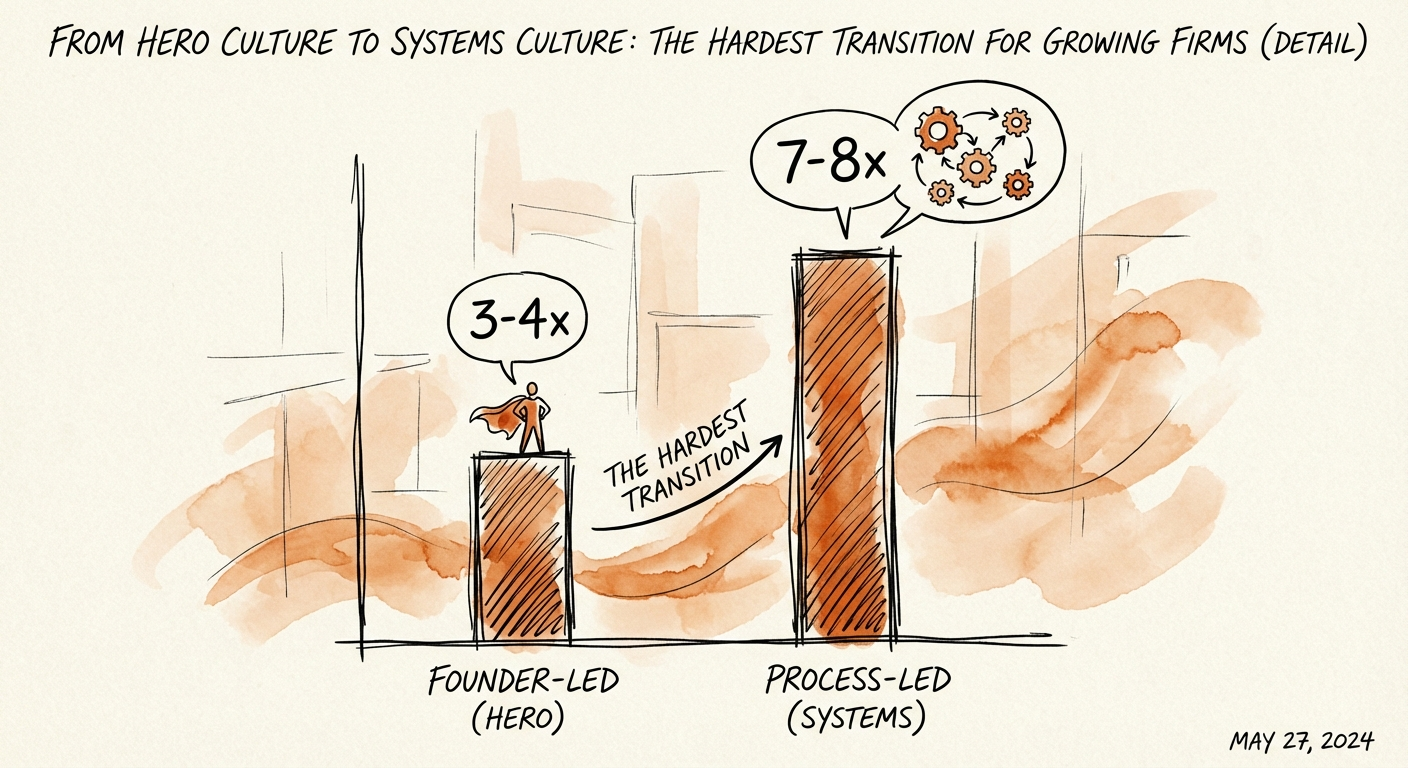
Hero Culture feels productive because it is high-activity. But it is low-leverage. Every time you have to be the hero, it is a failure of process. More importantly, the market punishes it severely. Data from strategic exit advisors indicates that businesses with extreme founder dependency typically trade at a 30-50% discount compared to their systematized peers. While independent firms command 7-8x EBITDA multiples, hero-led firms struggle to fetch 3-4x.
This is the "Hero Tax." You are paying for the privilege of being indispensable with millions of dollars in lost enterprise value.
Every time you have to be the hero, it is a failure of process. You are paying for the privilege of being indispensable with millions of dollars in lost enterprise value.
The Math of Systematization
The transition from Hero Culture to Systems Culture is not an HR initiative; it is a financial imperative. When knowledge is locked in the heads of a few "heroes," your operational costs balloon.
According to McKinsey, the average knowledge worker spends 1.8 hours every day—or 9.3 hours per week—just searching for information. That is effectively one day a week per employee lost to digital wandering. For a 50-person firm with an average fully loaded cost of $120k, that is $1.5 million in annual waste. That isn't just lost productivity; it's EBITDA incinerated.
Systems Are Equity
A founder often resists documentation because it feels "bureaucratic" or "corporate." She fears losing the agility that made the startup successful. This is a misunderstanding of what modern systems do. Good systems do not restrict talent; they liberate it from rote decision-making.
Consider the difference between a Hero Culture and a Systems Culture:
- Hero Culture: Success relies on specific individuals being available. "If Tom leaves unexpectedly, we're finished."
- Systems Culture: Success relies on the process. "If Tom leaves, the playbook remains."
The market premium for the latter is massive. Acquirers do not buy people (who can leave); they buy engines (which stay). The delegation paradox is that the less you do personally, the more your company is worth.
The 90-Day Extraction Plan
You cannot document everything overnight, nor should you. The goal is not to create a 500-page manual that nobody reads. The goal is Founder Extraction from the critical path.
Step 1: Audit the 'Just Ask Sarah' Moments
For one week, track every time a decision waits for you. Categorize them. You will likely find that 80% of these interruptions fall into three buckets (e.g., pricing approval, technical triage, hiring decisions). These are your "Crown Jewels"—the tribal knowledge that must be extracted first.
Step 2: Video-First Documentation
Stop writing long SOPs. It takes too long and they go stale too fast. Instead, record yourself doing the task or explaining the decision rubric using Loom or Zoom. Have a junior operator transcribe that video into a checklist. From tribal knowledge to turnkey is faster when you speak instead of type.
Step 3: The 'Use It or Lose It' Rule
A system only exists if it is used. Implement a rule: if a team member asks a question that is already documented, do not answer it. Send the link. If it isn't documented, answer it, but require them to document the answer immediately. This shifts the burden of documentation from the expert to the learner.
The transition to Systems Culture is painful. It requires you to stop getting dopamine hits from saving the day. But the reward is a business that scales without breaking you—and an exit valuation that reflects the machine you built, not just the hours you worked.