
The practical answer
- Short answer
- Your CTO wants a rewrite. Your board wants features. Here's how a B2B SaaS founder triages technical debt by what it actually costs in lost ARR.
- Best fit
- Industry: B2B SaaS. Function: Engineering
- Operating path
- Technical Debt → Turnaround & Restructuring → Transaction Advisory Services
- Key metric
- 33% Developer time spent on tech debt (Stripe)
Your CTO Just Asked for a "Stabilization Quarter." Don't Say Yes Yet.
Here is the conversation that lands on a B2B SaaS founder's desk somewhere between $5M and $20M ARR. Engineering wants to pause the roadmap for a quarter to "pay down debt." Sales is screaming because the feature they promised three enterprise prospects is two sprints behind. And you, holding the P&L, have to decide whether the platform problem is real or whether your team just wants to rewrite code they find embarrassing.
Both can be true at once. That's what makes the decision hard. The signal that something is genuinely wrong is rarely a complaint about ugly code — it's the schedule slipping in a way that compounds. A change that shipped in three days last year now takes a sprint. A "small" fix in checkout breaks reporting. New hires take four months to ship anything because nobody can explain how the billing module actually works.
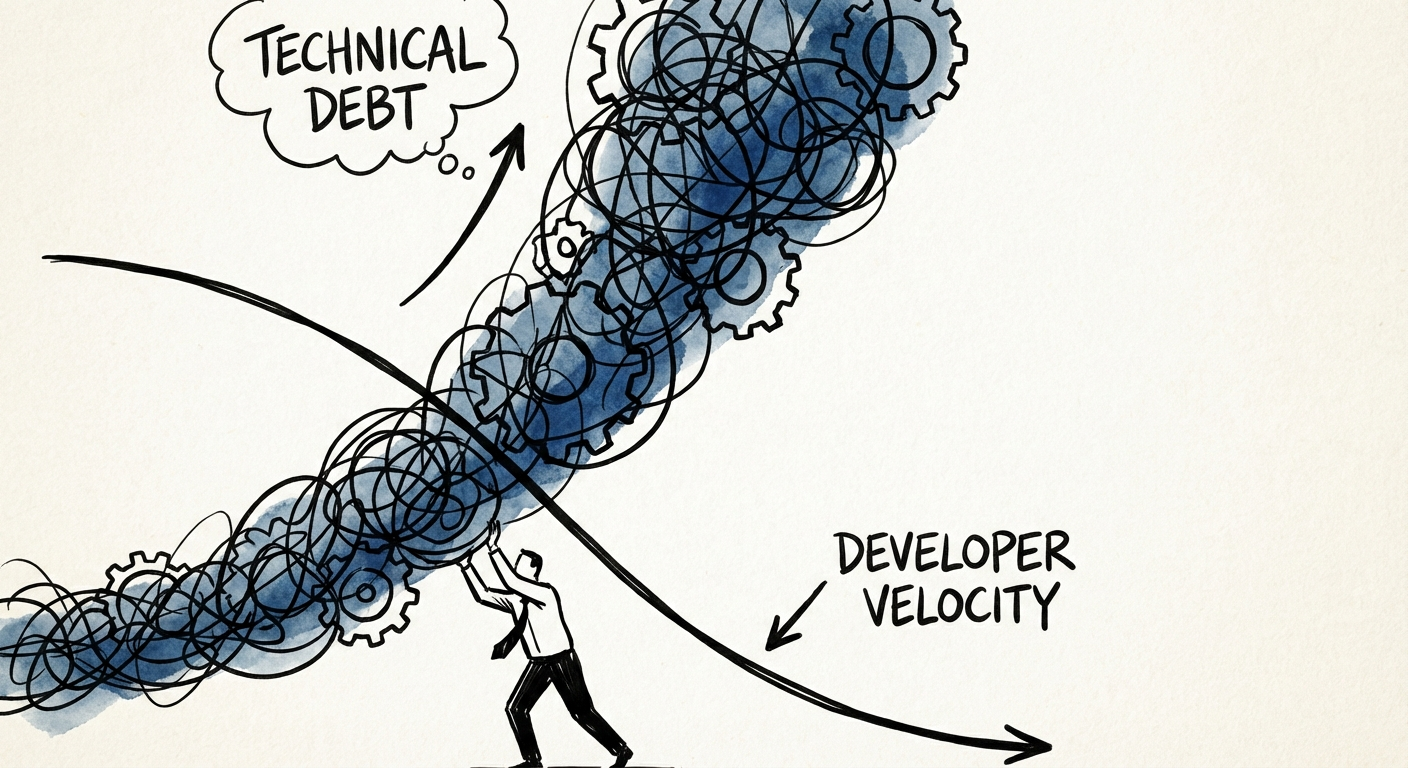
The scale of the leak is well documented. Stripe's Developer Coefficient found engineers spend about 33% of their time wrestling with technical debt and maintaining bad code. Run the arithmetic on your own org: at a $4M engineering payroll, that's roughly $1.3M a year you're spending to stand still. The aggregate number is staggering too — the Consortium for Information & Software Quality (CISQ) pegs U.S. poor-software-quality cost at $2.41 trillion. But that figure is useless to you. You don't owe $2.41 trillion. You owe whatever debt is sitting between your product and the next renewal cohort, and the job is to find exactly which debt that is.
Your engineers will rank tech debt by how much it annoys them to work in. Your job is to re-rank it by how much it costs you to grow. Those two lists almost never match.
Sort Your Debt by Lost Revenue, Not by How Much It Annoys Engineers
The default failure mode is letting engineering decide what to fix without giving them the commercial context. Left alone, a strong team will prioritize the code that's most painful to work in. That's an honest instinct and the wrong sort order, because the most annoying module and the most expensive module are usually different modules.
For a SaaS business specifically, debt earns its priority based on what it does to the metrics that move your valuation: net revenue retention, gross margin, and sales velocity. Walk your debt backlog through three questions, in this order:
- Is it costing you renewals or expansion? A multi-tenant data isolation bug, a usage-metering pipeline that under-bills, an onboarding flow that silently drops 8% of new seats — this debt directly attacks NRR. Fix it now. It's not maintenance; it's revenue you've already booked and are leaking.
- Is it blocking a deal you can name? The SSO integration enterprise buyers require. The audit-log gap that fails every security review. The reason your CI pipeline takes three days to ship a one-line copy change. This is debt with a dollar figure attached to a specific pipeline opportunity. Carve out steady sprint capacity against it.
- Does it merely offend the engineers? The reporting service nobody has touched in two years, written in a framework version everyone hates, that runs fine. Wrap it behind a clean API and walk away. Rewriting code that isn't blocking growth is the most expensive form of procrastination in software.
This is where the cost of the alternative — the full rewrite — has to be stated plainly. Pausing the roadmap to rebuild the platform usually buys you a quarter of zero new revenue and a fresh codebase carrying its own new set of defects. The pattern in the data backs the targeted approach: McKinsey's Developer Velocity research found the strongest performers concentrate effort on the small set of high-traffic components that everything else depends on, rather than boiling the ocean. In most codebases, a handful of files touch nearly everything. Repair those, and velocity returns without a rewrite. For founders eyeing an eventual exit, this same map is what a buyer's technical diligence will produce about you — better to have triaged it yourself first.
What to Actually Do Monday Morning
A triage list with no funding mechanism becomes a wish list. Annual "refactoring sprints" don't work for the same reason paying your credit card once a year doesn't — the interest outruns you between payments. Three concrete moves, in increasing order of leverage:
1. Fund it as a standing line item, not an event. Commit a fixed slice of every sprint — many SaaS teams land near 20% — to the renewal-and-deal-blocking debt at the top of your list. The point isn't the exact percentage; it's that it's recurring and protected, so the backlog stops growing while you draw down principal.
2. Make cleanup a side effect of feature work. When an engineer opens a file to build something, they tidy that specific file before they close it. This routes your cleanup effort precisely toward the code you actually touch — which is, by definition, the code that matters — instead of toward the museum pieces nobody visits.
3. Report velocity to your board, not bug counts. "Bugs fixed" is a vanity metric that rewards generating bugs. Track whether features are shipping faster and whether your change-failure rate (the share of deploys that cause an incident) is falling. Gartner expects most engineering organizations to formalize this kind of measurement by 2027; the teams already running it tend to outship the ones that aren't.
Your role in this isn't to read the code. It's to set the repayment schedule and defend it against both the rewrite evangelists and the ship-features-at-all-costs crowd. Triage by what each defect costs you in retained and net-new ARR, fund the top of that list every single sprint, and you turn engineering back from a tax on growth into the thing that compounds it. If you want to put a margin number on that shift, here's how to connect those engineering gains to the financials your board cares about.