
The practical answer
- Short answer
- 70% of digital transformations fail. Learn the board-level communication framework to survive a 6-month delay and pivot to a 30-day rescue plan.
- Best fit
- Industry: Enterprise IT. Function: Engineering & Operations
- Operating path
- Project Recovery → Turnaround & Restructuring → Transaction Execution Services
- Key metric
- 45% Avg. Budget Overrun for Large IT Projects (McKinsey)
The Watermelon Effect: Why You’re Green, Green, Green... Then Suddenly Red
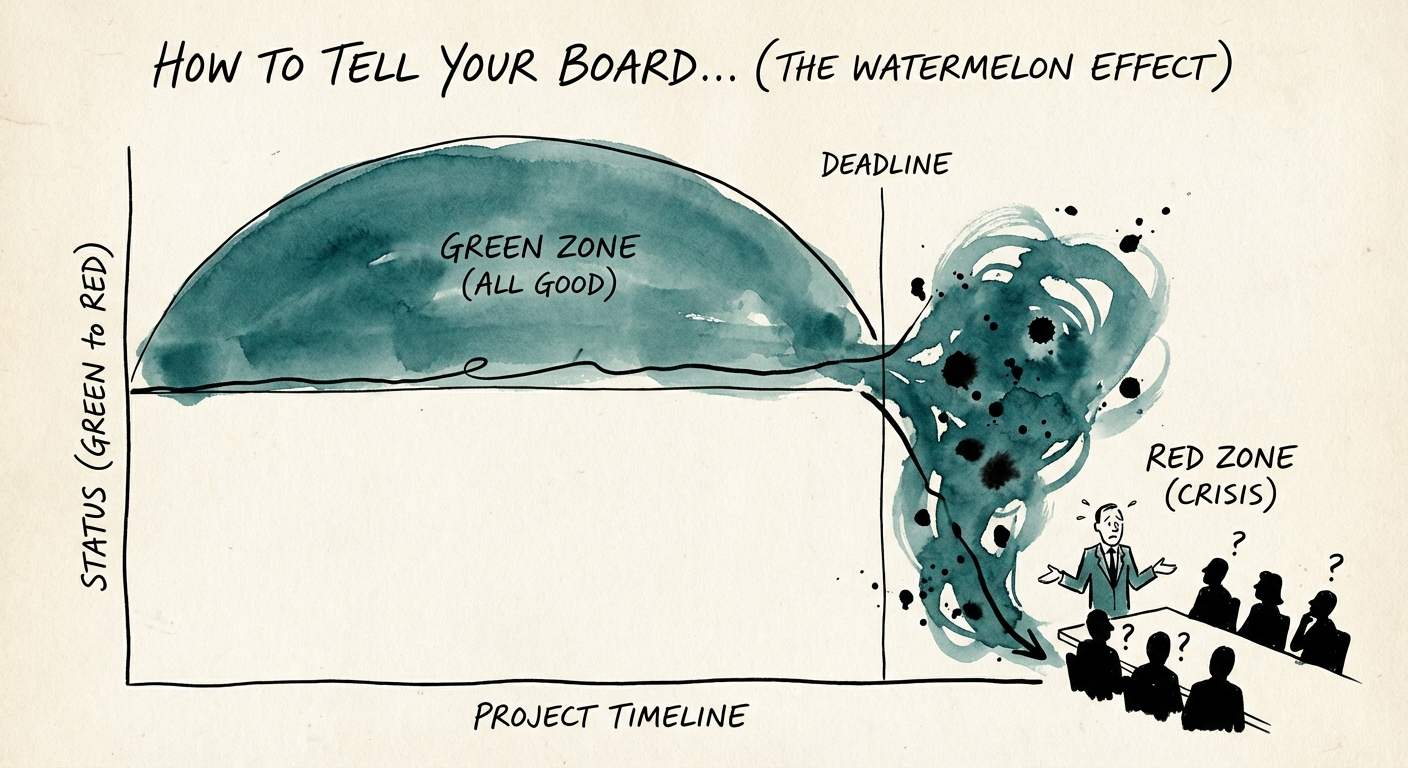
There is a specific moment in every failed digital transformation where the CIO realizes they have been reporting “Green” on a project that has been rotting from the inside for months. In the industry, we call this the Watermelon Effect: Green on the outside (your status reports), but deep Red on the inside (the actual code and delivery reality).
If you are reading this, you are likely staring at a board deck due in 48 hours. The ERP migration, the cloud consolidation, or the new customer portal was supposed to launch next month. But your engineering lead just told you they are “blocked on dependencies,” QA hasn’t started, and realistically, you are six months behind schedule.
The Cost of Optimism
You are not alone in this trap. McKinsey and Oxford University data shows that large IT projects run 45% over budget and 7% over time, while delivering 56% less value than predicted. The problem isn’t just the delay; it’s the surprise. Boards can forgive bad news; they cannot forgive bad surprises. When you report “Green” for three quarters and then suddenly drop a “Red” bomb with a six-month delay, you aren’t just killing the project timeline—you are killing your credibility.
The instinct is to hedge. You want to say, “We have some headwinds, but we’re pushing hard.” Do not do this. Hope is not a strategy, and “pushing hard” is not a metric. To keep your job, you must shift immediately from a defensive reporter of status to an offensive architect of recovery.
Boards can forgive bad news; they cannot forgive bad surprises. When you report 'Green' for three quarters and then suddenly drop a 'Red' bomb, you aren't just killing the project—you are killing your credibility.
The Diagnostic: Are You Late, or Are You Lost?
Before you walk into the boardroom, you need to understand the physics of your delay. Most “six-month delays” are actually indefinite stalls masked by activity. You need to present data that proves you know exactly why you are stopped.
The 3 “Red” Reality Checks
To regain trust, you must audit your own initiative against three criteria. If you fail these, you are not just late; you are failing.
- The Velocity Gap: Look at your burn down charts. If your team is completing 10 story points a week but scoping 15 new ones, you will literally never finish. Stalled initiatives need a triage framework, not just “faster coding.”
- The Dependency Deadlock: Is your delay caused by a vendor (e.g., waiting on APIs) or internal politics (e.g., InfoSec refusal to approve architecture)? Cross-functional deadlock is the silent killer of timelines. If you can't name the specific blocker, you are the blocker.
- The Sunk Cost Fallacy: Are you trying to save 12 months of bad code? Sometimes the recovery plan is a restart. Be prepared to show the math on why a “clean slate” might be faster than a “fix.”
The “Cost of Delay” Math
Your board speaks EBITDA, not Agile. Translate your delay into their language. If this platform was supposed to save $200k/month in manual labor, a 6-month delay is a $1.2M EBITDA hit. If it was a revenue product, calculate the lost ARR. When you quantify the pain, you demonstrate commercial maturity. This shifts the conversation from “Why did you fail?” to “How do we save this $1.2M?”
According to 2025 data, 85% of AI projects fail to deliver on their promises (Gartner). Do not let your project become a statistic by hiding the financial reality. Transparency builds the bridge back to trust.
The Recovery Script: 3 Slides to Save Your Job
You have 15 minutes in the board meeting. Do not bring a 40-page deck. You need three slides. This is your “30-Day Rescue” proposal.
Slide 1: The Brutal Truth (No Watermelons)
State the delay clearly: “We are 6 months behind. The original go-live of Q3 is impossible. The new forecasted date is Q1 next year.” List the Root Causes in bullet points (e.g., “Vendor X delivered non-functional code,” “Scope creep added 40% to requirements”). Own the oversight failure, but focus on the mechanical failure.
Slide 2: The “Kill, Fix, or Pivot” Matrix
Give the board agency. Present three options with costs attached:
- Option A (The Hero Push): Add $500k in contractor budget to hit a Q4 launch. (High Risk).
- Option B (The Descope): Cut 40% of features to hit the original Q3 date. Launch an MVP. (Medium Risk).
- Option C (The Pause): Pause development for 30 days to re-architect, launching fully in Q1. (Low Risk, High Delay).
Recommend one option strongly, backed by your “Cost of Delay” math. This shows you are managing the investment, not just reporting the weather.
Slide 3: The 30-Day Governance Fix
Promise a new reporting cadence. “For the next 30 days, we are moving to weekly ‘Build/Block’ reporting. You will see exactly what was built and what is blocked every Friday.” This removes the surprise factor. It proves you are adopting an operator’s mindset.
Conclusion: Crisis is Leverage
A project delay is a crisis, but it is also leverage. It is your opportunity to demand the resources, scope cuts, or governance changes you needed six months ago but were too polite to ask for. Use the crisis. Kill the watermelon. Turn the board into your partners in recovery, not your executioners.