
The practical answer
- Short answer
- Most revenue synergies in the deal model never reach the P&L. Here's how PE operators tie every claimed dollar to a GL code, a date, and a sign-off.
- Best fit
- Industry: Private Equity. Function: Operations
- Operating path
- Migration & Integration → Turnaround & Restructuring → Transaction Advisory Services
- Key metric
- 70% Of mergers fail to achieve projected revenue synergies (Bain)
The deal model said $5 million. The bank account disagrees.
Open the IC memo from the deal you closed in Q1. There's a line that reads something like "$5.0M run-rate synergies, fully realized by Year 1." It carried the model. Strip those synergies out and the entry multiple stops looking like a 4x and starts looking like a coin flip. So nobody stripped them out.
Now it's the second board meeting post-close and the EBITDA bridge won't reconcile. The savings haven't shown up — but the spend to chase them has. Severance is booked. The migration vendor invoiced. The integration consultant is on a six-figure retainer. You're carrying the full cost of capture against roughly none of the benefit, which means for two quarters the deal you bought is generating less cash than the two companies did standing apart.
This is the predictable failure mode, not the unlucky one. Bain & Company found that roughly 70% of mergers fall short of their projected revenue synergies, and overestimating those synergies is the single most common reason deals underperform. McKinsey puts the other half of the problem upstream — as much as half of a deal's value gets overlooked in diligence in the first place. The number in your model was never wrong because the idea was wrong. Merging two Salesforce orgs really does save money. It went wrong because nobody could tell you, in any given month, whether the saving had actually happened.
The three places the money disappears
When a synergy "fails," it almost never fails as a decision. It fails as a measurement. Three leaks account for most of it, and a portfolio CFO will cite all three to you in the same meeting:
- Baseline drift. "We cut $200K of software spend — but the business grew and added $300K of new licenses, so the line went up." Technically true. Also a way to bury a real synergy inside organic noise so no one can ever claim it.
- Negative payback. You spent $1.50 in one-time cost to lock in $1.00 of recurring saving and called it a win. It's a win in Year 3. In Year 1 it's a drag, and your fund's hold clock doesn't care about Year 3.
- The soft-synergy shell game. "Combining the support teams makes us 20% more efficient." Efficient how? If headcount didn't drop and no planned hire got canceled, that 20% is morale, not margin. Margin pays down the deal debt. Morale does not.
You don't need a more optimistic team. You need a forensic ledger that treats every claimed dollar as guilty until proven realized.
A synergy you can't trace to a specific GL line, on a specific date, signed off by three people who don't report to each other, isn't a synergy. It's a hope with a number next to it.
Sort the synergies by how hard they are to lie about
The first mistake is putting all synergies in one pot and tracking them with one method. They aren't one asset class. A vendor you can cancel tomorrow and a cross-sell that depends on a customer changing their buying behavior are not the same kind of number, and pretending they are is how the $5M turns into a mirage. Sort them by how easy it is to fool yourself.
Bankable: the savings that show up in a GL line
Redundant vendor killed, satellite office closed, duplicate tool retired. These are binary — you did it or you didn't — so track them against the general ledger, not against a slide. If you've claimed $500K of "IT vendor consolidation," then the software-subscription GL line has to drop by roughly $41.6K a month versus the combined pre-close baseline. It either does or it doesn't. "Volume variance" is not an acceptable answer. This is the only bucket you should let touch the EBITDA bridge before it's proven.
At-risk: revenue synergies, which depend on people who don't work for you
Cost synergies need your team to act. Revenue synergies need your customers to act — and McKinsey's read on the lifecycle is blunt: revenue capture takes years, not quarters, far longer than cost capture. So stop tracking closed cross-sell dollars in Month 3; there won't be any, and the absence will spook the board for the wrong reason. Track the leading indicators that actually predict Month 9: joint account plans built, reps certified on the acquired product, and pipeline explicitly tagged as synergy-sourced. If that tagged pipeline isn't filling by Month 3, the revenue isn't coming in Month 9 — and you've bought yourself six months to fix it instead of finding out at the annual review.
Soft: the bucket that should default to zero
"Productivity improvement" is where dead synergies go to look alive. The rule is unforgiving on purpose: a process efficiency only counts when it produces a canceled open requisition or an avoided hire you can name. Made the team faster but kept everyone and kept recruiting? Congratulations, you improved morale. It will not service the debt.
The ratio that decides whether any of it was worth it
Every dollar of synergy has a price to extract — severance, data migration, legal, the consultant. Track Cost-to-Achieve as a hard ratio and hold the line at 1:1 in Year 1: spend a dollar one-time to capture a dollar of annual recurring saving, and you've got a one-year payback. Deal models love to pencil in 0.5:1 — fifty cents to capture a dollar — and in a messy technical integration that assumption is usually fiction. Alvarez & Marsal's work on realization is consistent on this: the gap between modeled value and captured value is mostly a tracking discipline gap, not a strategy gap. Price the capture before you celebrate the saving.
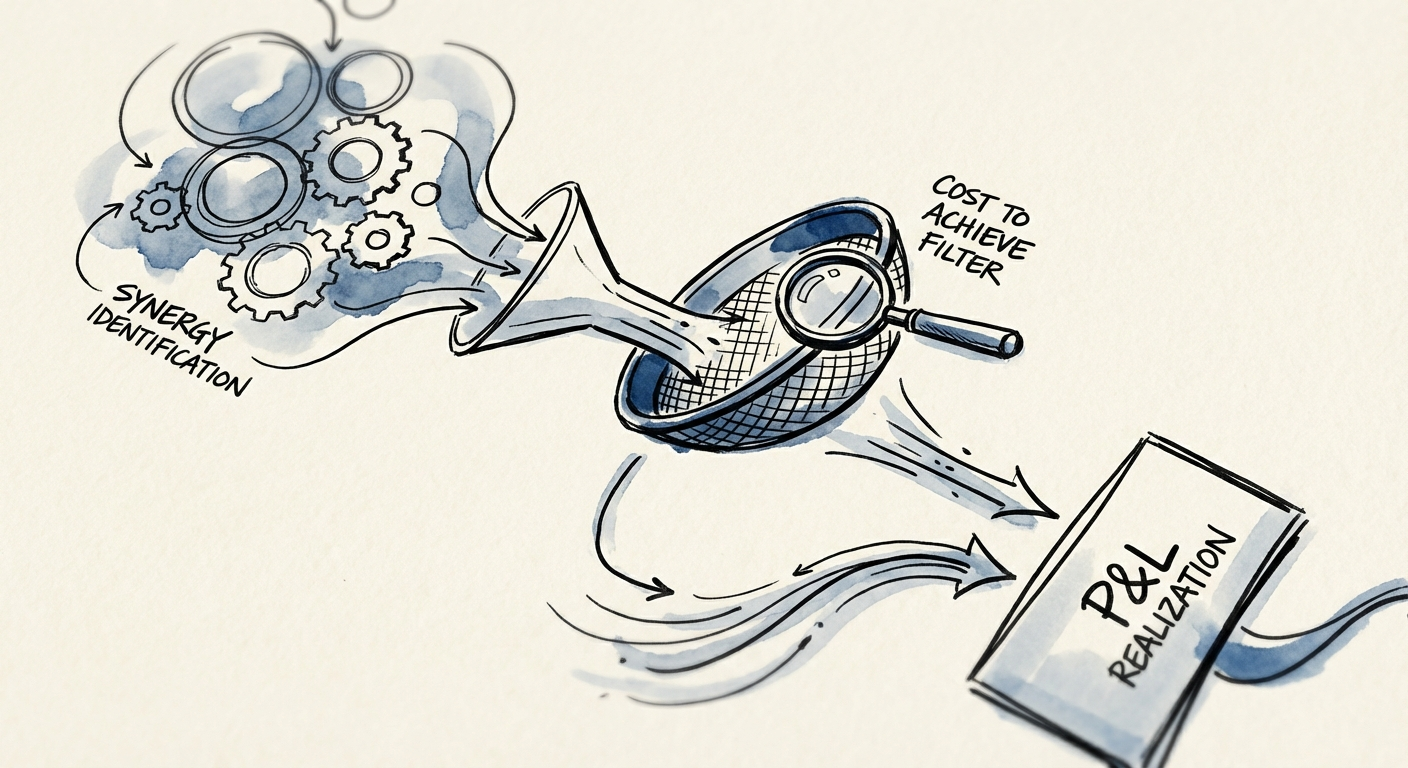
Run the IMO like a central bank that prints no money
Decentralized tracking is how the mirage survives. If every functional lead reports their own savings on their own spreadsheet, every one of them is incentivized to round up, and you'll find out at exit that the EBITDA you were paid a multiple on was partly imaginary. The Integration Management Office has exactly one monetary job: refuse to recognize a dollar until three people who don't report to each other agree it exists.
The three-signature rule
No functional leader self-certifies their own savings. Ever. A synergy card only turns green when all three of these are on record:
- Initiative owner: "The vendor contract is canceled, effective this date."
- Finance: "I see the expense gone from the forecast and the GL."
- Integration lead: "Nothing broke — no service disruption tied to this cut."
Three signatures or it stays amber on the steering-committee board. The owner who actioned it does not get to also confirm it landed. That separation is the whole point.
The distinction that the 100-day flash report exists to enforce
For the first quarter post-close, your weekly flash needs a synergy-pace section with three columns — and the columns are not decoration:
- Committed — identified, owned, and on someone's name.
- Actioned — the legal or operational trigger has been pulled (notice served, requisition canceled).
- Realized — the P&L felt it; the GL moved.
Failed integrations are almost always reporting "committed" while the board hears "realized." Your job is to make the org physically incapable of confusing the two, because the gap between those columns is exactly the gap between your model and your return.
What you do at Monday's standup
Stop accepting "we're working on it." It's not a status; it's the sound of a synergy quietly migrating from your IC memo to your loss column. For every line on the synergy register, ask three questions and refuse to move on without answers: which GL code, what date, how many dollars. The difference between a 2x and a 5x on this deal won't be decided at the closing dinner — it gets decided in the unglamorous weekly grind of forcing every claimed dollar to prove it's real. If you want the upstream view of why these numbers inflate before close, read the guide to real EBITDA add-backs or our breakdown of why projected savings so often never land.