
The practical answer
- Short answer
- Cloud budgets often miss the real cost of migration. See how egress, dual-run periods, skills gaps, and weak FinOps controls create overruns.
- Best fit
- Industry: Tech Services. Function: IT Operations
- Operating path
- Migration & Integration → Turnaround & Restructuring → Transaction Advisory Services
- Key metric
- 27% Of Total Cloud Spend is Wasted (Flexera 2025)
Why Cloud Migration Budgets Miss
You signed the contract based on a TCO (Total Cost of Ownership) analysis that promised lower infrastructure spend. The slideware was compelling: shut down the data center, move to the cloud, and convert fixed assets into flexible operating expense. Six months later, the monthly cloud bill is higher than expected, and the legacy environment still has not been decommissioned.
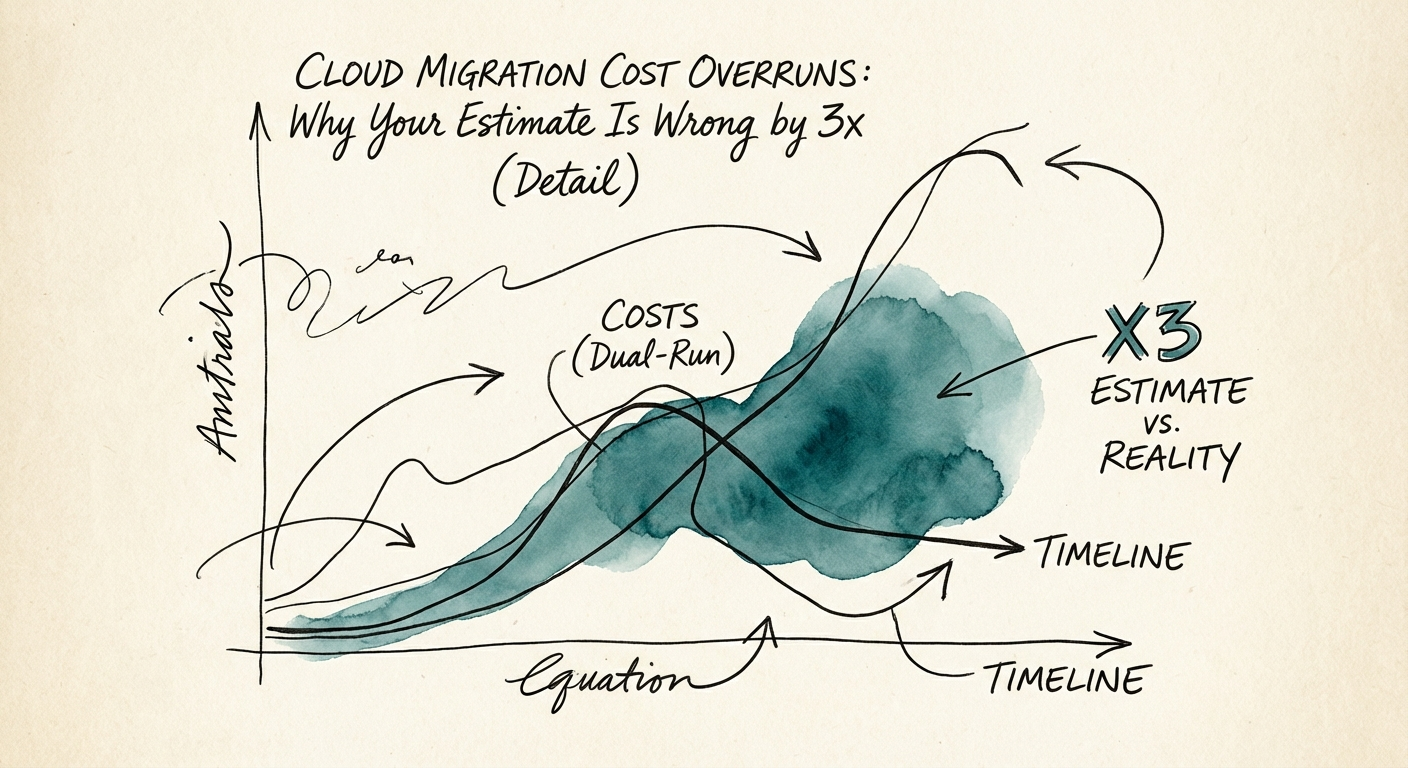
You are not an outlier. According to Forrester’s recent data, 72% of IT decision-makers exceeded their set cloud budgets in the most recent fiscal year. The problem usually is not that cloud is inherently too expensive. It is that the migration model underestimates dual-running, data movement, skills gaps, and governance work.
The root cause is often the lift-and-shift trap. In the rush to meet transformation deadlines, teams rehost inefficient, monolithic applications that were designed for static hardware. The result is legacy architecture running on premium cloud infrastructure. The infrastructure moved, but the operating model did not.
Cloud migration only creates value when the operating model changes with the infrastructure.
The Hidden Cost Categories
When we audit stalled migrations, budget overruns rarely come from the compute line item alone. The expensive misses usually come from three categories that are under-modeled in the initial system integrator proposal.
1. Data Egress and Integration Traffic
Ingress is often free; egress is where hybrid architectures become expensive. Data moves between legacy systems, cloud analytics platforms, backup environments, and third-party tools. Every gigabyte that leaves the cloud to communicate with a legacy environment can create an egress fee. We have seen migration budgets miss because the architecture diagram looked clean, while the invoice reflected continuous cross-environment traffic.
2. The Dual-Run Penalty
Most migration plans assume a linear transition: System A turns off on Monday, System B turns on Tuesday. Reality is messier. Many companies run both environments in parallel for 6 to 18 months. This dual-run phase can materially increase infrastructure cost during the transition window. If the budget did not account for paying the data center lease and the cloud bill simultaneously, the forecast was incomplete. Refer to our 28,000-User Migration Playbook for how to manage overlapping timelines without disrupting users.
3. The Talent Premium
Legacy infrastructure teams are not automatically cloud architecture or FinOps teams. The skill gap is real, and bridging it costs money. You may need specialized contractors, internal retraining, or a dedicated governance function. Flexera's 2025 State of the Cloud Report notes that 27% of all cloud spend is wasted, much of it from over-provisioned resources and unused instances.
The Recovery Playbook: Governance Before Optimization
If you are materially over budget, stopping the migration is rarely the best option. But you do need cost controls immediately. The solution is not to optimize later; it is to install governance while the migration is still moving.
- Implement a tagging policy immediately. If a resource is not tagged with a cost center and an owner, it should be reviewed, assigned, or retired under a defined governance process.
- Establish a repatriation review. Moving selected workloads back to private cloud, colocation, or owned infrastructure is not failure; it is a workload economics decision. If a workload is static, high-volume, and predictable, public cloud may not be the right financial instrument.
- Unblock decision latency. Costs often spiral because the migration is stuck in committee. Use the framework from The $3M Project Rescue to force alignment and stop funding work that is consuming budget without moving the business outcome.
Cloud migration is not a destination; it is a financial operating model. Treat it like one. If you do not have a FinOps function with the authority to right-size, retire, and govern cloud resources, you do not have a complete cloud strategy. For a deeper dive on benchmarking your spend against peers, read The Black Box of IT Spend: 2026 Benchmarks.