
The practical answer
- Short answer
- 40% of interim executives fail to deliver value. Learn why 'caretaker' CTOs stall growth and how to structure a 90-day mandate that drives EBITDA.
- Best fit
- Industry: B2B Tech. Function: Engineering
- Operating path
- Team & Hiring → Operational Excellence → Transaction Execution Services
- Key metric
- 40% Failure rate of new executives in PE-backed companies (PrimeGenesis)
The "Caretaker" Illusion
You just fired your portfolio company CTO, or perhaps they walked out after the earnout cleared. Now you have a vacancy in the most complex, opaque department in the building. Your immediate reaction is to stop the bleeding. You call a search firm, find a steady interim executive, and slot them in as Interim CTO.
The mandate? "Keep the lights on until we find the permanent hire."
This is the Caretaker Trap, and it can quietly damage your hold period. While you spend 6 to 9 months searching for the "perfect" permanent visionary, your Caretaker Interim is doing exactly what you asked them to do: nothing risky. But in technology, standing still is not stability—it is regression.
Data from PrimeGenesis indicates that 40% of new executives in PE-backed companies fail to deliver on their investment thesis. For interim leaders with vague mandates, the failure mode is not usually a spectacular crash; it is a slow erosion of velocity. They freeze architectural decisions, delay critical refactors, and allow "shadow IT" to proliferate because they lack the mandate to say no.
You think you are buying time. In reality, you are accumulating debt. By the time your permanent CTO arrives, they are not starting at zero; they are starting at negative six months, burdened by a backlog of deferred decisions that will take another year to unwind. As detailed in The Real Cost of Mis-Hires, the financial impact of this leadership void can reach 20x the executive's compensation when opportunity costs are factored in.
A caretaker Interim CTO can preserve the status quo while technical debt compounds. Every month of deferred decisions becomes another month of technical interest.
The "Parking Lot" Effect on Engineering Velocity
When an engineering team perceives their leader as a temporary placeholder, a psychological phenomenon occurs: the "Parking Lot" effect. Senior engineers stop pushing for necessary changes because "the new boss will just change it anyway." Product managers start bypassing engineering leadership to push features directly to developers, breaking process discipline.
The metrics confirm this paralysis. According to Korn Ferry, more than a third of employees report feeling directionless when leadership layers are stripped or in flux. In engineering specifically, this manifests as a collapse in Cycle Time—the time it takes for code to move from "in progress" to "shipped." Without a decisive leader to unblock code reviews and architectural disputes, Cycle Time balloons. What used to take 3 days now takes 10.
The Cost of the "Safe Hands" Approach
Consider the typical 9-month gap between CTOs:
- Months 1-3: The Interim CTO "assesses" the situation (often just reading existing documentation).
- Months 4-6: Critical infrastructure upgrades are paused "for the permanent CTO to decide."
- Months 7-9: The team bleeds top talent who lose confidence in the company's technical vision.
By the time your permanent hire walks in, the stabilization plan is no longer about growth—it's about disaster recovery. You haven't just lost time; you've degraded the asset. Industry analysis suggests that leadership gaps are cited by 70% of organizations as a top barrier to scaling, directly impacting the valuation multiple you're trying to expand.
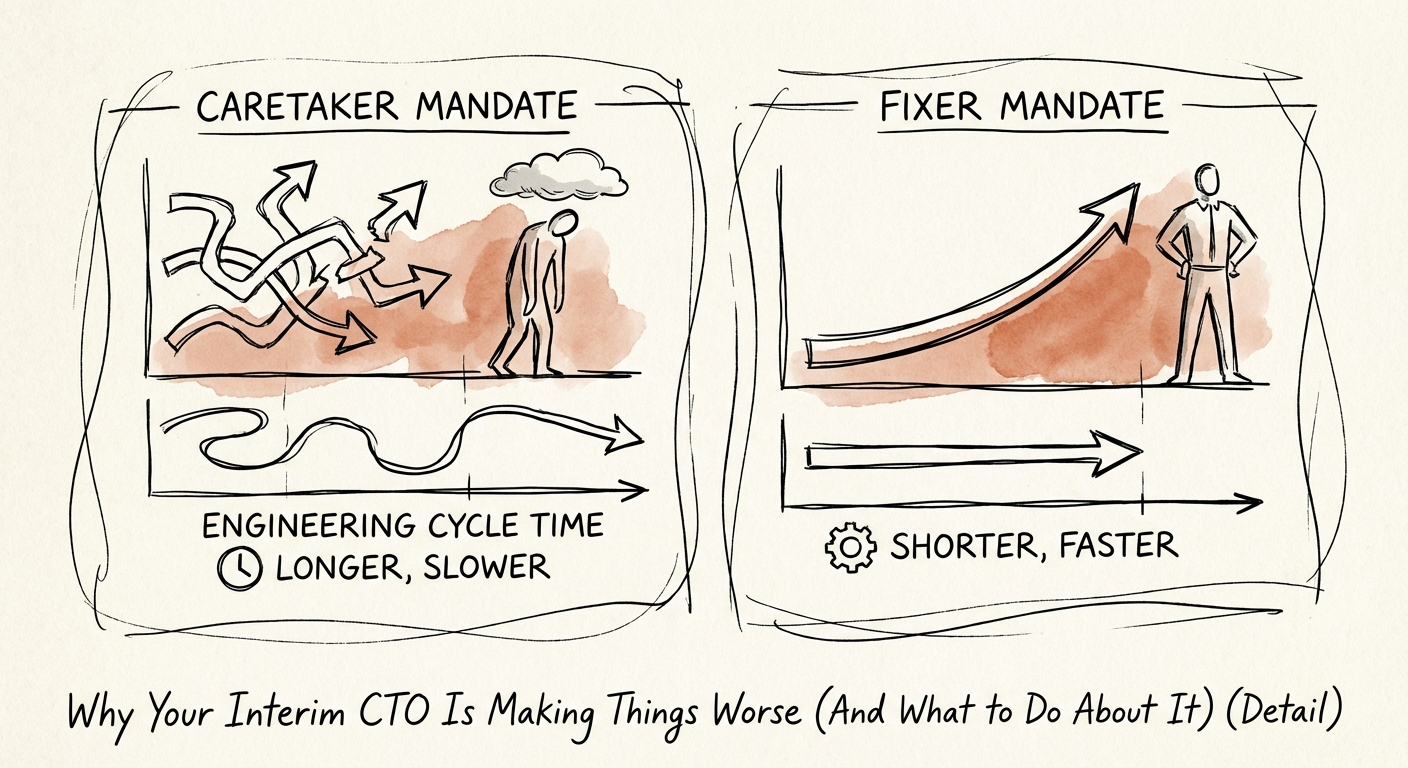
The Solution: From Caretaker to Fixer
To prevent this value erosion, you must change the mandate. Do not hire an Interim CTO simply to preserve the status quo. Hire them to stabilize the function and clear the backlog of hard decisions. The interim period is often the right time to execute necessary changes that a permanent CTO might struggle to survive politically in their first year.
Structuring the "Fixer" Mandate requires a 90-day execution plan, not a consulting agreement. Here is the framework:
1. Days 1-30: The Operating Audit
The Interim CTO must conduct a Non-Technical Audit of the engineering function. Their goal is to identify the talent gaps, architectural dead ends, and process bottlenecks. They should deliver a "State of the Union" report that is direct, evidence-based, and useful to the incoming permanent leader.
2. Days 31-60: The Hard Decisions
Use the interim mandate to make decisions that should not wait for the permanent hire. Have them:
- Stop projects that are draining resources without supporting the investment thesis.
- Restructure the team where accountability is unclear.
- Negotiate exit terms with failing vendors.
When the permanent CTO arrives, they should inherit a cleaner operating system, not a backlog of avoided decisions.
3. Days 61-90: The Handover Architecture
The final month is about documenting the "Why." Why were these decisions made? What is the roadmap for the next 6 months? The Interim CTO transitions from active operator to handoff partner, ensuring the new hire has a running start. This approach turns a liability (a leadership gap) into an asset (a turnaround phase), preserving velocity and protecting your EBITDA.