
The practical answer
- Short answer
- 70% of IT projects fail to deliver value. Learn the framework that turns your IT budget from a 'black box' cost center into a defensible investment portfolio.
- Best fit
- Industry: Enterprise Tech. Function: Information Technology
- Operating path
- Financial Infrastructure → Commercial Performance → Valuations
- Key metric
- 70% Digital transformation projects that fail to meet targets (BCG)
The Trust Gap: Why Your Budget Just Got Rejected
You spent three months building a bottoms-up budget. You gathered quotes from every vendor, accounted for every seat in Salesforce, and padded your cloud commit by 15% for safety. You walk into the board meeting with a 40-slide deck explaining why you need $12M to "modernize infrastructure."
The Operating Partner looks at Slide 1, sees a 12% year-over-year increase, and asks one question: "How does this $12M translate to EBITDA?"
If your answer involves words like "technical debt," "reliability," or "security posture," you’ve already lost. The board doesn’t speak Kubernetes. They speak value creation.
Here is the brutal reality: BCG data shows that 70% of digital transformation efforts fall short of meeting targets. To a Private Equity board, IT is a "Black Box"—a hole where capital goes in, and excuses come out. In 2026, the era of "trust me, we need this" is over. If you cannot draw a straight line from a server cost to a revenue outcome, your budget isn't just at risk—it's dead on arrival.
The "Keep the Lights On" Trap
Most enterprise CIOs present budgets that are 80% "Run" (keeping the lights on) and 20% "Grow" (innovation). But they present it as one lump sum. When a board sees a $15M line item for "IT Operations," they see a tax on the business. They don't see the complexity of maintaining 15 years of legacy code. They just see a cost center that needs to be squeezed.
We see this constantly in our work with mid-market tech firms dealing with the 'Black Box' of IT spend. The CIO argues for stability; the Board argues for margin. You need a translation layer.
If your answer involves words like 'technical debt' or 'reliability,' you’ve already lost. The board doesn’t speak Kubernetes. They speak value creation.
The Framework: Moving from Cost Center to Investment Portfolio
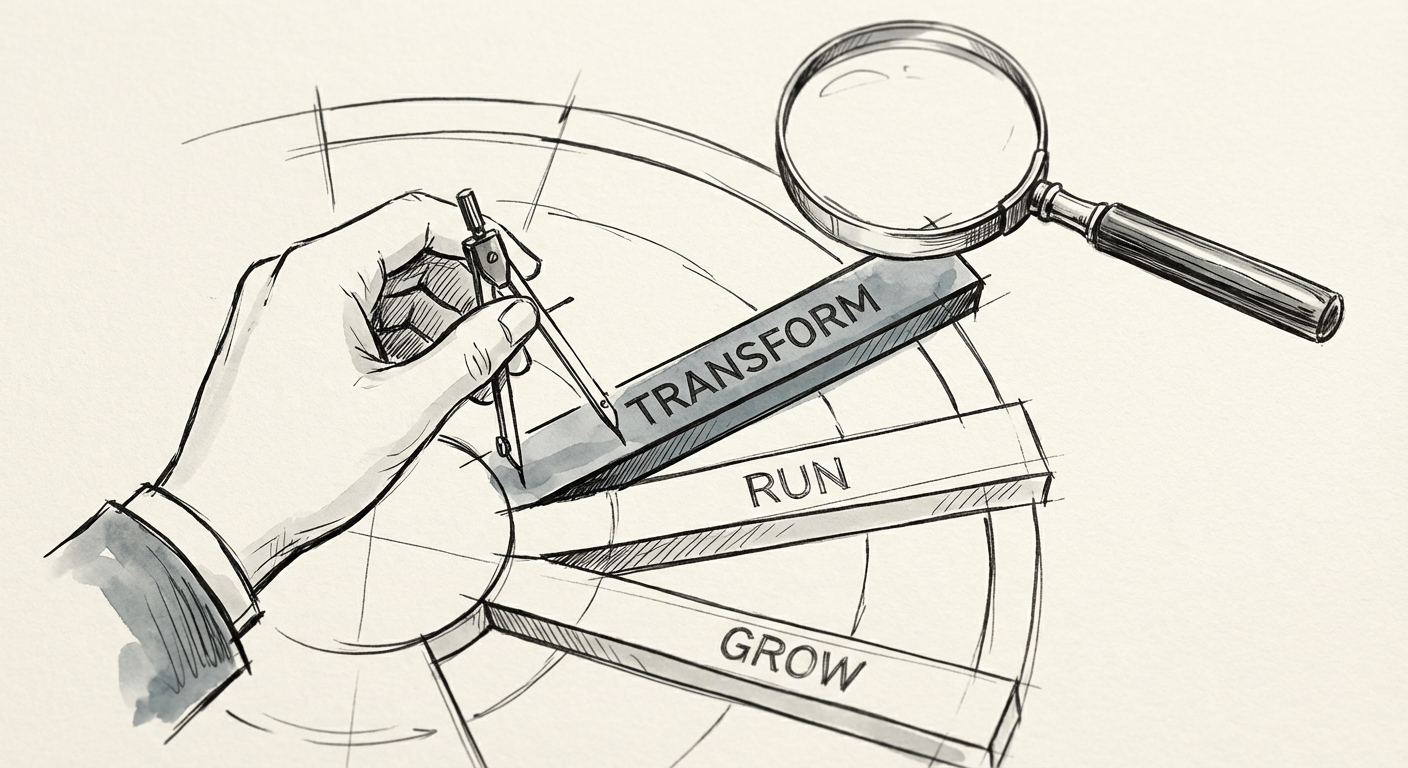
To survive scrutiny, you must stop budgeting like a department head and start budgeting like an investor. This requires restructuring your entire financial presentation into three distinct buckets: Run, Grow, and Transform.
1. Run (The Non-Negotiables)
This is the cost to keep the doors open today. Security compliance, server hosting, helpdesk, essential licensing. Your goal here is efficiency. The metric is Cost to Serve per Employee or IT Spend as % of Revenue.
- Benchmark: Across industries, Gartner forecasts global IT spending growth of nearly 10% in 2025, but for a PE-backed asset, "Run" costs should remain flat or decrease relative to revenue.
- The Defense: "We are keeping unit costs flat while the company scales."
2. Grow (The Scalability Engine)
These are investments that directly enable revenue expansion. New CRM features for the sales team, automated onboarding for customers, faster API response times to reduce churn.
- The Defense: Tie these line items to specific P&L outcomes. "This $200k investment in billing automation will reduce Days Sales Outstanding (DSO) by 5 days."
3. Transform (The Bets)
This is where the "Black Box" usually hides. AI pilots, platform re-architecture, massive migrations. Boards are skeptical here because McKinsey data suggests 17% of large IT projects go so badly they threaten the company's existence.
- The Defense: Ring-fence this budget. Present it as a venture bet with clear kill-gates. "We are spending $50k to pilot this. If we hit X metric, we unlock the next $150k."
When you present your budget as a portfolio, you force the board to make strategic choices rather than arbitrary cuts. If they want to cut the budget by 10%, you ask: "Do you want to increase the risk of an outage (Run), slow down the sales rollout (Grow), or delay our AI roadmap (Transform)?"
The Execution: Zero-Based Budgeting (ZBB) for IT
The lazy approach is "Last Year + 5%." That is how IT loses board confidence in a downturn. To build a bulletproof budget, you need to apply Zero-Based Budgeting.
Start from zero. justify every single dollar. This exposes the "stale spend"—the legacy SaaS tools nobody logs into, the premium support contracts for hardware you retired last year. In rebuilding board trust, showing that you have rigorously cut your own waste is the fastest way to gain credibility.
The 30-Day Action Plan
- Audit the Stack: Export every vendor from the General Ledger. Map them to Run/Grow/Transform. If a tool doesn't clearly fit, remove it.
- Benchmark Your Ratios: If your "Run" costs are >70% of your total budget, you are in maintenance mode, not growth mode. You need to automate or outsource to free up capital.
- Build the "Give/Get" Slide: For your final presentation, create a single slide showing "Investment vs. Return."
- Investment: $3.2M IT Budget
- Return: 99.99% Uptime (Revenue Protection), 20% faster customer onboarding (Revenue Acceleration), SOC 2 Compliance (Market Access).
Your board members are fiduciaries. They are terrified of risk and obsessed with return. If you can demonstrate that your budget is a calibrated engine for turning stalled projects into EBITDA growth, you won't just get your budget approved. You'll get a seat at the strategy table.