
The practical answer
- Short answer
- 90% of deal value erosion happens during integration. Here is the M&A governance framework that shifts the PMO from 'reporting' to 'decision velocity' for PE operating partners.
- Best fit
- Industry: Private Equity / B2B Tech. Function: Operations / PMO
- Operating path
- Migration & Integration → Turnaround & Restructuring → Transaction Advisory Services
- Key metric
- 53% Tech M&A Deals Missing Synergy Targets
The "Governance" Trap: Why PMOs Become Reporting Machines
In the private equity world, "governance" is often a dirty word. To a Deal Partner, it sounds like bureaucracy. To a portfolio CEO, it sounds like a distraction. But to an Operating Partner staring at a 100-day plan that’s already slipping, governance is the only lever left to pull.
Here is the brutal reality: 90% of deal value erosion happens during post-merger integration (PMI). You can get the valuation right, nail the due diligence, and secure cheap debt, but if the integration drags, the thesis dies. The market calls this the "Patience Gap"—the dangerous 12-to-18-month window where investors expect results but operations are stuck in the mud.
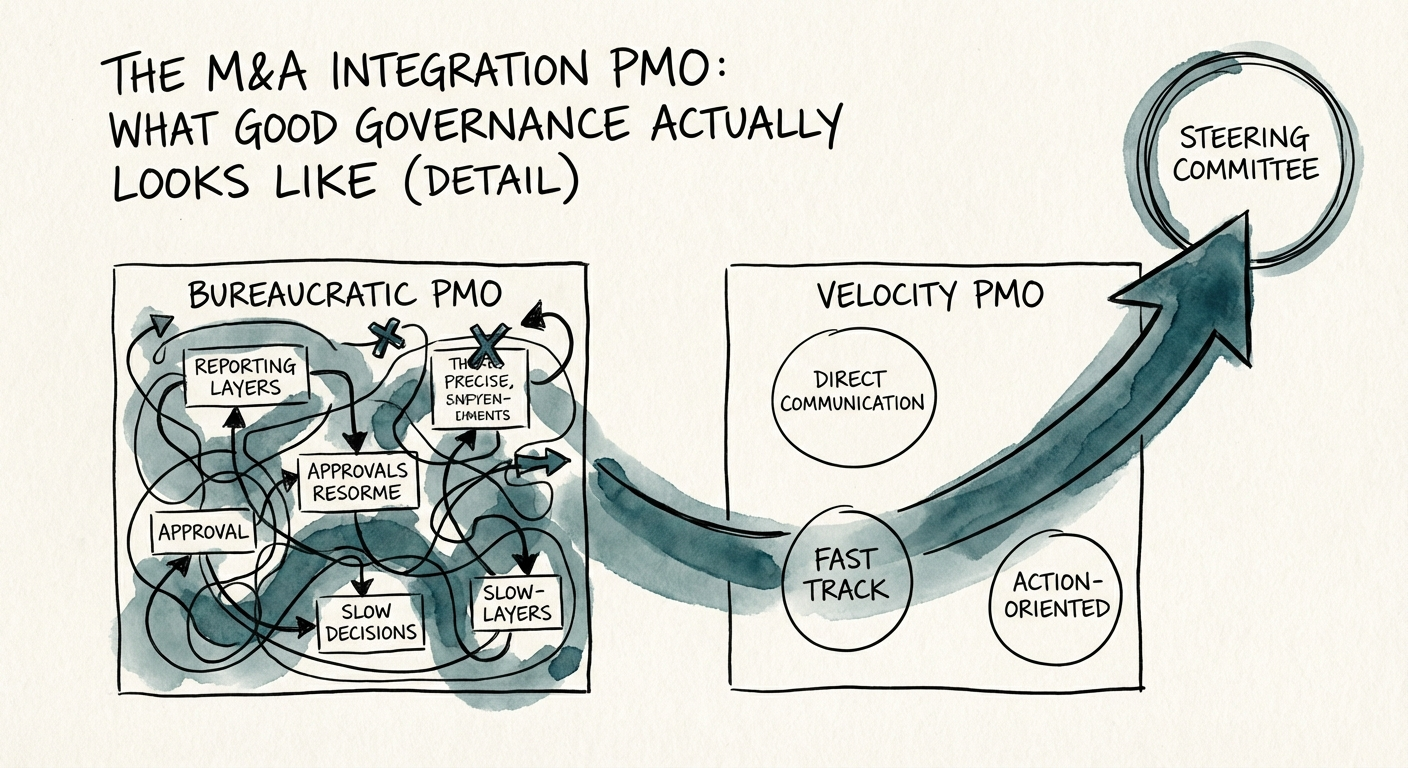
The problem usually isn’t a lack of effort; it’s a lack of decision velocity. Most integration PMOs (Project Management Offices) are set up to fail because they are designed to report news rather than make news. They generate 50-page weekly decks filled with "Harvey Balls" and red/yellow/green indicators, yet the critical decisions—ERP consolidation, headcount rationalization, product sunsetting—languish in committee.
When a PE Operating Partner sees a "Green" status report but knows EBITDA is flat, that is a governance failure. True governance isn't about slide formatting; it’s about the disciplined, systematic removal of blockers.
If your PMO is producing 40 slides a week but only logging one strategic decision, you aren't managing an integration—you're documenting a disaster.
The 60% IT Reality: Where Synergies Actually Live
Let's cut through the consulting fluff. Synergy capture is rarely about "cultural alignment" in the abstract; it is about systems. Recent data from HCLTech confirms that 60% of all synergy initiatives are IT-related. If you cannot merge the CRMs, you cannot cross-sell (Revenue Synergy). If you cannot consolidate the ERPs, you cannot reduce G&A (Cost Synergy).
Therefore, your PMO governance must be technical enough to understand the blockers but operational enough to force the issue. "Good Governance" in a PE context looks like this:
1. The Two-Pizza SteerCo
If your Steering Committee has more than 6 people, it is not a decision-making body; it is a town hall. The SteerCo exists for one reason: to resolve escalations that the Integration Management Office (IMO) cannot solve. Cross-functional deadlock is the silent source of deal-value erosion. The SteerCo must be small enough to vote and move on.
2. Decision Velocity vs. Slide Velocity
We track a metric called "Decisions Per Week." A healthy integration should be closing 5-10 strategic decisions weekly during the first 100 days. If your PMO is producing 40 slides but only 1 decision, you are burning cash. The PMO's job is to tee up decisions for the SteerCo with clear options: "Option A costs $50k and takes 2 weeks. Option B costs $0 but risks 5% churn. We recommend A. Decide."
3. The "Synergy Bank" Concept
Treat synergies like a bank account. At Day 0, you have a "potential balance" of $5M in EBITDA improvements. Every week, the PMO must report on how much of that has been "withdrawn" (realized). Successful integrations realize >50% of synergy targets in Year 1. If you are at Month 6 and only at 10%, you have already failed the year.
The Flash Report: Killing the 50-Page Deck
To fix governance, you must fix the cadence. Replace the hour-long "read-out" meetings with a 20-minute "blocker bash." The tool for this is the Flash Report. It fits on one page and contains only three sections:
- Critical Decisions Made (Last 7 Days): Proof of momentum.
- Critical Decisions Required (Next 7 Days): Forcing function for leadership.
- Red Risks (Blockers): Items that will kill the timeline if not resolved in 48 hours.
This format forces the PMO to act as an operator, not a scribe. It exposes IT integration decisions that are stuck in limbo—like the choice between migrating to the acquirer's tenant or keeping a federated model. These are not technical details; they are financial decisions wrapped in technical language.
The "Interim" Mandate
Often, the portfolio company's existing leadership cannot run the business and the integration simultaneously. This is where an Interim Integration Lead is worth their weight in gold. Unlike a consultant who advises, an Interim Lead holds the pen on the project plan and has the authority to call out the CEO when deadlines slip. They don't care about internal politics; they care about the exit timeline.
Governance is not about control; it is about speed. In the high-stakes game of PE roll-ups, the firm that integrates the fastest wins the multiple.