The practical answer
- Short answer
- 2025 operating partner pay: ~$425k total cash at sub-$500M funds to $850k+ at mega funds, plus 1–3% carry. The salary, bonus, and carry benchmarks.
- Best fit
- Industry: Private Equity. Function: Human Capital
- Operating path
- Exit Readiness → Operational Excellence → Transaction Advisory Services
- Key metric
- 1-3% Standard Carry Points (Fund Level)
The Value-to-Compensation Gap
For decades, the Operating Partner role was an advisory seat for former Fortune 500 CEOs—a place to dispense wisdom, attend four board meetings a year, and collect a modest retainer. In 2025, that model is dead. Today’s Operating Partner is a hands-on operator, stepping into distressed assets, owning the 100-day plan, and acting as the interim C-Suite when founders falter.
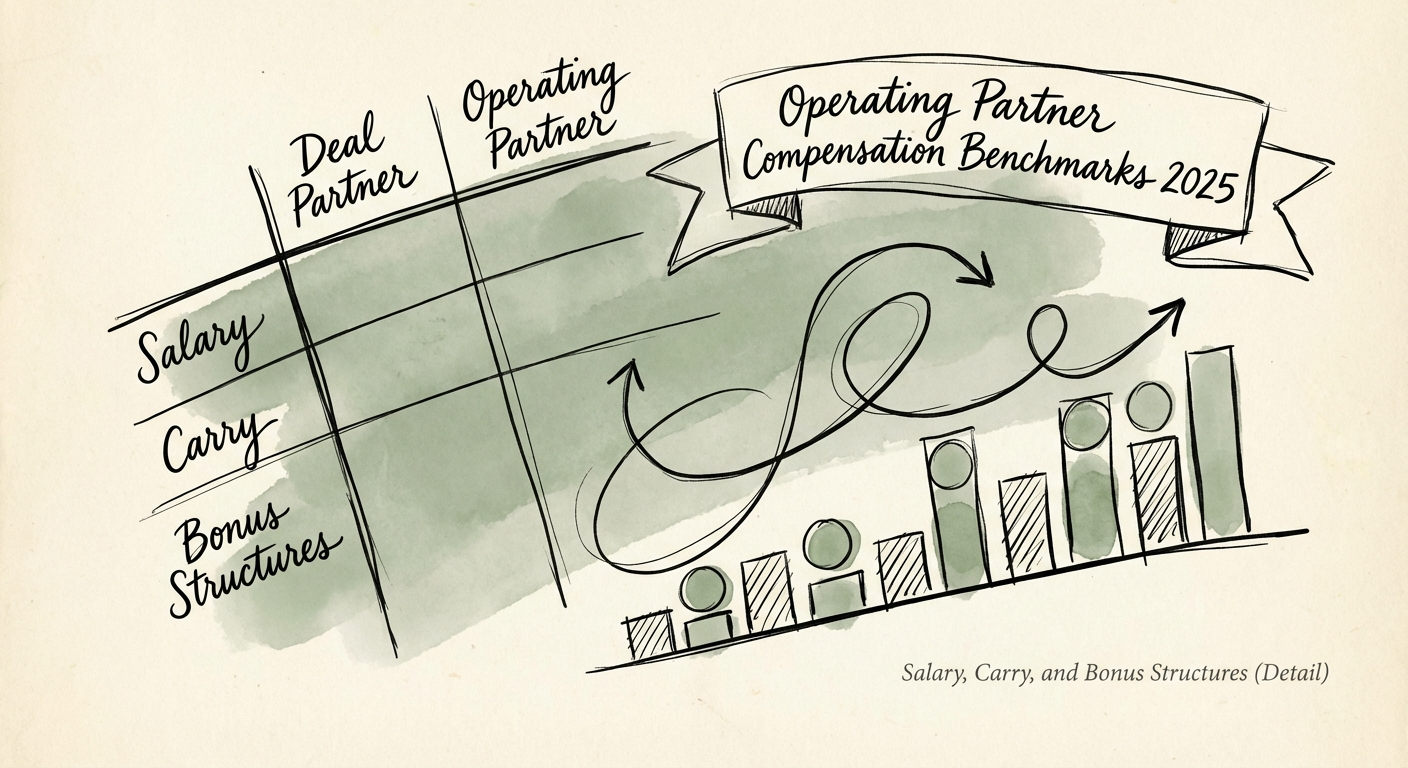
Yet, compensation structures haven’t fully caught up to this reality. While deal partners effectively own the asset selection, you own the asset correction. You are responsible for the multiple expansion that justifies the carry, yet data from 2024-2025 suggests a persistent gap: Operating Partners typically earn 70-85% of the Total Cash Compensation (TCC) of their Deal Partner counterparts at the same seniority level.
This article breaks down the real numbers for 2025—stripping away the ‘it depends’ ambiguity of recruiters and giving you the benchmarks needed to negotiate your worth. Whether you are an Operating Principal at a $500M fund or a Senior Operating Partner at a Mega Fund, the math has changed. If you are fixing EBITDA, you should be paid in EBITDA-derived instruments.
The Three Tiers of Operating Talent
Compensation varies wildly not just by fund size, but by engagement model. We see three distinct tiers in the 2025 market:
- The Advisor (Tier 3): Ad-hoc support, board seats only. Paid via retainer or deal fees. (Low Comp, Low Leverage)
- The Functional Expert (Tier 2): Heads of Talent, GTM, or DevOps. Full-time employees of the Management Company (ManCo). Paid market salary + bonus, often with capped carry.
- The Operator-Investor (Tier 1): The operating-investor role: deeply embedded in value creation plans (VCPs). Paid near-parity with deal teams, with significant carry participation.
If you are fixing EBITDA, you should be paid in EBITDA-derived instruments. If you aren't getting carry, you are a consultant, not a partner.
2025 Compensation Benchmarks: The Hard Numbers
Based on aggregated data from Heidrick & Struggles, Raw Selection, and private market surveys, here are the baseline ranges for North American Private Equity Operating Partners in 2025.
1. Base Salary & Bonus (Cash Compensation)
Cash compensation has stabilized after the 2021-2022 inflation spike. The biggest shift in 2025 is the compression of the middle market—funds with $500M–$2B AUM are having to pay near-Mega Fund rates to attract operators capable of turning around struggling assets.
| Fund Size (AUM) | Median Base Salary | Target Bonus % | Total Cash (Median) |
|---|---|---|---|
| <$500M | $275k - $325k | 30-50% | ~$425k |
| $500M - $5B | $375k - $450k | 40-60% | ~$600k |
| $10B+ (Mega) | $475k - $600k+ | 50-75% | ~$850k+ |
The Bonus Problem: Unlike deal teams, whose bonuses are often formulaic based on capital deployment or exit events, 75% of Operating Partners report their bonuses are ‘discretionary.’ This is a red flag. Elite operators negotiate bonuses tied to specific VCP milestones: e.g., achieving SOC 2 compliance across the portfolio or reducing aggregate burn by 20%.
2. Carried Interest: The Real Wealth Builder
If you aren't getting carry, you are a consultant, not a partner. The standard for a full-time Operating Partner is now firmly 100 to 300 basis points (1-3%) of the General Partner’s carry pool. However, the structure matters more than the percentage.
- Fund-Level Carry: The gold standard. You get points in the whole fund. This diversifies your risk across winners and losers. Typical for Senior Operating Partners.
- Deal-by-Deal Carry: Common in Lower Middle Market (LMM). You get 0.5% - 1.0% of the equity on specific deals you work on. High upside, but high risk if your specific asset is a dud.
- Phantom Equity / Synthetic Carry: Often used for Functional Partners (e.g., Head of Talent). A cash bonus structure that mimics carry payouts but is taxed as ordinary income.
3. The "Carry Dollars at Work" Metric
Don't just ask for points; calculate ‘Dollars at Work.’ If a $500M fund targets a 2x net return, the carry pool is roughly $100M (20% of $500M profit). A 2% allocation equals $2M in expected value over the fund's life (7-10 years). If you are fixing technical debt that threatens exits, ensure your allocation reflects the enterprise value you are protecting.
Negotiating Your Package: Levers for 2025
You cannot negotiate effectively if you don't understand the ManCo's economics. If the firm is 2 & 20 (2% management fee, 20% carry), the management fee pays your salary, and the carry pays your wealth. If the firm is small, they may be ‘cash poor’ on management fees.
1. Trade Cash for Co-Invest
If a firm balks at a $500k base, propose a $400k base with a guaranteed, leverage-free Co-Invest allocation. Access to the deal flow with no management fee is often worth more than the $100k gross salary difference over 5 years. This signals you are aligned with the exit.
2. The "Founder Extraction" Premium
If your role specifically involves removing founder dependency to prepare assets for sale, you are directly de-risking the exit multiple. We are seeing Operating Partners successfully negotiate Transaction Bonuses—fixed payouts (e.g., $250k) triggered upon a successful exit above a certain IRR hurdle, independent of the carry pool.
3. Demand "Attribution"
The biggest risk to an Operating Partner's career is the "attribution gap." When a deal goes well, the Deal Partner claims they bought it right. When it goes poorly, they claim operations failed. Ensure your employment agreement defines Key Performance Indicators (KPIs) for your bonus that are within your control: EBITDA margin expansion, retention rates, or successful key hires, rather than just vague "firm performance."
Conclusion: Know Your Multiple
Your compensation should be a reflection of the multiple expansion you drive. If you are essentially a glorified project manager, expect the $300k base and zero carry. If you are the architect of a turnaround who speaks fluent EBITDA and fluent DevOps, you are a rare operator profile. Demand the 300 bps.