
The practical answer
- Short answer
- Your CRM shows 5x coverage and you still miss. Here is how to spot stalled deals, set kill criteria, and clean a founder-CEO's forecast — without firing anyone.
- Best fit
- Industry: B2B SaaS / Services. Function: Sales Operations
- Operating path
- GTM Execution → Commercial Performance → Performance Improvement
- Key metric
- 60% Deals Ending in 'No Decision'
The board slide that lies to you
Here is the meeting that ends a lot of credibility. It's the second Tuesday of the quarter's last month. You pull up the CRM, and the number is beautiful: target of $1.5M, weighted pipeline of $7.5M. Five times coverage. You could lose four out of every five deals and still clear quota. So you tell the board the pipeline is "strong," and everyone exhales.
Then you close at $1.1M. Off by $400K. Nobody lied to you on purpose. The pipeline was never strong — it was bloated with deals that were technically open and functionally dead.
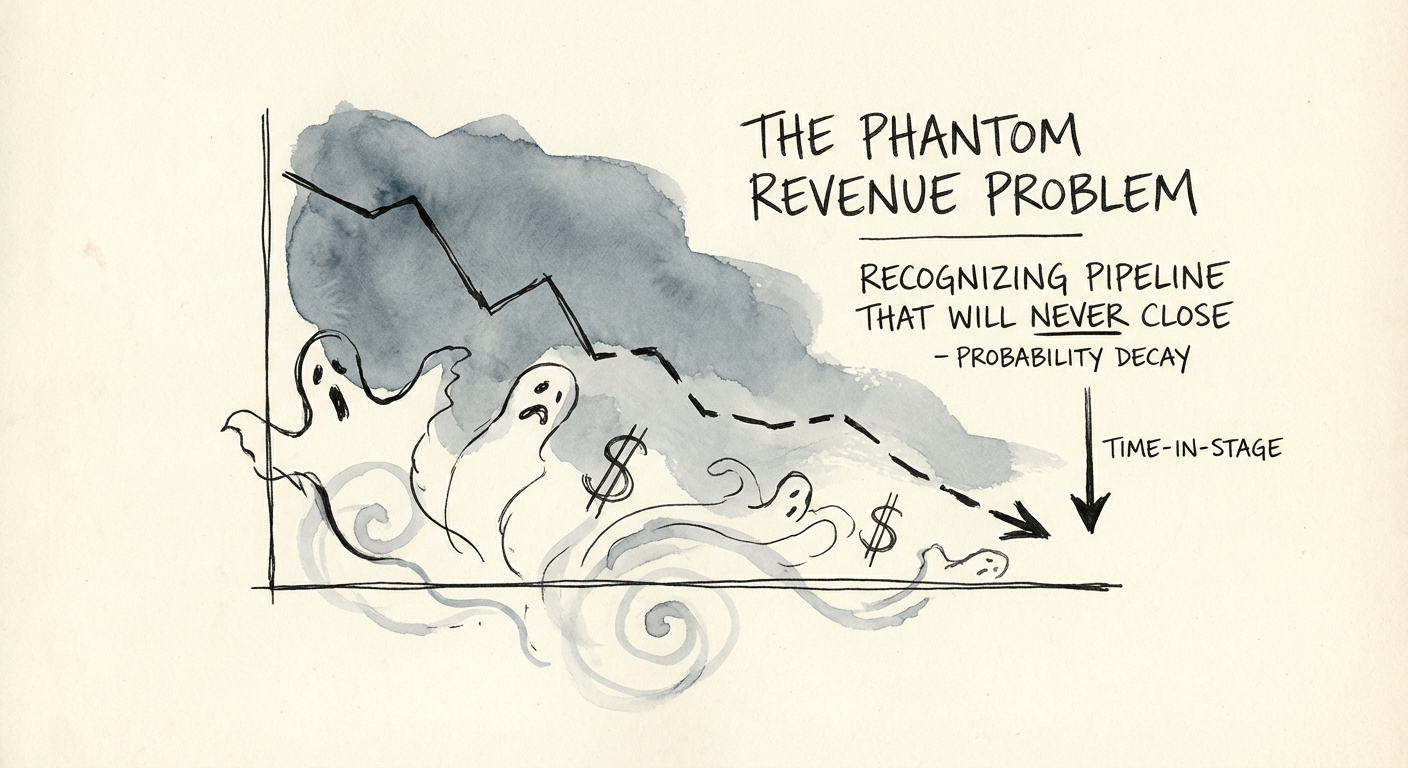
That gap has a name: phantom revenue. It's the slice of your pipeline that counts toward coverage but will never hit the bank. It didn't lose to a competitor. It didn't get disqualified. It just drifted — close date pushed a month, then another month, kept warm by a rep who is more afraid of a thin pipeline than a wrong forecast. And the data backs up how big this problem is: across B2B benchmarks, something close to 60% of qualified opportunities don't end in a win or a loss at all. They end in "no decision." The prospect simply stops moving.
For a founder-CEO who just crossed $10M and is now reporting to a board instead of just running on instinct, this is the specific way the wheels come off. You scrubbed your unit economics. You built the forecast model. But if the deals feeding that model are phantom, you didn't build a forecast — you built a very precise way to be wrong. Lean on a raw coverage ratio without scrubbing the ghosts first, and the multiplier just makes the lie bigger.
A deal that has been "closing next month" for four straight months isn't a deal. It's a pen pal your rep is afraid to break up with — and it's the line item that will blow your board meeting.
Stage age tells you what total age hides
The mistake almost everyone makes is judging a deal by how old it is. Total age is noise — enterprise cycles run long for legitimate reasons. The signal lives in time-in-stage: how long a deal has been parked in one place without advancing.
Here is the rule we use, and you can run it on your pipeline this afternoon: once a deal sits in a stage for more than twice that stage's average duration, treat its real close probability as near zero — regardless of what the CRM weighting says. Say your average Discovery runs 14 days. A deal on day 29 of Discovery is not "in Discovery." It's in a coma. It may still read 50% in the system, but the momentum that justified that number evaporated two weeks ago.
That's where the damage compounds. A stalled deal sitting at "Proposal — 70%" doesn't just fail to close; it actively poisons the math. Your board sees expected revenue (probability × value, summed across the pipe). What actually arrives is realizable revenue. When a third of your pipeline is phantom, the spread between those two numbers is the exact size of the miss you haven't been told about yet — and it's why so many orgs blow their forecast by double digits when they thought they had margin to spare.
Why do reps let deals rot in place? Not malice — incentives. If the one number you grill them on every Monday is coverage, the rational move is to never kill a deal until the prospect literally says no. And since roughly 60% of prospects ghost rather than reject, that "no" never comes. So the rep pushes the close date another 30 days, every 30 days, forever. You get a rolling wave of phantom revenue that never crashes and never converts. It just sits there, lying to your forecast with a straight face. Look at the benchmark data on stalled deals and ghosting and the pattern is consistent across the market — this is structural, not a problem with your particular team.
Three moves to clear the ghosts before next quarter
You can't scale spend, hiring, or a board narrative on a pipeline you can't trust. Here's the cleanup, in order of how fast it pays off.
1. Give reps a third exit: "Closed — No Decision"
Right now your reps face a binary: Won or Lost. Lost feels like failure, so they avoid it by keeping zombies alive. Break the binary. Add a "Closed — No Decision" status and say it out loud: "I will never penalize you for marking a stalled deal No Decision. I will absolutely penalize you for forecasting a stalled deal that doesn't close." You're not asking for honesty as a favor — you're removing the reason to lie.
2. Run the Monday scrub with one question
Pull every deal that has either pushed its close date twice or exceeded 2x its stage average. On the forecast call, don't ask "how's this one looking?" — that question invites a story. Ask: "Why is this not Closed — Lost?" The bar to keep it in the forecast is a confirmed next step inside the last seven days. Not "they said to check back." Not a hopeful email. A calendar invite that exists. No invite, no forecast. It feels brutal the first week. By week three, your reps stop bringing zombies to the call because they know the question is coming.
3. Stop reporting coverage; start reporting velocity
A static 5x coverage number rewards hoarding. Replace it with pipeline velocity — value × win rate × (1 ÷ sales cycle length). Under this lens, a $100K deal closing in 30 days outranks a $500K deal that's been "closing" for six months, because one moves cash and the other moves your stress level. Velocity punishes exactly the behavior coverage rewards.
This matters most precisely when you're handing sales off from yourself to a real team. Your gut used to filter the phantom deals automatically — you knew which prospects were stringing you along. Replace your gut with dirty data and you've upgraded nothing. A lean, scrubbed pipeline lets you commit to a hire or a marketing spend with confidence. A fat, phantom one walks you straight into a cash crunch you'll only see on day 89. Want the deeper accuracy mechanics? The companion piece on forecast methodology and our forecasting fix guide are where I'd send you next.