
The practical answer
- Short answer
- You bought four companies, not a platform. Here's how to consolidate 4+ acquisitions onto one stack in 100 days before fragmentation eats your exit multiple.
- Best fit
- Industry: B2B Tech & Services. Function: Operations & IT
- Operating path
- Migration & Integration → Turnaround & Restructuring → Transaction Advisory Services
- Key metric
- 30-50% Value lost in M&A due to slow or ineffective integration (McKinsey)
The board deck you can't trust
Picture the Monday of the quarterly review. Your platform company is supposedly a $40M business — four add-ons, one thesis, one logo on the slide. But to produce a single revenue number, your FP&A lead spent the weekend hand-reconciling four exports: NetSuite at the platform, QuickBooks at the company you closed in March, two flavors of Salesforce, and a spreadsheet someone at the fourth entity swears is "basically the same thing." The number you present is an estimate of an estimate. Everybody in the room knows it.
This is the Federation, and it's where most buy-and-build theses quietly die. The arbitrage looked clean on the model: buy four founder-run businesses at 6x, bolt them together, sell the platform at 12x. The multiple expansion was supposed to come from scale. Instead you inherited four CRMs, four definitions of "active customer," four billing cadences, and four founders who each believe their way is the reason their business worked. You didn't build a platform. You built a holding company with a shared cap table.
The leak is measurable. McKinsey research finds that 30–50% of the value an acquirer expects from a deal is lost to slow or ineffective integration — and in a roll-up, that destruction compounds across every add-on you leave un-integrated. You cannot optimize CAC when "customer" means four different things. You cannot prove a cross-sell synergy when the systems can't even agree on who already bought what. And the bill arrives before you see any of the upside: EY benchmarks put integration costs in tech and media sectors at more than 5.5% of the target's revenue. If that 5.5% wasn't in your EBITDA bridge before close, the bridge is already broken and the IC just doesn't know it yet.
You aren't running a $40M company. You're running four $10M companies that happen to share a logo and a board deck nobody trusts. The Federation isn't a phase you grow out of — it's the thing that compresses your multiple at exit.
Pick the Golden Master before you close the next deal
The Federation persists because operating partners treat integration as a negotiation. They ask each acquired company which systems it "prefers," and four founders give four answers, and the path of least resistance is to let everyone keep their own. That instinct feels like respecting culture. It's actually how you sign up to run four separate companies forever.
The fix is to decide the operating stack once, centrally, and make every future acquisition migrate onto it. Call it the Golden Master: one CRM, one ERP, one HRIS, one delivery toolchain — validated at the platform, non-negotiable for the add-ons. The conversation with an acquired team stops being "should we move?" and becomes "you're moving by day 90; here's how we make it painless." That single reframe is the difference between a platform and a federation.
Three things have to be true for the Golden Master to actually compound value, and they're specific to a multi-entity roll-up in a way they wouldn't be in a single bolt-on:
- One financial dictionary across all four entities. Revenue recognition, gross margin, and churn need a single definition the moment you have more than two companies — because the second you're averaging across four inconsistent ledgers, your board deck is fiction and your synergy math is unprovable. Lock the data model first; you can't govern what four different controllers each define their own way.
- One service-delivery standard, or you're hiding a margin leak. If the platform delivers an implementation in six weeks and the March add-on takes twelve for identical scope, you don't have a culture difference — you have a utilization gap that will show up as a margin discount at exit. Standardizing delivery against the Operating Partner's M&A Integration Scorecard turns "their way" and "our way" into one measurable way.
- Triage inherited tech debt before it becomes a diligence finding. You bought four codebases and four sets of shortcuts. Left alone, they're a latent surprise for the next buyer's technical diligence. Work the guide to inheriting someone else's tech debt early, so you're fixing the critical vulnerabilities on your timeline, not under a deal clock.
Discipline is the rare ingredient here, not capital. Deloitte found that fewer than 20% of organizations meaningfully improve IT costs after a merger — most let the Federation survive in the name of preserving culture. A culture built on operational inconsistency isn't worth preserving. It's the thing the next buyer will pay you less for.
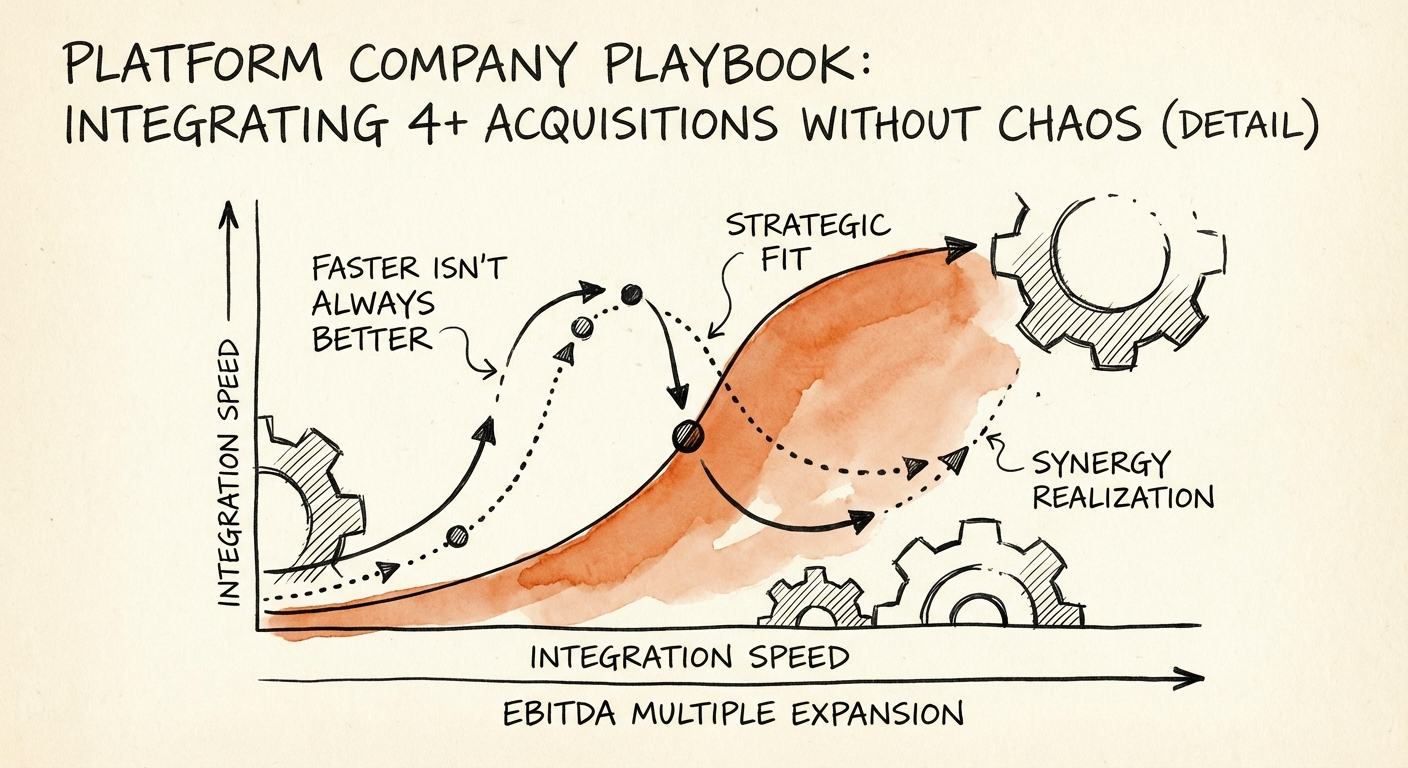
The 100-day consolidation clock
Speed is your only real hedge against the 30–50% value leak, and in a roll-up the clock matters more because every day of delay multiplies across four entities instead of one. Treat the first 100 days after each close as a financial-governance project that happens to involve IT — not the reverse.
Days 0–30 — Triage and freeze. The Golden Master makes most decisions for you: if the platform runs NetSuite and the add-on runs QuickBooks, the add-on moves, full stop. Map the data fields between the systems, identify the half-dozen that actually feed the P&L and the pipeline, and freeze all non-critical IT spend at the acquired entity so nobody's buying a new tool you'll rip out in sixty days. Stand up the post-merger stack-consolidation roadmap here, while the closing energy is still high.
Days 31–60 — Migrate and hold the line. This is the ugly part. The acquired sales team will hate the new CRM because their old one let them freelance. Engineering will resist the new ticketing workflow. The pushback is not a signal that you chose wrong; it's the sound of the Federation defending itself. Your only job this month is to make sure that by day 90 there is exactly one source of truth for the pipeline and exactly one for the P&L.
Days 61–90 — Now you can actually build. Unified systems are the precondition for the "build" half of buy-and-build, not the reward for it. Turn on the cross-sell motion across the now-shared customer base. Centralize finance, HR, and legal once they're all standing on the same platform. Measure synergy capture against the bridge you promised the IC. The honest test: if you can't point to real margin expansion by month six, the integration didn't happen — the entities just stopped fighting in public.
Here's the Monday-morning move. Before your next add-on closes, write down the Golden Master stack on one page and circulate it to your deal team as a binding condition of integration, not a post-close discussion. Every acquisition you sign after that page exists gets cheaper and faster to absorb. Because at exit, the next buyer isn't paying for four good businesses — they're paying for one machine. If they lift the hood and find duct tape connecting four companies that never truly merged, they discount the multiple or they walk.