
The practical answer
- Short answer
- A roadmap that's 100% new features tells a SaaS buyer you stopped maintaining the product. Here's what tech diligence reads into it — and the fix before LOI.
- Best fit
- Industry: SaaS / Tech Services. Function: Product & Engineering
- Operating path
- Exit Readiness → Operational Excellence → Transaction Advisory Services
- Key metric
- 40% IT Budget Consumed by Debt
The slide you're proud of is the slide they screenshot
Picture the management presentation. Slide 14 is the roadmap: twelve months, four swimlanes, an AI copilot in Q3, a new analytics suite in Q4, all of it color-coded and bristling with momentum. Your board loves it. The two associates from the acquirer's deal team are nodding along. Then their technical advisor — usually a fractional CTO or a diligence shop they've used on six prior deals — asks one question: "Where's the work that isn't a feature?"
Silence. Because there isn't any. And in that silence, slide 14 stops being a growth story and becomes Exhibit A.
Here's what a founder-CEO running a $15M-ARR SaaS business almost never internalizes until it's expensive: at a Series B-to-C scale, the roadmap is read backwards. You wrote it to show where you're going. The buyer reads it to infer what you've been neglecting. A roadmap that is 100% new capability and 0% platform work doesn't say "we ship fast." It says "we have been borrowing against the codebase for three years and the interest is about to come due — and now it's the acquirer's problem."
The number that gives this teeth: McKinsey puts technical debt at roughly 40% of the total IT balance sheet across the companies they studied. A buyer isn't acquiring your revenue in isolation; they're inheriting every shortcut your team took to hit those revenue numbers. If a meaningful slice of your engineering payroll is being consumed just to keep the existing product upright, the diligence team will price the remediation — and it comes straight out of your purchase price, not theirs.
A roadmap that's all new features and no remediation isn't an ambition statement. To the buyer's diligence team, it's a confession that you stopped maintaining the thing you're selling.
What "we're slower than we were" actually costs at the table
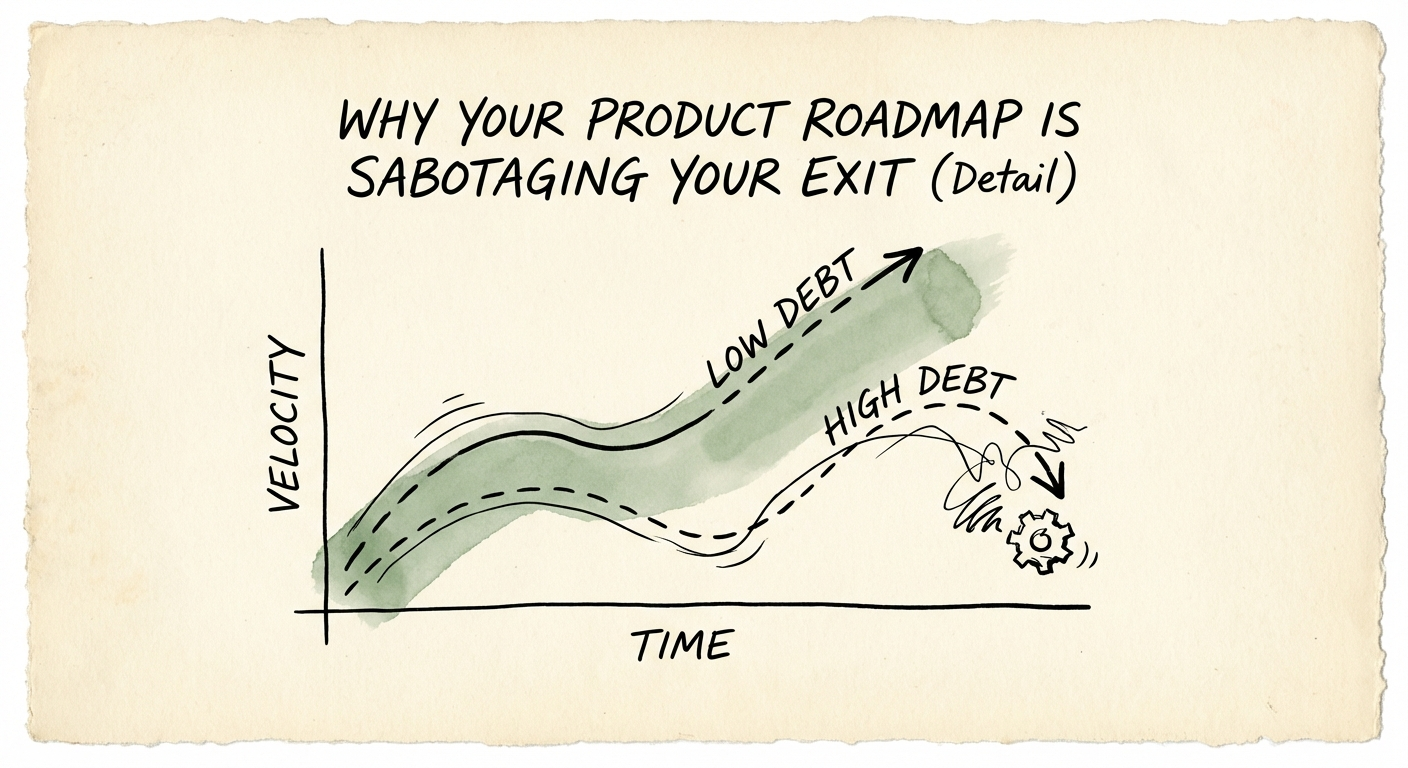
If your team shipped a major feature every six weeks two years ago and now it takes eleven, you don't have a motivation problem. You have a compounding problem. Codebase complexity at a scale-up doesn't grow with headcount; it grows with the surface area of everything you've ever shipped and never cleaned up. ByteIota's 2025 figures peg developer time spent wrestling debt — chasing regressions, working around fragile architecture, decoding decisions made before half the team was hired — at about a third of their hours. That's one engineer in three, every day, producing nothing a customer or a buyer will ever see.
A technical diligence team doesn't measure that mood. They reverse-engineer it from artifacts, and the roadmap is the easiest one to read. Three patterns get flagged hard on SaaS deals specifically:
- The all-features roadmap. Zero capacity allocated to architecture, scalability, or debt paydown reads as an unstable platform that nobody is allowed to stabilize. Mature SaaS roadmaps carve out 20–30% for non-functional work, and diligence knows the healthy range cold.
- The ghost feature. An item that's been "next quarter" for three consecutive quarters. It signals the backend can't support what sales already promised, and the buyer will go find the customer who was told it was coming.
- The missing safety net. No automated regression testing. A startup survives this; a company asking for an 8x multiple does not. Without it, every new feature on that pretty roadmap quietly breaks two shipped ones, and velocity decays even as headcount climbs.
This is where the valuation gap opens. You're arguing for a multiple on forward growth — the roadmap as upside. The buyer is arguing for a discount on the cost to make the engine reliable enough to deliver that growth — the same roadmap as liability. The gap between those two readings of one slide, as we lay out in our work on quantifying technical debt in due diligence, is frequently the largest single line item negotiated after the LOI. Software Improvement Group's analysis of PE-backed software shows why: investors increasingly run code-level scans precisely because the gap is real and recurring.
How to rewrite the slide before the deal team sees it
You can't make debt invisible — a competent scan finds it in an afternoon. What you can control is whether you found it first and what story the roadmap tells about your maturity. Three moves, starting Monday, with roughly a two-to-three-quarter runway before you'd realistically run a process.
1. Put remediation on the roadmap in ink — and tell the buyer why
Set a standing split: call it 70/30, innovation to platform health, and actually defend the 30% against the next sales escalation. Then make it visible. A buyer who sees a documented, recurring "platform & reliability" lane doesn't see slowness — they see an operator who manages the asset instead of mortgaging it. Undocumented debt paydown buys you nothing in diligence; documented debt paydown is a selling point.
2. Write outcomes, not modules
"AI Reporting Module" tells the team to bolt a UI onto whatever's already there. "Cut customer report-generation latency from 9 seconds to under 2" forces them to fix the query layer and the data model underneath — the exact work that makes the product worth more, not just busier. Outcome-framed line items also survive diligence scrutiny because they map to enterprise value, not to whichever customer shouted loudest this quarter.
3. Run your own scan before anyone runs theirs
Commission a code and architecture scan now, on your timeline, while you still control the narrative. The point isn't a clean bill of health — nobody has one. The point is that when the buyer's team finds the missing database indexes or the hard-coded credential, you can say "yes, here's the remediation plan and where it sits on the roadmap" instead of learning it live in a data room. This is the same posture we coach founders into during a pre-process technical readiness review: surface it, scope it, schedule it.
The reframe that matters: your codebase is an asset on the buyer's balance sheet the moment they sign, and your roadmap is the document that tells them whether it's an asset they trust. A roadmap that proves you can scale without breaking — and that you knew exactly what needed fixing — is how you stop a tech-diligence finding from rewriting your enterprise value on the last page of the deal.