
The practical answer
- Short answer
- A B2B SaaS founder missed the quarter and the board went quiet. Here is the 90-day variance-and-flash-report protocol that buys back credibility.
- Best fit
- Industry: B2B SaaS. Function: CEO Office
- Operating path
- Financial Infrastructure → Commercial Performance → Valuations
- Key metric
- 58% PE-Backed CEOs replaced within 2 years (AlixPartners)
The board went quiet, and that's the part that should scare you
You finished the QBR slide that says the number came in 14 points light. You braced for the explosion. Instead, the lead director took off her glasses, set them on the table, and said, "Okay. Walk us through it." Then she stopped talking. So did everyone else.
That silence is not relief. It's repricing. Around that table, three people are quietly redrawing the curve in their heads — not just the company's next two quarters, but the probability that you are still running it when the fund needs a markup. Founders read calm as a reprieve. On a PE-backed board, calm is the sound of a model being rebuilt without you in the room.
The arithmetic behind that silence is brutal. AlixPartners' work on portfolio leadership found that 58% of PE-backed CEOs are replaced within two years of the investment. And the appetite for waiting has collapsed: Russell Reynolds' turnover tracking shows tech CEO turnover jumped 90% year over year. The grace period you think you have is shorter than the sales cycle you just blew.
The miss isn't what fired the last founder. The surprise was.
I've sat on both sides of this table, and here is the distinction that decides everything. If you had told me in week three of the quarter that the Q3 expansion deal with your biggest logo had slipped to a "maybe Q4," we'd have had options. Pull a renewal forward. Re-cut the cash plan. Pre-wire the board so the number landed soft. A managed miss is a Tuesday.
But you said "tracking to plan" in the monthly update, said it again in the mid-quarter call, and then dropped 14 points in the deck. That sequence doesn't read as a sales problem to the people who funded you. It reads as: this founder cannot see what is happening inside their own company. For a SaaS business — where the entire valuation rests on the predictability of recurring revenue — being blind to your own pipeline is the one sin the multiple cannot absorb.
This is also the exact moment that worked at Series A and stops working now. The hustle that closed the early logos doesn't scale into a $30M ARR forecast with four sales pods and a renewals motion. You cannot out-work a forecasting model that was never built.
A board can forgive the number you missed. What it can't forgive is finding out three days before the meeting that you knew it was at risk for six weeks. That's not a forecasting problem. That's a "does this person actually see inside their own company" problem.
Don't show them the miss. Show them where the math broke.
The instinct after a miss is to explain. You stand up, you talk about the macro, the elongating buying committee, the one deal that "we're confident closes next week." Every minute of narrative without numbers deepens the suspicion that you're improvising. SiriusDecisions' sales-metrics research found that most B2B sales organizations miss forecast by more than 10% — so "we missed" tells the board nothing. Being typical is not a defense. It's a confession that you forecast like everyone who gets replaced.
What changes the room is decomposition. The companies that earn a 90%+ quarterly forecast hit don't treat the number as one bet — they treat it as four. So before the next meeting, build the variance bridge that turns your 14-point miss into four diagnosable line items:
- Volume: Did fewer qualified opportunities enter the top of funnel than the model assumed? (A demand problem — marketing and SDR.)
- Conversion: Did opps convert below your historical win rate? (A sales-effectiveness or competitive problem.)
- Velocity: Did the average enterprise cycle stretch from 90 to 120-plus days? (A deal-stage or buying-committee problem — the most common B2B SaaS culprit, and the one that hides in "tracking to plan.")
- Value (ACV): Did you hit volume but discount to close, shrinking average contract value? (A pricing and packaging problem.)
Say the bridge shows your bookings count was nearly on plan but average deal cycles ran 28 days long because procurement reviews got added to every six-figure deal. That's not a story about a lost quarter — that's a mechanical finding with an owner and a fix. The conversation flips from "the CEO is lost" to "the CEO found the broken gear before we did." That is precisely the line between a board that no longer trusts your numbers and one that leans in to help you fix the machine.
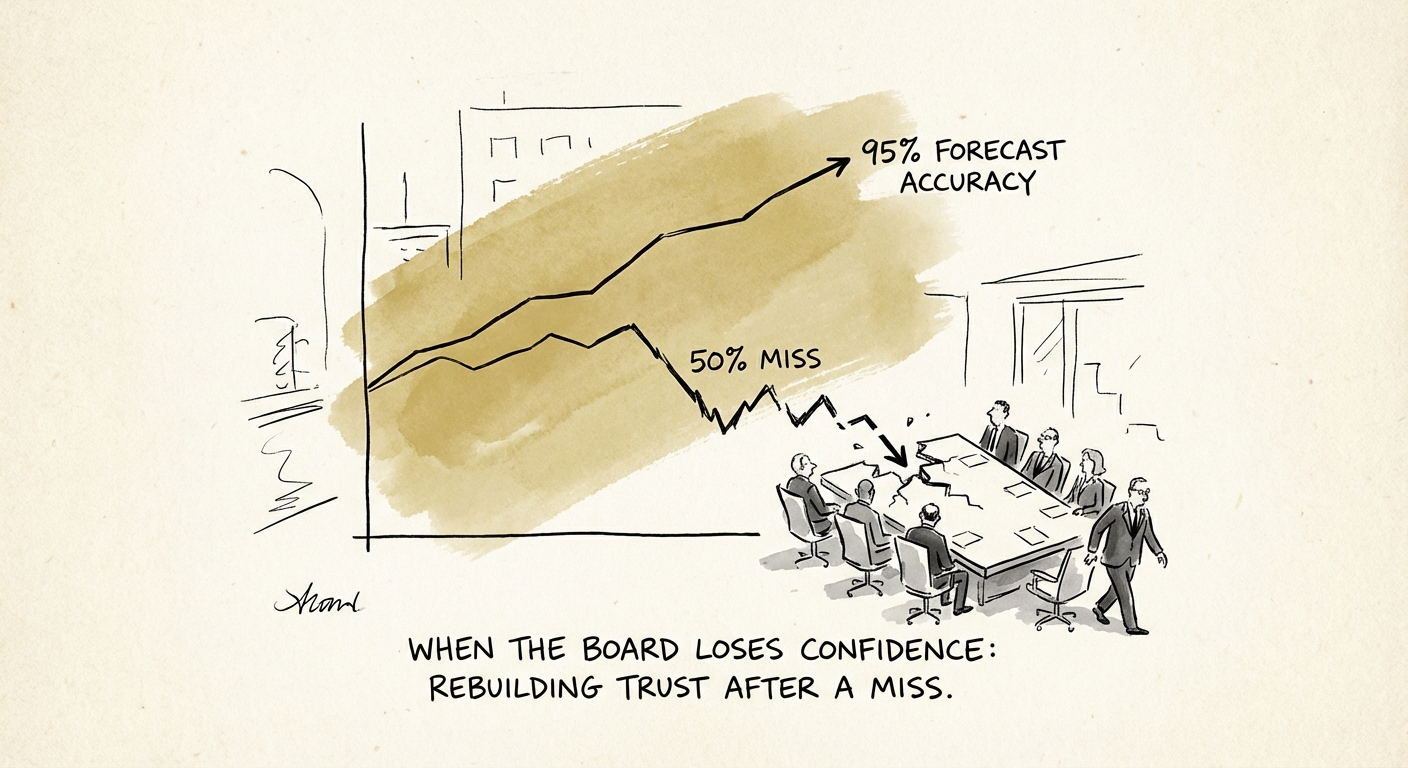
The 90-day protocol that buys the job back
You are in the penalty box and the clock is one fiscal quarter. Miss again in Q+1 and assume the retained search has already started — turnover data says the patience isn't there. So treat the next 90 days as a single, narrow campaign: not to dazzle the board, but to make yourself boring and legible.
1. Run the bad news first, every Friday
Send a one-page Flash Report every Friday by noon: current cash and runway, pacing-to-forecast as a percentage, the top three deals at risk this week, and the top three that advanced. The rule is non-negotiable — if a flagged deal slips, the board hears it within 48 hours, not at month-end. A director who gets your bad news on Friday afternoon stops checking your pipeline on Sunday night. Silence is what they fill with worst cases; a steady drip of unflattering truth is what rebuilds the covenant of predictability you broke.
2. Replace the rep's gut with weighted coverage
Kill the top-down number your sales leader committed to and rebuild the forecast bottoms-up off pipeline coverage at your real, historical win rate. If you close 25% of qualified pipeline, you need 4x coverage to call a hit — full stop. If you're carrying 3x and still forecasting plan, you're not forecasting, you're hoping, and the board will smell it in one meeting. Make sure the CFO's board reporting shows coverage ratio next to the commit, so the number defends itself.
3. Ship the system, not the promise
"Better execution" is the phrase that gets founders fired, because it depends on you. Show structure instead. If the bridge pointed to velocity, stand up a deal desk with a stage-gate that procurement can't blindside. If it pointed to ACV erosion, freeze discount authority above a threshold and route exceptions to finance. As the Founder Extraction Playbook argues, the board needs to see a fix that survives you taking a week off — not a heroics plan that quietly re-centers the whole company on your 80-hour weeks.
Recovery isn't a comeback quarter. It's a single, then another single, then another — three quarters where you said $5M and delivered $5M. The board doesn't want to be impressed. After a miss, the most valuable thing you can be is predictable. Fix the instrumentation, narrate the variance before they ask, and turn the lights back on in the room before someone decides to change who's standing at the front of it.