
The practical answer
- Short answer
- Data shows 84% of sales reps missed quota in 2024. Before you fire your VP of Sales, check these 7 signs that your problem is coaching, not hiring.
- Best fit
- Industry: B2B SaaS. Function: Sales Leadership
- Operating path
- GTM Execution → Commercial Performance → Performance Improvement
- Key metric
- 28% Increase in Win Rates with Formal Coaching
The Hiring Treadmill is Bleeding You Dry
You’ve fired your VP of Sales. You’ve replaced your bottom three reps. You’ve rewritten the job description to demand "A-players with rolodexes." Yet, six months later, you are staring at the exact same dashboard: two reps crushing it, three struggling to explain their pipeline, and five who seem to be evaporating capital.
For founders stuck at $15M ARR, the instinct is almost always to blame the who. "We just haven't found the right athletes," you tell the Board. "The talent pool is weak."
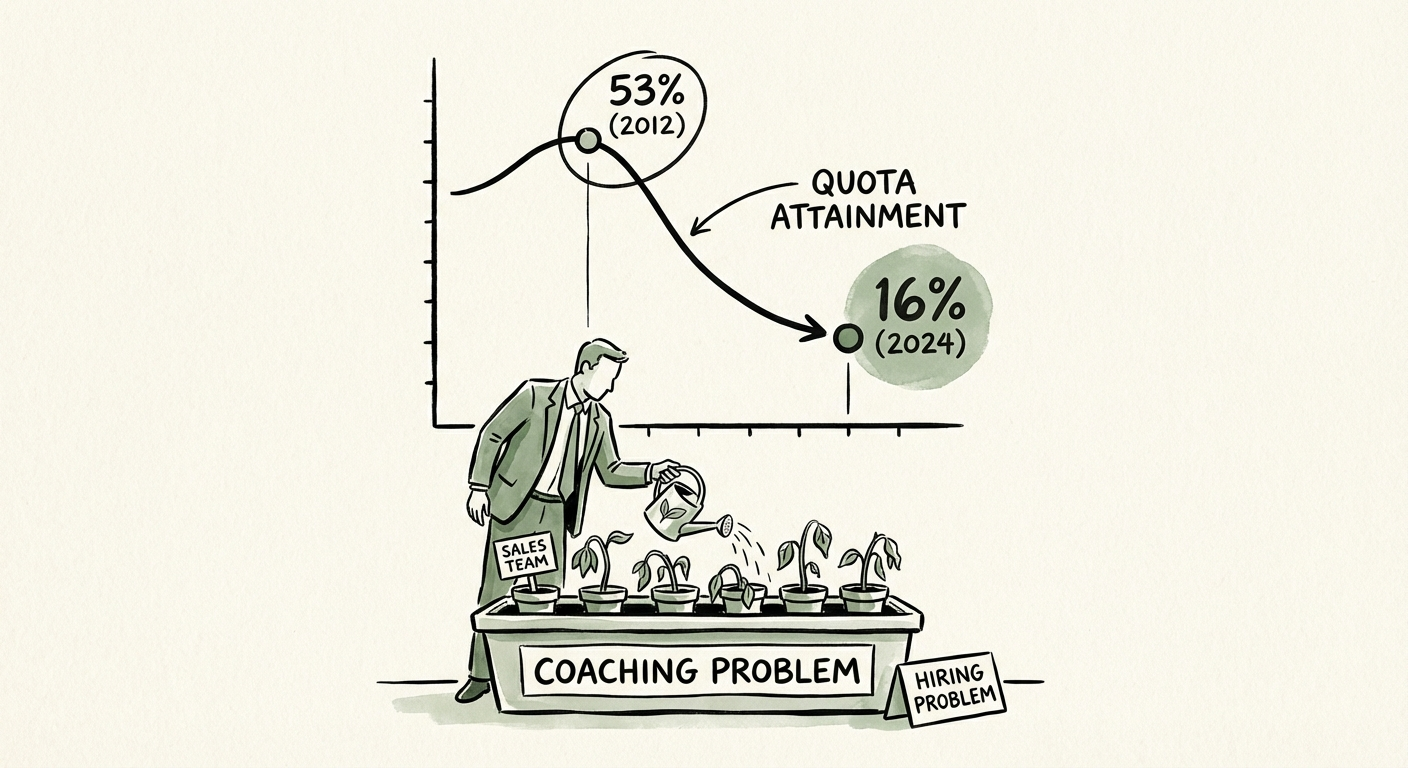
But the data suggests the problem isn’t who you’re hiring; it’s what happens to them once they arrive. In 2012, 53% of sales reps hit their quota. By 2024, that number plummeted to 16%. Unless you believe the global workforce collectively lost its ability to sell in the last decade, we have to look at the environment, not the individual.
We call this the Coaching Void. In the rush to scale, "sales management" has devolved into "forecast inspection." Managers spend hours scrubbing Salesforce data to tell you what will happen, rather than coaching reps to change the outcome. Your problem isn't hiring. You have a development engine that is broken.
Managers and sellers should be assessed on their willingness to coach and be coached... It would be better to provide no coaching at all than to provide bad coaching.
The 7 Diagnostic Signs of a Coaching Failure
Before you pay another recruiter $25,000 to find a "unicorn," audit your organization against these seven signs. If you see three or more, your issue is structural, and new hires will simply inherit the same failure rate.
1. The "Month 10" Exodus
If your reps are churning voluntarily between months 8 and 12, you have a coaching problem. Industry benchmarks for 2025 show the average ramp time has ballooned to 5.7 months. This means reps are leaving exactly when they should become profitable.
The Diagnostic: A high "unwanted turnover" rate in the first year usually means reps feel set up to fail. They joined, realized there was no playbook to success, and left for a company where they could actually hit their number. The real cost of mis-hires isn't just the recruiter fee—it's the 12 months of burnt leads.
2. The "Hero" Dependency
Look at your leaderboard. Do you have one or two reps hitting 150% while everyone else hovers at 40-60%? This "barbell" distribution is the hallmark of a lack of coaching. Your top performers succeed on raw talent or tenure (tribal knowledge), while the rest starve because there is no system to transfer that success.
The Benchmark: In healthy coaching cultures, the "middle 60%" of reps should be hitting 80-90% of quota. Coaching is about moving the middle, not saving the bottom.
3. Generic Loss Codes
Open your CRM. If more than 50% of your closed-lost opportunities are tagged as "Price" or "No Decision," your managers are not coaching deal strategy. "Price" is rarely the real reason; it’s the excuse customers give when value wasn't established. "No Decision" means the rep failed to build a business case.
The Fix: Managers must conduct deal autopsies, not just forecast scrubs. If they aren't asking "Why did the customer feel the problem wasn't worth solving?", they aren't coaching.
4. Ramp Time Creep
Is your ramp time extending? If it took 4 months to ramp a rep in 2023 and now it takes 7, your enablement is failing. As Sales Rep Ramp Time Benchmarks indicate, anything over 6 months in mid-market B2B creates a negative CAC payback cycle that is nearly impossible to recover from.
5. The "Inspector" Manager
Audit your sales managers' calendars. If they spend more time in "Forecast Review," "Pipeline Scrub," and "QBR Prep" than in "Call Review" or "Ride-alongs," they are inspectors, not coaches. Gartner research reveals that managers who spend just 20% of their time coaching can realize 91% quota attainment across their teams.
6. Pipeline Bloat (High Coverage, Low Close)
Does your team consistently show 4x pipeline coverage but still miss the quarter? This indicates a coaching failure in qualification. Reps are reluctant to disqualify weak deals because they get yelled at for "thin pipe," so they keep stale opportunities alive. A coach teaches a rep how to disqualify early; an inspector just demands more volume.
7. Stagnant Deal Sizes
If your Average Contract Value (ACV) has been flat for 24 months despite product improvements, your team is order-taking, not selling value. Upselling and cross-selling require sophisticated negotiation coaching. Without it, reps revert to the path of least resistance: selling the basic package at a discount.
The Pivot: From Inspection to Development
If you recognized your organization in the list above, firing your reps won't fix it. You need to professionalize your management layer. Here is the immediate treatment plan for a founder-led CEO.
1. Redefine the Manager Role
Explicitly shift your sales managers' KPIs. They should not just be measured on the team's number, but on the percentage of reps hitting quota. This forces them to develop the middle of the pack rather than riding the coattails of a single hero. Mandate that 25% of their week is spent on forward-looking coaching (pre-call planning, call reviews) rather than backward-looking inspection.
2. Implement "Game Tape" Reviews
In the NFL, players spend more time watching film than playing the game. In sales, we rarely watch the tape. Implement a mandatory weekly session where the team reviews one winning call and one losing call. This democratizes tribal knowledge and sets a standard for "what good looks like." Tools like Gong or Chorus are useless if nobody watches the recordings with a coaching rubric.
3. Measure Coaching Velocity
Stop accepting "I'm coaching them" as an answer. Measure it. Track the correlation between coaching hours logged and win rate improvement. The PE Playbook for Professionalizing Founder-Led Sales relies on these leading indicators because they predict revenue durability better than the forecast does.
Conclusion: Stop Renting Talent, Start Building It
The market has shifted. You can no longer rely on hiring "coin-operated" sales veterans who bring their own playbook. The complexity of modern B2B sales demands a coaching culture that turns B-players into A-players. If you don't build that engine, you will stay on the hiring treadmill until your cash runs out.